
Parva 4
Virata Parva
A year in hiding, five new names, and the one that nearly gave them away
Five disguises
The thirteenth year meant living in hiding. A full year had to pass undetected, or another twelve years in the forest would follow. The five chose the kingdom of Matsya, ruled by King Virata. Before entering, they tied their weapons in a shami tree and hung a corpse above it, so no one would come near, dare to touch it, or ask what lay hidden inside.
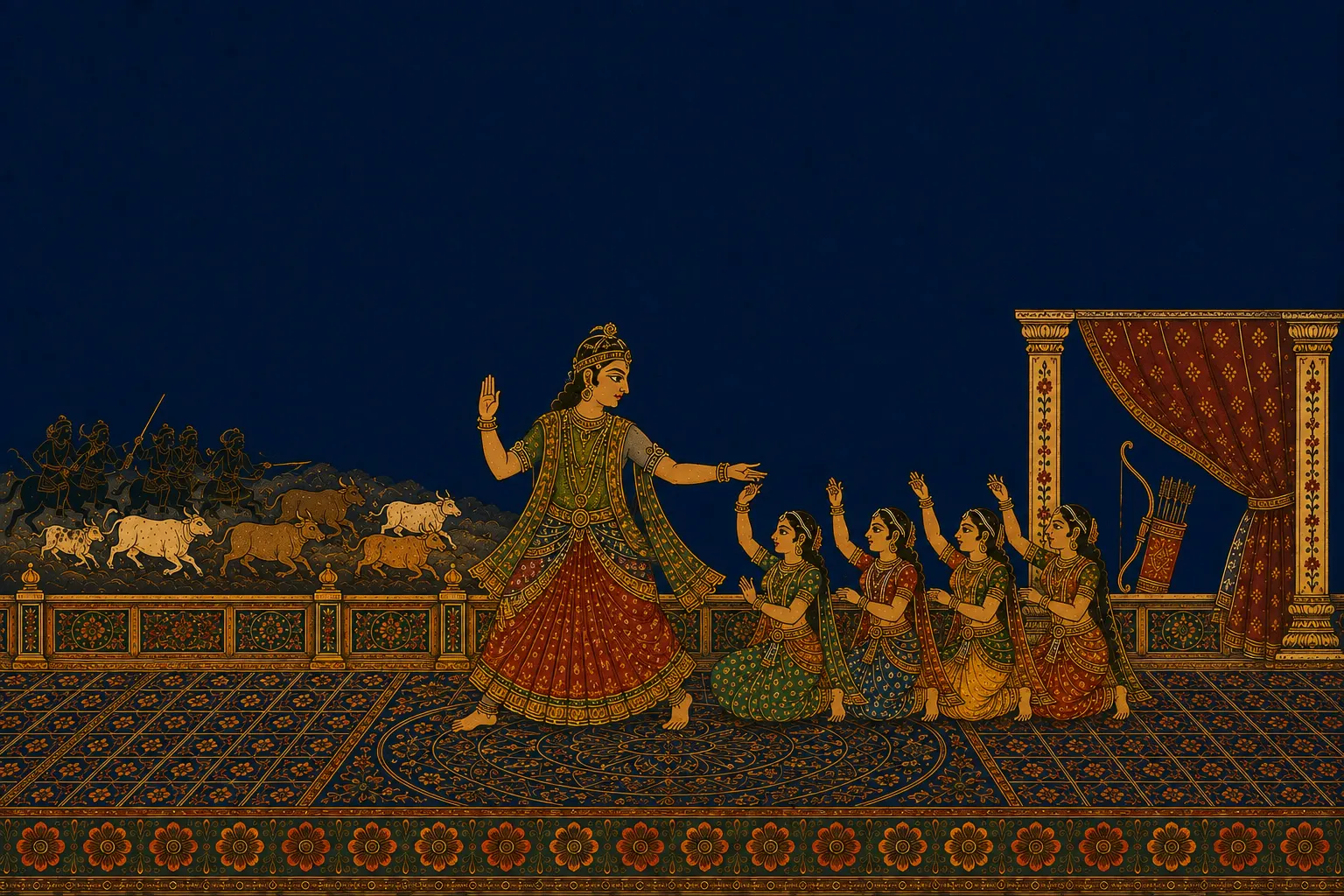
Then each of them took a new name and role. Yudhishthira became Kanka, a brahmin who sat with the king playing dice, the very game that had brought him here. Bhima became Vallabha, a cook, arms strong enough to tear an entire army apart. Arjuna became Brihannala, teaching Princess Uttara dance and music, Urvashi's curse finally useful, since it lasted exactly one year, and this was that year. Nakula became Granthika and took charge of the horses, Sahadeva became Tantripala and took charge of the cattle. And Draupadi became Sairandhri, maidservant to Queen Sudeshna. People who had lived as royalty until now had to spend a year in service to others, quietly, eyes lowered.
The killing of Kichaka
The queen's brother Kichaka was the kingdom's commander, and real power lay with him. His eye fell on Sairandhri. He pursued her, she refused, he would not listen. One day he kicked her in front of the full court. Yudhishthira sat right there and could do nothing, speaking up would expose them all, undoing thirteen years of sacrifice in an instant.
That night Draupadi went to Bhima. A plan was made. Draupadi arranged to meet Kichaka in the dance hall. In the dark, Kichaka arrived, not to Draupadi, but to Bhima. Bhima killed him, and mangled the body so thoroughly that no hand, foot, or head could be told apart, kneaded into a shapeless mass. This was deliberate, so no one would think it the work of a man, if people realized someone of such strength was here, the disguise would end that very day. People said a gandharva had killed him.
The cattle raid
With Kichaka dead, Matsya grew weak, its greatest warrior gone. Word reached the Kauravas, who were also searching for the Pandavas. They raided Virata's cattle. The king and his army rode out to fight on one side, leaving only Prince Uttara in the city. Uttara boasted that he alone would defeat everyone, if only he had a good charioteer. Brihannala was sent as his charioteer.
When the chariot reached the Kaurava army, Uttara saw Bhishma, Drona, Karna, Duryodhana, all standing together, and leapt off the chariot in fear and ran. Brihannala caught him, brought him back, and said, now you drive. They went to the shami tree, took down the Gandiva, and returned. A single chariot held off the entire Kaurava army. Bhishma recognized them, so did Drona. But by then the thirteenth year was already complete, Bhishma himself counted it out and said so. The terms had not been broken.
Arjuna revealed
Uttara returned and began telling everyone he had won. King Virata was delighted. Uttara said he had not won it, and explained who his charioteer had been. Then the five dropped their disguises. Virata wished to marry his daughter Uttara to Arjuna. Arjuna declined, but not unkindly, he said that having been her teacher for a year, teaching her dance, she was like a daughter to him. Instead, he said, let her be my daughter-in-law. Uttara was married to Abhimanyu. The people who gathered for that wedding would go on to plan the war.
Note: Hiding the weapons in the shami tree, the five new names, the killing of Kichaka, the cattle raid, Arjuna revealed and the marriage of Uttara and Abhimanyu are all in the Virata Parva of Vyasa's Mahabharata. Arjuna becoming Brihannala ties back to Urvashi's curse in the Vana Parva, and the text records it as a blessing. Arjuna's refusal to marry Uttara is in the text, and so is the reason — he had been her teacher, and so she was as a daughter to him. Bhima crushing Kichaka's body into a shapeless mass is in the text too, and so is the reason: to protect the disguise.
Source: Mahabharata (ascribed by tradition to Vyasa), Virata Parva