
Chapter 6
Aputran
A child raised on a cow's milk who stole a sacrificial cow, fed the hungry by begging at a temple in Madurai — and laughed in Indra's face
Aputran is chapter 6 of Manimekalai. Source: Manimekalai, Cantos 13–15. It is told in 9 scenes — The child a cow saved; The sacrificial cow; Aputran's answer; Sali's story; The temple in Madurai; That rainy night; Before Indra; When no one was hungry; The golden egg — followed by 10 quiz questions.
The child a cow saved
Aravanar told Manimekalai, 'Listen, I will tell you the story of Aputran — who gave you this divine bowl.
'In Varanasi there was a Brahmin named Abanjikan, who studied the Veda and kept the sacred fires. His wife Sali was not faithful to him. Afraid to stay in the village, she went south, reached Kanyakumari and bathed in the sea. At midnight she gave birth to a son — but she dared not stay in a Brahmin village. In her worry for the baby she left him in a grove and went away.
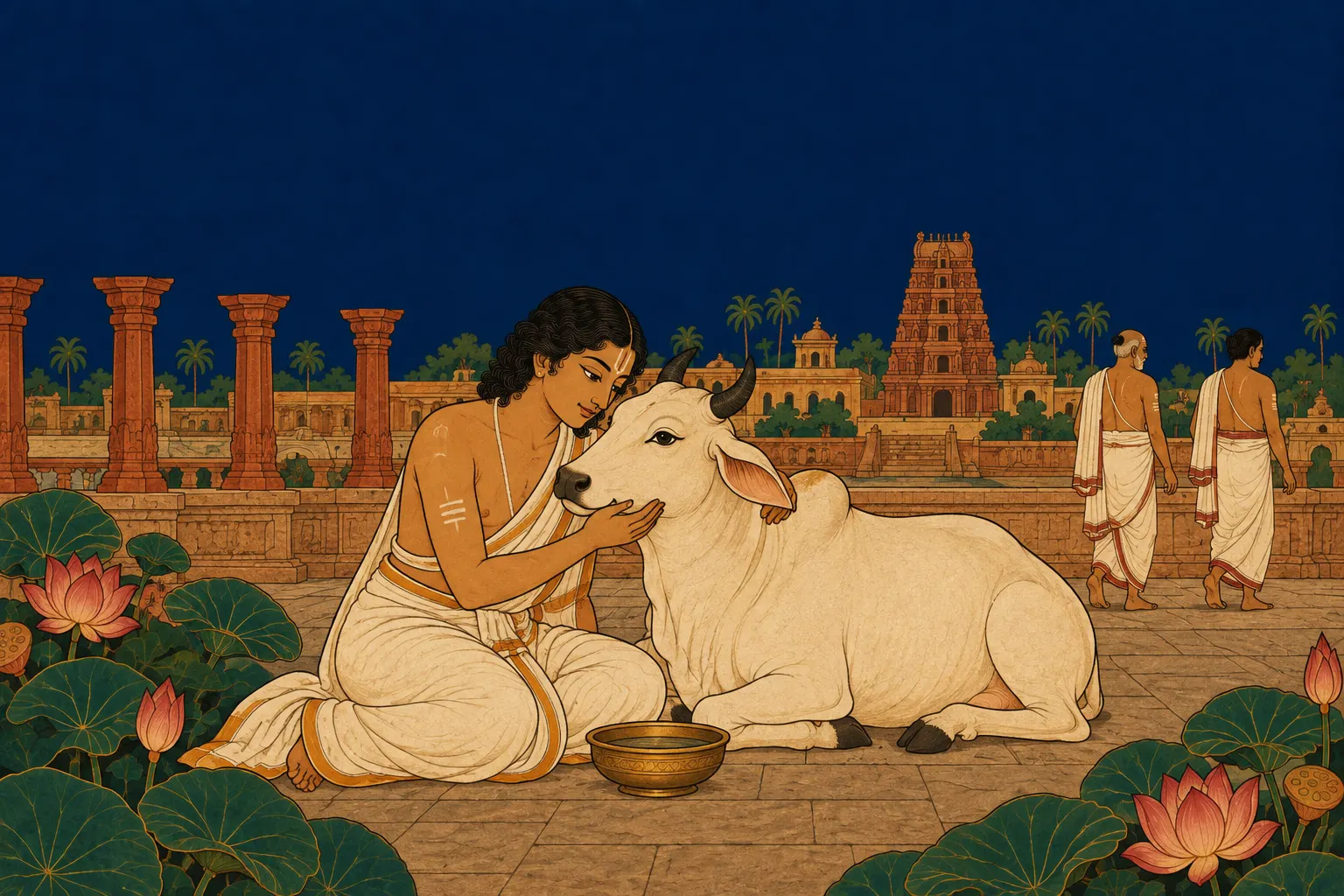
'A cow heard the baby's crying. She came near, licked him lovingly and gave him sweet milk. For seven days she stayed by the baby and guarded him.
'In the village of Vayangodu there lived a Brahmin learned in the Vedas — Pudi. He heard the baby crying, went near and saw. The sight moved him to tears. He understood that this was not a cow's son, and said, "This is my son!" He took the baby home and put him in his wife's arms. The two thanked the gods — "A son is born to us — may our family flourish!" The father taught him all the scriptures and, on his birthday, called his friends and performed the sacred-thread ceremony. Whatever the boy learned, he remembered without error.'
The sacrificial cow
'One day the boy went to another Brahmin's house and saw preparations for an animal sacrifice. A cow stood tied — a coloured garland on her horns — trembling like a deer in a hunter's net. Terrified of the Brahmins who stood ready to sacrifice her, she called out piteously for help.
'The boy saw her, his heart shook, tears ran from his eyes. He thought, "I will steal this cow in the dead of night and take her away." That is what he did — slipping in unseen at night, he untied the cow and set out for the forest.
'As he crossed the forest, some strong, hard Brahmins caught him with the cow. They said, "You are stealing a cow in the middle of the night and running! You are not the son of a good Brahmin. You are the son of someone of low birth and we will cast you out of the caste!" And they struck him with a stick.
'When the cow saw that a Brahmin was about to strike Aputran, she went wild, gored the Brahmin in the belly and ran into the forest.'
Aputran's answer
Aputran said to the Brahmins, 'Do not hurt anyone. Listen. Since her birth this cow has grazed on the free land the king gave and has lovingly given sweet milk to all the people of the world. Why are you angry at this poor cow? You know the ancient Vedas — tell me, why do you think this way?'
The Brahmins scolded him: 'Brahma is the creator of the world, the son of Vishnu... he gave us these sacred Vedas. You do not know his greatness and you insult us. You deserve to be called a cow's son, not a man's.'
Aputran said, 'Asalan was the son of a cow. Shringi was the son of a deer. Virinji was the son of a tiger. And Kesakambalan, whom sages praise — was he not the son of a fox? You praise all of them as sages in your own Brahmin lineages. Is there anything in the four Vedas that says a person cannot belong to a cow's family?'
Sali's story
One of those Brahmins said, 'I know about this boy's birth. A woman named Sali came from the north, tired and worn, on foot to the sea at Kanyakumari. As she was worshipping at the feet of the goddess Kanyakumari I asked her, "Where have you come from?" She told me her story: "I am the dear wife of a Vedic Brahmin of Varanasi. I did not live the good life of Brahmins and was unfaithful to my husband. I shamed him and he left me. Afraid of the villagers I left the city with wandering pilgrims and came south to bathe in the sea at Kanyakumari. I walked ten miles and reached Korkai, where the Pandya kings rule. I stayed in the houses of cowherds and gave birth to a child. I could not show him love and left him in an unknown grove and came away. I have committed a heavy sin — will the gods forgive me?" She wept and wailed. This boy is that sorrowful woman's son. I did not want to tell this, because everyone thought him a Brahmin's son; but now you know. Do not protect him — he is of low caste.' Here the text differs from the earlier account: in Aravanar's opening telling the birth came after she reached Kanyakumari; in Sali's own words she says she gave birth to the child at Korkai.
Aputran heard this and laughed out loud. He said, 'Hear also about the families in which great Brahmins, the scholars of the Vedas, were born. Is it not true that two Brahmin sages were born of Brahma, the author of the Vedas, and Tilottama, a dancer of heaven? O Brahmin with your sacred thread — what did Sali do wrong?'
He laughed at the scholars of the four Vedas and stood where he was. But his foster father Pudi thought that the Brahmins would not accept the boy and that he was no longer fit to recite the Vedas, and drove him out of his house. The whole Brahmin village scolded him — 'Thief! Cow-thief!' — and threw stones into his begging bowl.
The temple in Madurai
Aputran left the village and went to Madurai, where rich people lived. He stayed in the beautiful temple of the goddess Sindhadevi, in the pavilion near the seat. With a begging bowl in his hand he begged from good houses, and from what he got he called the blind, the deaf, the lame, the orphans and the sick and gladly fed them — whatever was left, he ate himself — and slept with the begging bowl as his pillow. He was a protector of beings.
That rainy night
'One dark rainy night,' said Aravanar, 'some people came to the temple. They woke Aputran, bowed to him, and said, "We are very hungry and in distress." He had nothing to feed them — whatever alms he brought he gave away. He was distressed: how could he feed them when he had nothing left?
'Then the goddess of the temple, Sindhadevi, worshipped by all, appeared before him. She said, "My son, do not worry. Get up and take this — you need not worry any longer. Even if the country suffers famine, this vessel will not become empty. It will fill people's hands with so much food that their hands ache." And she put the vessel in Aputran's hands.
'He praised the goddess and began to feed the people. The Amudhasurabhi gave food by the handful; the animals and birds that lived in the fruit trees gathered too and made happy sounds.'
Before Indra
'At this generosity of Aputran the marble throne of Indra in heaven shook. Taking the guise of an old Brahmin, bent-backed and leaning on a stick, he came before Aputran and said, "I am Indra and have come to see you. Pleased at your generosity I will give any boon — ask."
'Aputran laughed so loud it seemed the bones in his chest would break. He said sarcastically, "Go away. In your heaven only handsome gods live and enjoy the fruit of their merit. You are the strong king of heaven, but the gods there give no charity. Protectors of people, sages doing hard penance, and those without desire do not live in your heaven. Are there in your world divine bowls like this Amudhasurabhi of mine to feed the hungry? Are there clothes for the poor? Are there women there who feed the poor and protect them? O king of the gods, what can you give me?"
'The thousand-eyed Indra grew angry. He said, "Let the rain fall abundantly! Let this land flourish with immense wealth! You will find no beggar, and with this Amudhasurabhi that gives so much food you will not be able to feed anyone — you will be left disappointed!"
'After that, for twelve years there was no famine in the Pandya country. The rain fell and food was so plentiful that people did not know what hunger was.'
When no one was hungry
'In the temple where Aputran stayed, no one came to eat near the Buddha-seat. The sounds of people, animals and birds stopped. The place filled with bad people, idle people, people without kin, and wanderers, who gambled, gossiped and mocked Aputran. Aputran left the temple and went from village to village asking whether anyone was hungry. People laughed, "Who is this?" No one asked him for food, or even asked whether he was still alive. He became like a lonely king whose wealth the great ocean has taken.
'Then some people came in a ship and said to him, "O protector of lives, in the land of Javaga there is no rain; many people and creatures are dying of hunger." Aputran said, "I cannot feed anyone here because of Indra's curse. I wish to go to Javaga with my Amudhasurabhi." Gladly he boarded the ship.
'On the way a storm rose on the sea and the ship stopped for a day at the island of Manipallavam. When it set off the next day, the travellers thought Aputran had come back on board and left him behind in the dark of night. When Aputran learned it, he was sad. He searched but found no one — he understood that no one lived on the island. He thought, "This wonderful vessel is for saving lives. It would not be right to keep it only to save my own life. I have lost the penance by which I could save beings with this vessel. What use is it to keep it for myself alone?"
'Then he went to the pond Gomukhi and put the vessel into its water. He said, "May you rise from the pond once a year. If there is someone kind and generous, who lives to care for others and save precious lives, may you pass into the hands of such a person." Then Aputran took a vow to give up his life by fasting. I saw him and asked, "Are you in any trouble?" He told me everything, and, as the sun that rises in the east removes the darkness and sets in the west, he left his body on the island of Manipallavam.
'Then he was born from a cow's womb — so that he could save the lives of all the creatures of the world. He became the king of the land of Javaga.'
The golden egg
'Listen further,' said Aravanar. 'In the cool white mountains of Javaga lived a divine sage named Manmuhan. He had a cow with golden horns and golden hooves who gave her milk selflessly to all, even before giving birth to her calves. Aputran gave his life on Manipallavam so that he might be born again to give charity and take away the disease of hunger. The cow's love that had nursed and guarded him as a baby stayed with him. In this birth he was born of the sage Manmuhan's cow. He had no umbilical cord — he came out of a golden egg. The gods were pleased.
'He was born in spring, on the thirteenth day of Vaikasi under the star Visakha, on the full moon — at the same time of year the Buddha was born. Although there was no rain at his birth, pure water and flowers poured down everywhere. The sages of Chakravala-kottam were amazed: "This is not the year of the Buddha's birth, yet the earth is flourishing!" At midnight they went to the Kanthil-pavai, and the statue said, "Aputran gave his life on Manipallavam and has been born again in Javaga to save the lives of creatures. The sage Aravanar knows his story — ask him."
'King Bhumisandran, by worshipping the feet of the sage Manmuhan, had received a son through his grace. The childless king raised him as his own son, and that same boy became the garlanded king of the land of Javaga. His name was Punniyarajan. After his birth, rain never failed there.'
Then Aravanar told Manimekalai, 'The bowl you have will take away the terrible pain of hunger. Do not keep it hidden from people. When the milky ocean was churned and the gods drank the nectar, they hid the rest instead of giving it to the Asuras — that was not right.'
Manimekalai bowed to Aravanar with Sudhamati and Madhavi, and, taking the divine bowl, went out into the wide streets of the city.
Note: Cantos 13–15, from Kausalya Hart's English translation. This story appears in different forms in different summaries — some sources make Aputran straight away a Brahmin ascetic of Madurai, in some Sali is called a courtesan; here Hart's text is followed, in which Sali is called 'unfaithful to her husband'. The insults concerning sacred thread and caste are in the text in the mouths of characters — the Brahmins' accusations against Aputran, and his own answers; no sentence here is presented as the poet's own opinion. The text shows its Brahmin characters as harsh; read this as the standpoint of this Buddhist epic, not as a statement about a whole community. Asalan, Shringi, Virinji and Kesakambalan are the text's names — Shringi (Rishyashringa) is held to have been born of a doe; the identity of the other three is not given here. The geographical meaning of 'Javaga' (Java, Sumatra or the Malay region) is disputed among scholars.
Source: Tamil epic — the Manimekalai (traditionally by Sittalai Sattanar), Aputran