
Chapter 5
The Amudhasurabhi
Once a year, on the full moon of the Buddha's birthday, a bowl that never empties rises from a pond — and on that day it comes into the hands of a courtesan's daughter
The Amudhasurabhi is chapter 5 of Manimekalai. Source: Manimekalai, Cantos 11–12. It is told in 5 scenes — Tivatilakai; The pond Gomukhi; Hunger is a disease; Return; Aravanar — followed by 10 quiz questions.
Tivatilakai
The goddess Manimekhala left Manimekalai on the island and flew away. Manimekalai walked a short way, wandering among the white sand dunes, flowering groves and blooming ponds.
Then a goddess appeared before her and asked, 'Did you come on a ship and escape when it sank in the sea here? You are beautiful as a golden vine — who are you?'
Manimekalai said, 'You ask who I am — in this birth or in my past birth? Listen. In my past birth I was the wife of Ragulan and my name was Lakshmi. In this birth I am Manimekalai, daughter of the dancer Madhavi. The goddess Manimekhala has the same name; it was she who brought me here. The Buddha-seat on this island told me my past birth. And who are you?'
The goddess said, 'My name is Tivatilakai. Next to this island is Rattinadvipa, on whose high mountain Samandam is the footprint of the Buddha, lord of dharma. His feet are a boat that carries across the ocean of birth. I am back from circling it there. I guard this shining seat because Indra placed it here and gave me the charge. Only those who follow the Buddha's auspicious dharma can see this seat; if they fold their hands they come to know their past births. You too are such a seeker.'
The pond Gomukhi
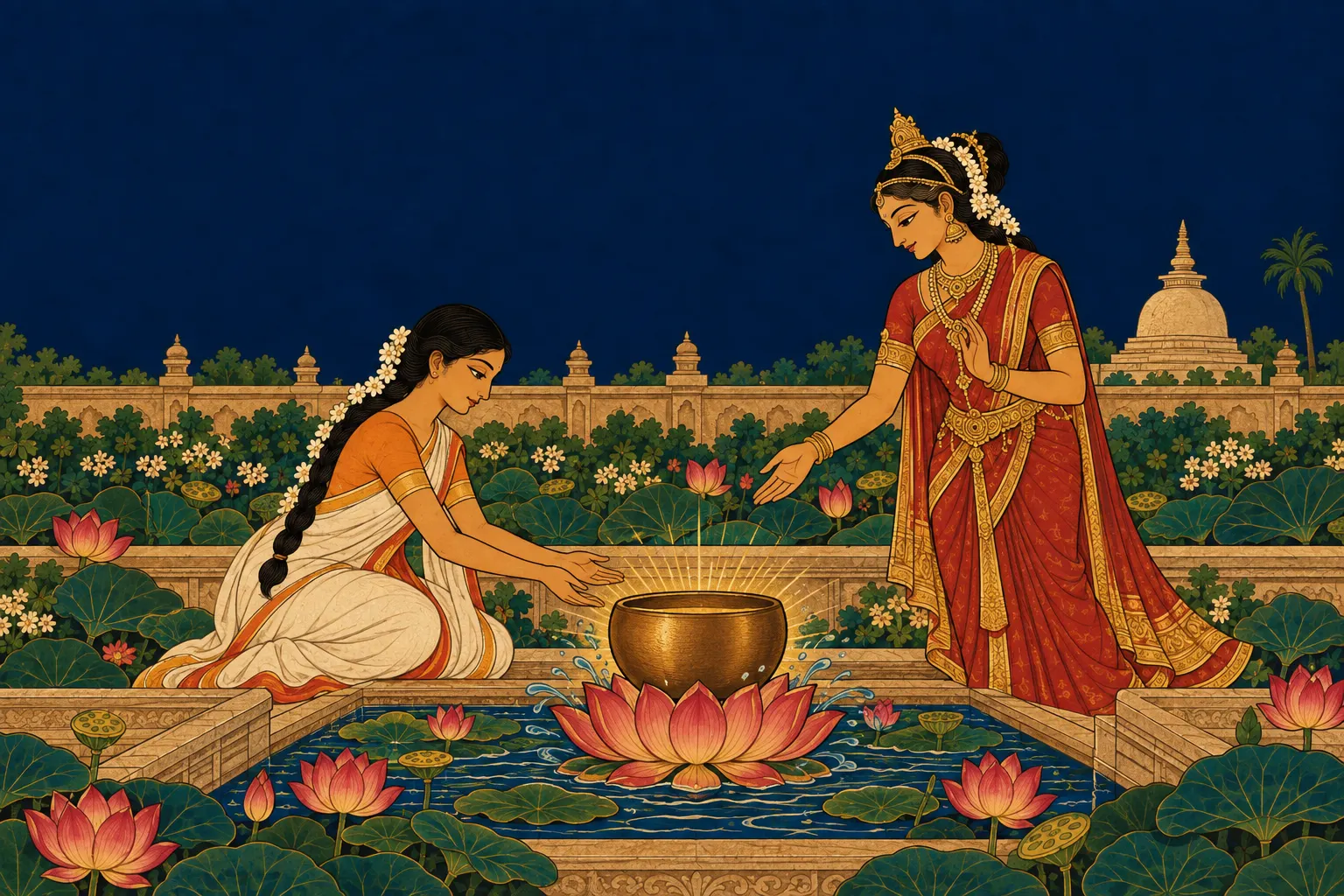
'In front of this seat,' said Tivatilakai, 'is a pond called Gomukhi — full of clear water, adorned with night-lilies and blue lotuses that bloom in spring. On the full moon of Vaikasi, when the moon is in the star Visakha — that is, on the very day the Buddha was born — a bowl rises from that pond. Its name is the Amudhasurabhi. It is a vessel that is always full of food and never empties.
'It was kept here by a man named Aputran. He used to feed the hungry with it. Once Indra grew angry with Aputran and sent so much rain that the land was filled with wealth and grain. Aputran could not find any hungry person to feed, and decided to do penance. Then he put the bowl into the pond Gomukhi and prayed that every year, on the full moon of Vaikasi under Visakha, on the same day the Buddha was born, it should rise from the pond.
'Today is that very full moon of Vaikasi. And it seems the bowl will come into your hands. Its food is an unfailing medicine for all the hungry; people may take it by the handful, and it does not diminish. About all of it you will learn from the sage Aravanar in your own city.'
Then Manimekalai circled the pond Gomukhi with Tivatilakai and stood with folded hands. And the bowl rose from the pond — and came into the hands of the innocent Manimekalai.
She was glad. She bowed to the Buddha-seat and praised the Buddha — 'You conquered desire; I worship your feet. You remove the cruel enmity of wrongdoing; I worship your feet. You teach dharma to all... you do not even long for liberation... you are the light of everyone's eyes... you do not hear evil words... you take away the sorrows of the beings of the earth — I worship your feet. My tongue knows only to praise you.'
Hunger is a disease
At that moment, what Tivatilakai said to Manimekalai is the plainest statement of this whole epic.
'Hunger is an evil disease. It destroys a good family, kills excellence, ruins the knowledge that is a person's boat across births. It takes away the jewel of self-respect, destroys beauty, and forces a man to beg in the street with his lovely wives. My tongue has no power to sing the glory of one who ends hunger.'
Then she told the story of Vishvamitra. 'Once there was no rain in the world. All the trees and plants withered in the sun, all living beings died without food and water. Vishvamitra, learned in the Vedas, had given up kingship and become an ascetic. As he wandered his country he saw hunger and famine everywhere. He had nothing to eat — he even ate the food given to dogs. He prayed to the generous Indra to bring rain. Indra came and made it rain, crops grew, people lived. To give food to the hungry, to give in charity, to end the hunger of the poor — that is true living on earth. To give food is to give life. You have been given the gift of giving life to all.'
Manimekalai then spoke of what the bowl meant to her. 'In my past birth, when a snake bit my husband and I was about to enter the fire, as I was losing consciousness I saw a dream in which I was feeding the sage Sadhu-chakran. It is the merit of that act of feeding a holy man that has brought this Amudhasurabhi into my hand. It will end hunger and save lives. On this earth the rich enjoy their wealth through good karma of the past birth; but many are born poor through bad karma and go to the houses of the rich to beg for bread. Their clothes are torn, their stomachs hollow. This divine vessel gives food as a mother's breast gives milk when she sees the withered faces of her children. I want to see the glad faces of people receiving food.'
Tivatilakai said, 'I had forgotten the power of this Amudhasurabhi; you have reminded me again. The world still receives rain because compassionate people continue to live by dharma. Now return home.'
Return
Manimekalai touched Tivatilakai's feet, took the bowl in her lotus-like hands, circled the Buddha-seat, and used the mantra to fly back through the sky to Puhar.
Meanwhile Madhavi was restless for her daughter. 'The goddess said my daughter would come in seven days. The seventh day has come, but she has not. Has something gone wrong?'
That same evening Manimekalai appeared before Madhavi and her worry vanished. She said, 'In your past birth you were the daughter of King Ravivarman and were married to King Thuchayan, who commanded a great cavalry. Your mother was Amudapati, and your sisters Tharai and Veerai. Tharai has become my mother in this birth, and Veerai Sudhamati. May your bad karma be cut away in this human birth! Now let us go and ask the sage Aravanar about your births. And here is the Amudhasurabhi — which once belonged to Aputran and has now come into my care. Bow to it.'
Madhavi and Sudhamati bowed to the bowl and praised it. Then the three set out to see Aravanar.
Aravanar
Searching for Aravanar's hermitage they came to him. He was old, his hair was white, and his tongue trembled when he spoke. Manimekalai bowed at his feet three times.
She told him everything — the day in the garden, the prince, the goddess taking her to Manipallavam, the seat telling her past birth, the three things the goddess taught her — *to take whatever form she wished, to fly in the sky, and not to feel hunger when there is no food* — and Tivatilakai telling of the Amudhasurabhi, the bowl rising from the pond on the full moon. 'Tivatilakai said that you know Aputran's story.'
Aravanar was pleased. 'Listen, I will tell you of your past birth. Once I went to that mountain where there are the lotus feet of the ancient god Buddha. There in a garden of flowers I saw Thuchayan, king of Kacchayam. I asked, "Are you and your wives well?" He was grieving. He told me that his wife Veerai had drunk, walked in front of an elephant and been killed; her sister Tharai, hearing that, could not bear the grief, climbed onto a building, fell and died. I told him it had come from the karma of the two, and the king should not grieve.'
Then he asked Manimekalai, 'Why have you dancing women come today in other garments?' and told them the truth about birth. 'The lives of those who never give are like a road choked with thorns and stones. Life is like this: one sees a red sun in the sky and the cool dew vanish, and people do not realise that the two are connected.'
Then he told that the god of the Tushita heaven had said to the gods gathered in Chakravala-kottam that, as the sun rises in a dark world, a very wise one would be born — the Buddha. 'When he appears, dharma will enter people's small ears as the flood of a big pond runs through a small hole. Sun and moon will look auspicious, the stars will shine, the planets will stop wandering; rain will fall in season and the earth will flourish; creatures will not go hungry and will not suffer. The wind will blow gently, cows will give pots-full of milk and their calves will drink. Birds will not have to fly far from their nests. All beings will live without enemies. The dwellers of hell and the ghouls will frighten no one.'
At the end Aravanar told Manimekalai, 'Because of you a great deal will happen in this place. In your hand is the Amudhasurabhi, the life-saving medicine. I will tell you a dharma that does good to both humans and gods — and that is ending hunger.'
Manimekalai took the bowl in her hand.
Note: Cantos 11–12, from Kausalya Hart's English translation. Aputran's name is also written Aputtiran in Tamil ('son of a cow'). Vishvamitra's eating of dog's meat or food in famine appears in the Mahabharata and other traditions too; here it is said only that in the text he ate the food given to dogs and asked Indra for rain. This chapter says nothing about Jain monks or other religions. The year given for the Buddha's coming in Aravanar's account (2116 in the translation) is not given here, because the basis of the text's reckoning is unclear. 'Tushita' is the heaven of Buddhist tradition from which the future Buddha is believed to descend.
Source: Tamil epic — the Manimekalai (traditionally by Sittalai Sattanar), The Amudhasurabhi