
Chapter 2
The Days of Indra's Festival
A twenty-eight-day festival to which one mother did not bring her daughter — and the whole of Puhar talked of nothing else
The Days of Indra's Festival is chapter 2 of Manimekalai. Source: Manimekalai, Cantos 1–3. It is told in 4 scenes — A drum on an elephant's back; The mother who did not come; The garland soaked with tears; Scenes on the road — followed by 10 quiz questions.
A drum on an elephant's back
One day a message from the sage Agastya reached the king of Puhar: hold a festival in your city for Indra, the king of the gods. The Chola king Chembiyan sent Indra an invitation — come down to earth and stay in my city for twenty-eight days. Indra agreed.
But the festival carried a fear with it as well. It was said that the guardian spirit of Puhar, whose voice roars like thunder and whose teeth are strong, would destroy the whole city if the king forgot the festival, and that famine would fall on the land. So this was not just a festival; it was a vow.
The drummer from the village of Vajrakottam fastened his great drum on the back of an elephant and began to beat it. Its sound was like thunder, or like Yama calling. He proclaimed —
*'May Puhar flourish. May the rain fall three times a month. May the king's sceptre stay straight. And in these twenty-eight days may hunger, sickness and enmity be gone — may homes and wealth prosper!'*
The people decorated the city — pots dressed with flowers and leaves, golden lamps, plantain and areca trees, strings of pearls on the pillars; old sand was cleared and fresh sand spread on the streets. And the drummer told the learned too: go to the debate-halls, but do not quarrel — if someone displeases you, quietly walk away from the place.
Remember that last line. Much later, this same epic will bring a whole assembly of debates.
The mother who did not come
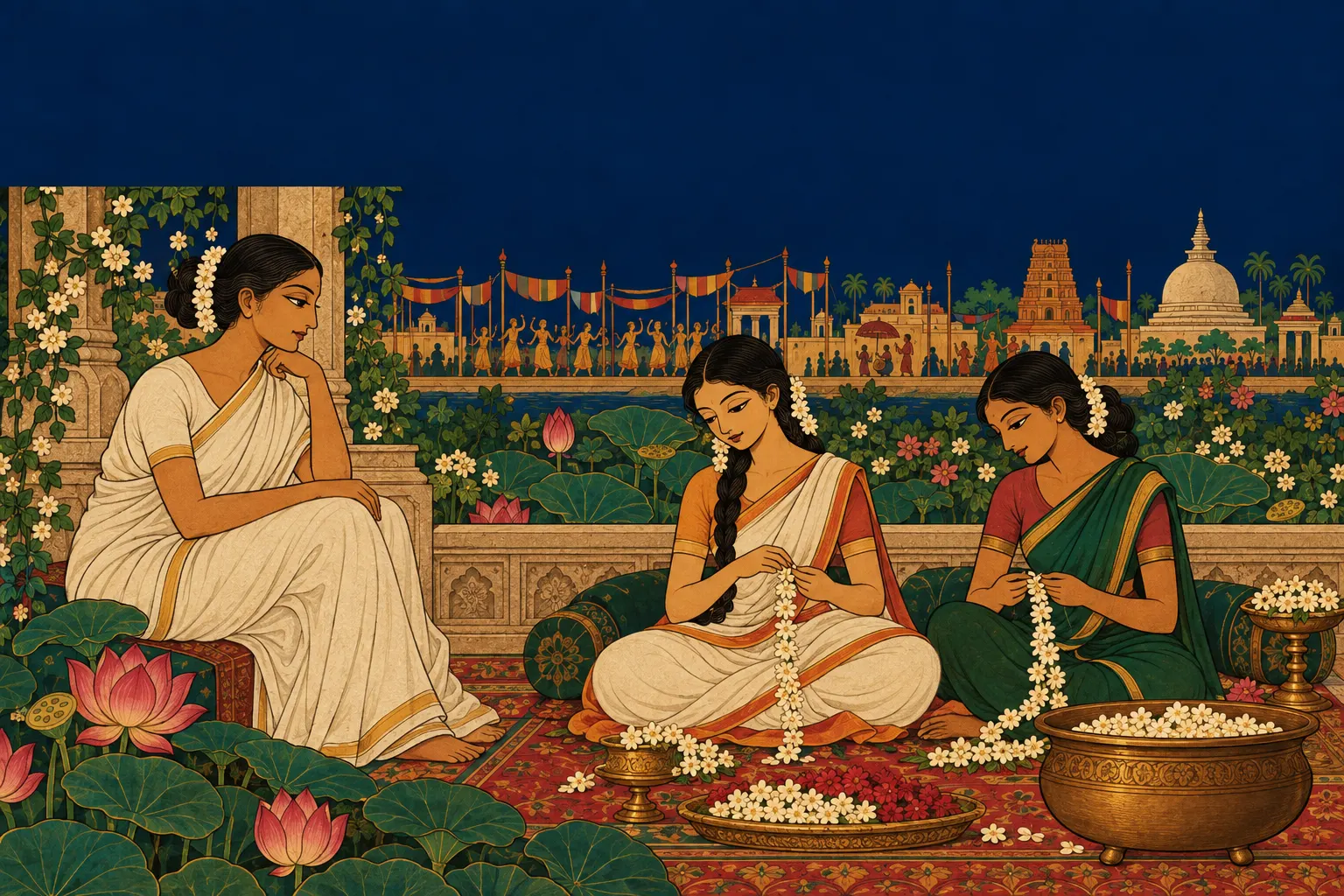
On that very festival day, one mother did not come with her daughter. Madhavi stayed with her daughter Manimekalai in the flower pavilion of their house.
When her mother Chitrapati saw that the two had not come, her heart sank. She told Madhavi's friend Vayandamalai, 'Go and tell her what people in this wealthy city are saying.'
When Vayandamalai reached Madhavi she looked tired and thin. Vayandamalai listed her skills — 'You know the vettiyal and poduviyal dances; you keep seven rhythms with your feet and with clapping; you play the yazh, you know the flute and the drum; ball games, cooking, painting, stringing garlands, astrology, the sixty-four abhinayas — everything. And you have become an ascetic? People say it is shameful.'
Madhavi answered quietly:
*'Friend, when I heard that my beloved Kovalan had been killed, even then I did not die — I lived on. I lost my wealth, I lost my shame. Some women, when their husbands go, leap into the fire; some wear their bodies away with penance. But Kannagi was not like those women. When this calamity fell on her husband, she tore off one of her breasts, flung it, and burned Madurai. Manimekalai is like the daughter of that great chaste woman. For my daughter there is no path now except the life of a bhikshuni. She has done no wrong, and she cannot live the life of a courtesan.'*
Then she told how she herself had gone to Aravana Adigal's hermitage, fallen at his feet and told him the grief of Kovalan's death. Aravana had said: *'Those who are born suffer because of their wish to live; those who are not born receive great joy.'* And he named five things to avoid — killing, stealing, drink, lying and lust. 'Walk the path without desire; there lies peace.'
Madhavi told Vayandamalai, go and tell my mother Chitrapati this. Vayandamalai felt as if she had been plunged into a roaring sea. She turned back with a heavy heart.
The garland soaked with tears
Manimekalai had heard all of Madhavi's words. Her parents' sorrow went down into her heart. Tears ran from her eyes and began to soak the garland she was stringing.
Madhavi looked at her daughter's face, wiped her tears with her own hands and said, 'Your garland is spoiled by your tears. Go and fetch fresh flowers from the garden.'
Sudhamati, who was stringing garlands too, grew anxious at this. She was Madhavi's close friend, and her own story was no less strange — she was the daughter of a Brahmin named Kausika, whom a vidyadhara named Maruthavegan once carried off into the sky and then left alone. 'I was never afraid of anyone,' she used to say. Even so she told Madhavi, 'Manimekalai must not go into the garden alone; I'll go with her.'
And she explained which gardens of the city were safe and which were not. Near the Ilavandigai garden the king's guards are posted. The Uyyavanam is only for the gods — even at the festival men do not go there, for it is said spirits guard it with ropes in their hands. In the gardens of Sampati and Kavera an old spirit attacks goddesses. 'But there is one garden,' she said, 'the Ubavanam. It is the Buddha's garden — the trees there never stop flowering.'
In the marble pavilion of that garden the voices of the outside do not reach; those outside can see only a blurred shape of someone sitting inside. And in the pavilion there is a jewelled lotus-shaped seat (*peedikai*) with the Buddha's footprints on it. They say that if you place flowers on it with faith, they do not wither — they go straight to the feet of whichever god you hold in your mind; and for one who holds no god in mind, the flowers just lie there. It was made long ago by an artisan named Mayan.
So if Manimekalai goes anywhere, it will be the Ubavanam.
Scenes on the road
The two friends passed through the streets of Puhar. The festival streets were crowded with every kind of spectacle.
A Jain monk appeared — naked, with a pot hanging from a long staff; he walked carefully even over his own body for fear of hurting some creature, and, without food or bath, looked thin as a tired elephant. A drunkard stopped him and said, 'Revered one, I touch your feet. Our teacher has taught us that pleasure and pain all come from karma. Does anyone die from drinking toddy? You do penance — but if you eat and drink as I do and find the pleasure beats the fruit of your yoga, then take me as your disciple.' The people around gathered to watch the show.
There was a madman-like figure — a garland of calotropis flowers at his neck, clothes of leaves, ash on his body; sometimes he wept, sometimes fell, sometimes ran; he was startled at his own shadow. People stood around him in pity.
Somewhere a performer dressed as Mohini was dancing, as Vishnu once changed his form at the churning of the ocean, or as Arjuna took a dancer's disguise in Virata's city; a separate crowd had gathered to watch. People stared at the tall walls covered in paintings. Mothers were taking their little children, with the five-weapon pendants swinging on their golden chains, for rides on elephants and chariots — and people said, 'Look, they're like Murugan.'
And when Manimekalai passed, the crowd began whispering after her: 'How beautiful she is. Her mother has made her a bhikshuni — how hard-hearted! If she went to the garden to pick flowers, wouldn't the swans be ashamed of their walk beside hers? Could the peacocks learn her grace? Could the parrots rival her sweet speech?'
Sudhamati kept leading her onward. The two bowed to the Ubavanam and went inside.
Note: The names and events of this chapter are from Kausalya Hart's English translation, Cantos 1–3. In Hart's translation Agastya's dwelling is named 'Vindhya'; in Tamil tradition Agastya is linked with the southern Pothigai/Malaya hills, so no mountain is named here. Hart describes the performer in dance dress with the word 'pedi'; here it says only that he is imitating Mohini or Arjuna's (Virata-city) disguise. Puhar's guardian spirit, the drummer of Vajrakottam, and the gardens of Sampati and Kavera are names from the text. In English spelling the Tamil names are kept in one form: Madhavi, Chitrapati, Vayandamalai, Sudhamati, Aravana Adigal.
Source: Tamil epic — the Manimekalai (traditionally by Sittalai Sattanar), The Days of Indra's Festival