
Chapter 11
The City the Sea Swallowed
A king who digs up his own past life's bones, a stopped festival whose price a whole city pays — and a statue that speaks like a mother
The City the Sea Swallowed is chapter 11 of Manimekalai. Source: Manimekalai, Cantos 25–26. It is told in 6 scenes — The garden of Nagapuram; Before the king; The minister's word; The bones; Peelivalai and the drowned Puhar; Kannagi's statue — followed by 10 quiz questions.
The garden of Nagapuram
Punniyarajan, king of Nagapuram, came to the garden and bowed at the feet of the sage Dharmasavagan. The sage told him of good deeds and bad deeds, of things that last and things that do not, of strength and sorrow; he also explained how a person is bound by the bonds of this world, and can reach liberation only by loosening them.
Just then the king saw Manimekalai and said to the sage, 'This girl is very beautiful. Even Kama could not escape her beauty, yet she carries an alms-bowl and begs. Who is this matchless woman?'
His guard Kanjugan bowed and said, 'This woman ascetic is matchless; no one has such power. O king, descendant of the Chola king Killivalavan and as famous as he — when I went by boat to a garden on the bank of the Kaveri, the sage Aravanar told me about her birth. I told you of it then. This is that same girl, who has left her city and come here.'
Before the king
Manimekalai went to King Punniyarajan's palace and said, 'When you were Aputran, you put that bowl into the pond Gomukhi. You do not know that the same bowl has come to me. You do not know its worth, and you do not know your past birth, nor that in this birth your mother was a cow. I will wait for you at Manipallavam. Until you come to Manipallavam and circle the Buddha-seat you cannot know your past birth. O king, come with me to that island.'
She flew to Manipallavam and waited for the king. Before sunset she saw the Buddha-seat, which takes away desire for the world. She circled it, worshipped — and the seat told her her past births.
Meanwhile the king left the garden and returned to his palace. He now remembered his birth — that he had been born of a cow, that the childless King Bhumisandran had raised him as his own son. And when his stepmother Amarasundari told him that his real mother Sali had abandoned him as a baby in his past birth, he was deeply troubled.
He no longer wished to see plays or hear music. He had lost interest in love and quarrels with his queens. He forgot to bow to the kumkum-marked feet of the women. Neither their smiles nor the glances of their dark eyes on moon-like faces attracted him. Kama kept shooting his flower-arrows at him, but the king wished to escape his grip. He understood that his mind was changing and he wished to know his past births.
The minister's word
The minister Janamitran understood that the king's mind was not as it had been. He bowed and said, 'O king, victory to you. Listen. Before you were born there was no rain in this country, and people and animals died. Mothers could not feed the children they had borne, nor eat themselves. At your birth it was as if rain had fallen in summer heat. Since you were born the rain has never stopped, the earth has flourished, and no one has gone hungry. If you leave, all the people of the country will suffer like motherless children. If you wish to leave the protection of the country for penance and liberation, all beings will die. Surely you do not want that. It is said that it is a king's dharma not to worry about his own life but to save the lives of others. Think in this way.'
The king said, 'I cannot restrain my wish to go to Manipallavam. I will be back in a month, and it is your duty to protect my country and people till I return.' He called the carpenters, had a boat built, and set off on the sea of shining waves. His boat reached Manipallavam.
The bones
Manimekalai saw the boat and was glad to see the king. She took him around the wave-ringed island's flower-gardens and, showing him the Buddha-seat, said, 'This is the dharma-seat that tells people their past births.' The king circled the seat and praised it. As a mirror, held in the hands, shows the face fully, so the seat showed the king his past birth as Aputran.
He remembered the goddess Sindhadevi, who had given him the Amudhasurabhi. He worshipped her and said, 'Now I know my past births and my worries are gone. O goddess, you are the beautiful goddess of Tamil Madurai in the south. On that rainy night I worried about feeding the hungry. Then you said, "Go to the temple and feed the people. Even if famine comes to the country this vessel will not be empty. Rise, do not worry." You removed all my sins so that I could feed the hungry. I will not forget you in any birth.'
With Manimekalai, King Punniyarajan went south-west and stayed near the pond Gomukhi in the shade of a punnai tree. The island's guardian goddess Tivatilakai was glad to see them and said to the king, 'Come. With your divine hands you ended people's hunger. You gave food from this very Amudhasurabhi.
'In your past birth nine Chetti merchants came with you on a ship and left you on this island. But when they learned what a good man you were, they came back. They saw that you had died here — and they died too. See, these are their bones. Their bodies lie under the sand, pushed by the waves, in the shade of that flowering punnai tree. These are the bodies of merchants who gave their lives for their beloved king. To save your own life you took others'. Are you not a murderer? Yet you are king today.'
The king and Manimekalai dug the ground, and the skeletons of Aputran and the Chettis came out. The king was greatly grieved. Manimekalai rose and said, 'O king in the garland of flowers, I came to your country and brought you here to tell you your past births. Is it right for kings of the earth or gods of the sky to decide to leave their country and become ascetics? Listen carefully, and remember what dharma means: for the beings of this world, nothing is more necessary than food, clothing and a place to live. That is dharma.'
The king said, 'O lovely-browed one, whether in my own country or another I will do good dharma. You told me my past births and made me understand who I am. I will never forget you.'
Manimekalai said, 'Do not worry. Your kingdom is waiting anxiously for your return. I am going to the city of Vanji.' And Manimekalai, in her beautiful ornaments, flew up into the sky.
Peelivalai and the drowned Puhar
Before flying away Tivatilakai had said to Manimekalai, 'O lovely girl with the praised bowl, listen to why the sea swallowed your city.'
'Peelivalai was the most beautiful of women, the daughter of the king of the Naga country. Nedumudikkilli saw her in a punnai grove and the two fell in love. One day Peelivalai left him and went away, and Nedumudikkilli could not find her. Then she gave birth to a son. Once, as she was circling this island and the seat Indra had set here, she met a carpet-merchant whose boat had stopped here. She showed him the baby and said, "This is a king's son; take him with you." The merchant was glad and bowed to Peelivalai. But on the very day the merchant left with the child, his ship sank.
'Some surviving sailors told the king. The king, losing everything, writhed like a snake that has lost its jewel. He searched the forests and the seashore for his son. He decided not to hold Indra's festival.
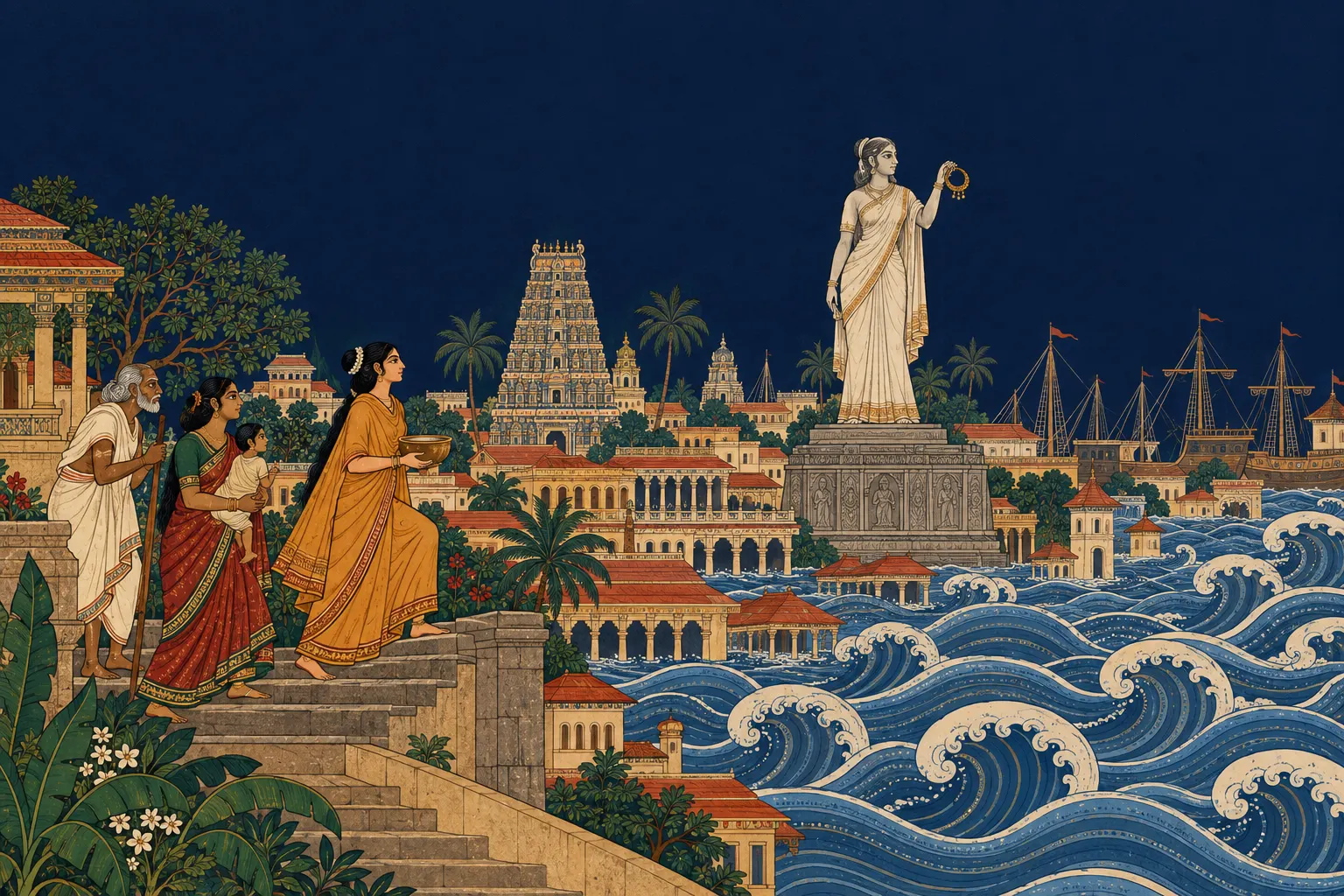
'The goddess Manimekhala, who knew about the king's son, grew angry and cursed — "May the waving sea swallow the beautiful city of Puhar." So it happened. The divine city Puhar went into the sea, and the king, like a god with a spear in his hand, left it alone.
'Then your mothers — those in ornaments — went with the sage Aravanar to the city of Vanji. If you wish to know why the god of the sea, who lets the world flourish, destroyed Puhar, ask Aravanar in Vanji; he will tell you. He will also tell you how the goddess Manimekhala took Aputran, saviour of the people, to another country, and how he became king there.'
Saying this the divine Tivatilakai went to her place.
Kannagi's statue
Flying through the sky, Manimekalai wished to see the statues of her beloved parents — her generous father Kovalan and her mother Kannagi. She reached the temple and saw their statues. She worshipped the goddess Kannagi and said, weeping, 'You did not have a happy family life, and you did not do penance either. Tell me, why did you spend your life like this?'
The statue of Kannagi — the goddess of chastity — said, 'When your father and I were in Madurai, I could not bear his suffering and I burned Madurai. Then a goddess came to me and said that all that had happened was the fruit of my past karma. I will tell you the story of my past life.
'Two related kings — Vasu and Kumaran — ruled Simhapuram and fertile Kapilai, and fought each other. In my past birth my husband was Sangaman. In those days of fighting the two of us took our ornaments and went to Simhapuram to sell them. The king's guards saw Sangaman selling the ornaments and told an evil man named Bharatan that Sangaman was a thief. Bharatan told the king he was a spy, and the king had Sangaman killed. I, Sangaman's wife, wept, climbed a hill and cursed.
'The goddess of the city, Madhurapuri, came before me and said, "Do not curse the city. That evil act will bring you punishment." I did not heed the goddess; in anger I destroyed the city. Now your father and I are in heaven by our good deeds, but the bad karma will not leave us. We will be born many times again in the world and suffer like all others.'
Kannagi went on, 'In Kapilavastu in the land of Magadha a Buddha like the sun will appear under a bodhi tree. He will tell the four truths, explain the rise and end of the twelve causes of suffering, and the light of dharma will spread in the Chakravalam. O you in ornaments, because I and your father worshipped at the seven temples of Indra, we will not take sorrowful births. We will lovingly hear the Buddha's dharma and our hearts will follow the ascetics' path. After that we will not be born in this world; we will serve all beings.
'O you with fragrant hair, in this city you will hear the religious views of every philosophy. When you understand the truth you will follow the lord's Buddhist path. This is what will happen to you. The ascetics will not tell you the truths of dharma, for they will think you are young and a woman in bangles. You must take another form.'
Kannagi, her foster mother, left her with these words. Manimekalai recited the mantra the goddess Manimekhala had given her and took the form of a male ascetic.
She passed temples, courtyards, hermitages, blooming groves and ponds, and stayed in the area outside Vanji and its forts, where ascetics doing penance, scholars, and poets who know the ancient books live.
At that very time the just Chera king of Vanji, Cenguttuvan, was preparing for war. The Chera soldiers wore Vanji flowers in their hair and mountain-like elephants went among the people swaying their trunks. Chariots, horses and soldiers with heroic anklets advanced like the rainy-season roar of the sea. They halted on the northern bank of the beautiful Ganga, crossed the river, and reached the land of the kings Kanaka and Vijaya. They defeated them and other enemy kings, and made them carry divine stones on their royal heads to make a statue of the goddess Kannagi. For his valour the king received the golden *vakai* flower, the mark of victory.
Manimekalai reached golden Vanji, where golden banners waved to celebrate the victory of the great archer, the Chera king.
Note: Cantos 25–26, from Kausalya Hart's English translation. This explanation of Puhar's drowning (Peelivalai, the lost son, the lapsed festival, the goddess's curse) is the text's own; some scholars also link the memory of Kaveripattinam being swallowed by the sea with an ancient geographical event — only the text's statement is given here. Tivatilakai's line 'you took others' lives, are you not a murderer?' is short and hard in the translation; read it as a sharp word of the text, not as a verdict, and keep the interpretation within the limits of the translation. The identification of 'Javaga' and 'Chavakam' (Java/Sumatra) is disputed. Kannagi's statue is called Manimekalai's 'foster mother' (the translation also says 'mother'), whereas as Kovalan's wife Kannagi is not her biological mother. Hart's translation sometimes blends the 'Killi' names; here the name that the Tamil text gives at each place is used (Killivalavan only in Kanjugan's address to Punniyarajan). The mention of Cenguttuvan's Himalaya campaign and of Kanaka and Vijaya matches the last section of the Silappadikaram.
Source: Tamil epic — the Manimekalai (traditionally by Sittalai Sattanar), The City the Sea Swallowed