
Chapter 9
Kanchanan's Sword
A vidyadhara searching for his wife after twelve years, a prince who returns to the temple at midnight — and a misunderstanding that takes a life
Kanchanan's Sword is chapter 9 of Manimekalai. Source: Manimekalai, Cantos 20–21. It is told in 4 scenes — News of the ashram; Kanchanan; The sword; The word of the Kanthil-pavai — followed by 10 quiz questions.
News of the ashram
Udayakumaran heard that at Manimekalai's request the king had turned the prison into an ashram, and had also built a temple of the Buddha where the poor could come and stay. The place that had once been a house of punishment now held ascetics cooking food and feeding the hungry.
He thought, 'Even if the king is angry with me and the wise despise me, I will go. When she comes out of the temple I will put her on my golden chariot and bring her away. Then I will hear from her what she has learned, and her wise words.' Wearing his garland of flowers, he set off for the Ulaga-aravi hall, where Manimekalai stood like a statue feeding the hungry.
Kanchanan
At that same time another person reached the temple from the sky — the vidyadhara Kanchanan, Kayasandihai's husband. He thought, 'It has been twelve years since the sage cursed Kayasandihai on the bank of the forest river, near the cloud-covered mountain of bamboos. Yet she has not come.' Anxious, he descended from the sky and arrived in that famous city.
He searched for her everywhere — in the Buddha's chaitya, in groves of flowers, in the ashrams of ascetics, in temples. And he saw Manimekalai, in the guise of Kayasandihai, feeding many hungry people with a single bowl. He thought, 'Have the dwellers of the sky taken pity and cured her *yanaitti* disease?'
He went to her lovingly — thinking she was his wife — and began to talk of years of love and to praise her. Manimekalai did not like it. She went to Prince Udayakumaran, pointing to an old woman, and said —
*'See, her hair, which was like black sand, has turned to white sand. Her forehead, which was like a crescent moon, is full of wrinkles. Her brows, which were curved like bows, have turned to dried prawns. Her eyes, which were like night-lilies, are full of dirty water; water drips from her nose. Her teeth, which were like pearls, are like *surai* seeds. Her lips, which were red as flower petals, have dried and smell of meat when she smiles. Her ears, which were like *vallai* leaves, look like dried flesh. Her breasts, which were full, have sagged like empty bags. Her shoulders, which were like young bamboo, have sunk and hang like coconut fronds. Her fingers are thin, her nails falling. Her thighs, which were like plantain trunks, are like dried screwpine stalks. In her knees and back the nerves and bones show. Her feet are like the dry, fallen nuts of an old coconut palm. O prince, you do not know how this loathsome body, covered with flowers, sandal, clothes and ornaments, looks beautiful. This is what an adorned body really is, and this is the nature of the body when it grows old. You are innocent, you do not know this.'*
Thus Manimekalai, in the guise of Kayasandihai, told the prince what happens to the body in old age.
The sword
Kanchanan saw Manimekalai speaking to the prince and took her for his wife. He thought, 'When I praise her she pays no attention. But she has gone after another man, and looks at me as at a stranger. She gave that prince advice, smiled at him with shining teeth and coral lips, looked at him lovingly with eyes like night-lilies. He must be her lover, and she must be living with him.'
His anger blazed like fire. Taking a shining sword he entered the temple where Manimekalai was, and hid like a snake in a hole.
The warning changed nothing. Udayakumaran still wanted her. He thought she had perhaps taken Kayasandihai's form to ensnare Kanchanan by her magic. He said to himself, 'She will come near the temple at night to meet that stranger. I will come in the dark, at midnight, and see what she is doing.' And he left that place.
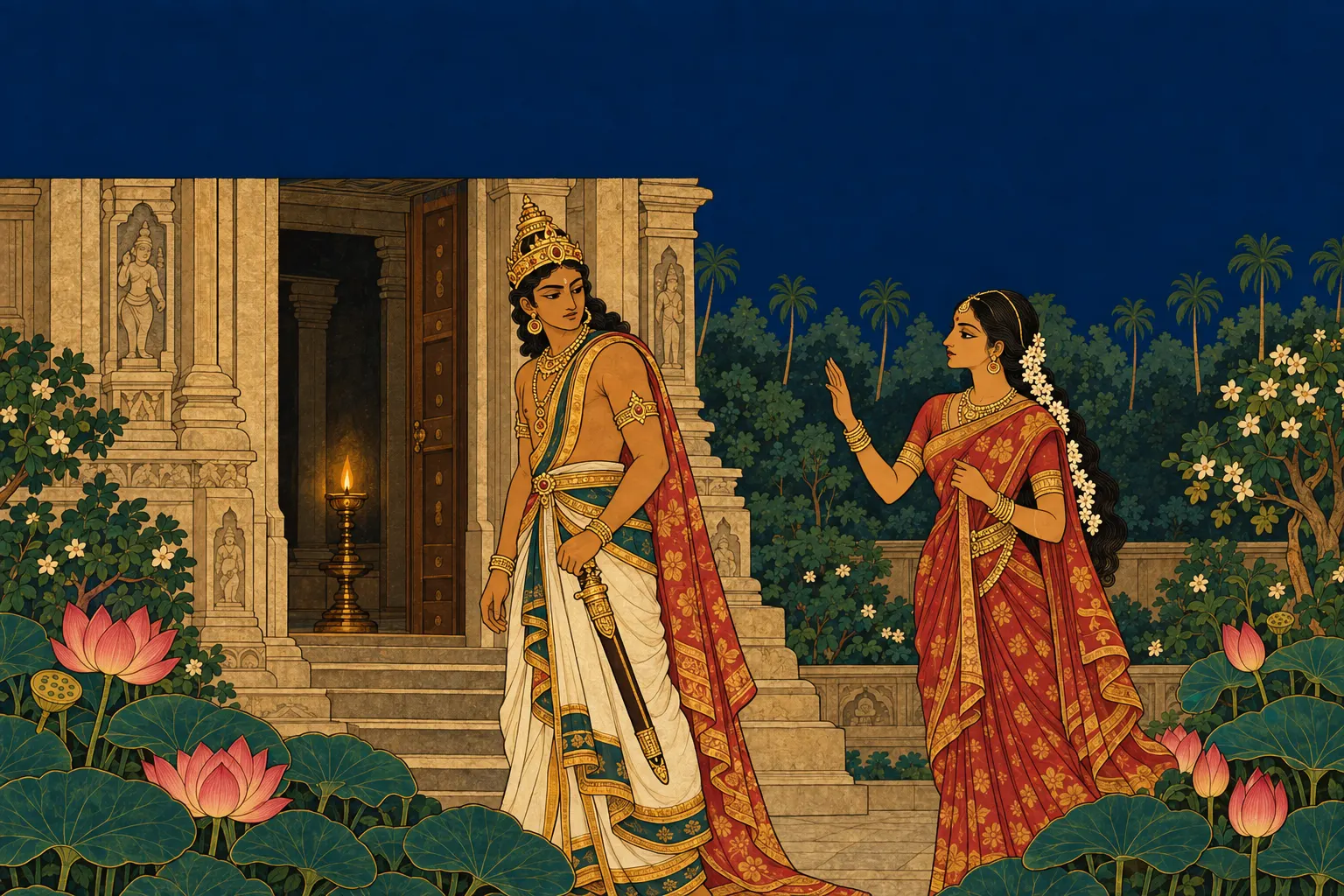
At midnight, when all were asleep, the prince went alone towards the temple — like a cruel tiger going to hunt an elephant, taking as his friend Kama, who rides a chariot in the sky with a fish banner and a sugarcane bow. He passed the temple gate and reached the place where Manimekalai was. He was like a burning snake going down into a large pit; the sandal on his chest had dried. He walked into the temple, and into the fate already waiting for him.
When he came in, Kanchanan with his garland was there. Kanchanan thought, 'This man has come to take my wife.' Like an angry cobra raising its hood he rose, went behind the prince, flung his sword and cut through his shoulders — on which wreaths swarmed with bees.
He thought he would take Kayasandihai with him into the sky; but when he went near her, the Kanthil-pavai, seated on the pillar, said to him —
*'Kanchanan of the sky! Do not go near her, do not go near her. She is Manimekalai in the form of Kayasandihai. Listen — the time has come for Kayasandihai's hunger to end and for her to go with you to the celestial realm. You dwellers of the sky should not go across the Vindhya mountain, where Andari lives. If they go that way, Vindhakadikai, the guardian of the Vindhya, grows angry, drags their shadows and swallows them. Kanchanan, do not worry, listen. Udayakumaran's life was taken here by his own fate. Though you did not know it was fate, you have done a cruel deed, and the result of it will come to you also.'*
The vidyadhara Kanchanan, repenting what he had done, took flight into the sky and went to his world.
The word of the Kanthil-pavai
Manimekalai, her hair adorned with honey-dripping flowers, woke from sleep. She was sleeping in the Mudiyal-kottam, the old goddess's shrine, where the Kanthil-pavai stood on its pillar. The Kanthil-pavai told her what had happened to the prince and what Kanchanan had done in the temple. Then she said, 'I put aside this form of Kayasandihai!' and returned to her own form.
She grieved greatly. She wept and spoke as if the prince stood before her. 'When a snake bit you, in my past birth I burned in the fire. When I saw you in the garden, I desired you. Then the goddess Manimekhala appeared and took me to Manipallavam, where the great sage Buddha's seat is; she told me my past birth and your past birth. I took Kayasandihai's form so that you might be freed from the pain of desiring me and might not recognise me. It is nature's law that people are born, die and are born again. My dear! I wanted you to understand that, and that is why I took that form. But Kanchanan fell into confusion, took me for his wife, grew angry with you and killed you with his sword.'
Sighing and weeping she rose. Then the divine Kanthil-pavai — whose name was Tuvatihan — appeared before her and said, *'Do not worry. The prince has been your husband in many past births and you his wife. This is not the first birth for you two. O beautiful girl, you are confused because you think this is your only birth. Do not grieve.'*
Manimekalai bowed to her: 'You are the goddess of the Potiya mountains and always speak the truth. My husband Ragulan died of a snake in the past birth and in this birth by Kanchanan's sword. Do you know that? If you do, show me your grace.'
Tuvatihan told her a story of Ragulan's past birth. 'When you and Ragulan were on the bank of the Kayangarai river, the faultless sage Brahmadharman came to your house. He used to help the confused and clear the confusion in their minds. You invited him and said, "We will make food for you; please wait till morning." The night passed and morning came. As the cook was bringing food for the sage, he slipped, the pot broke and all the food spilled. Ragulan was angry that the cook could not give the sage food on time, and took a sword and cut off the cook's head. Ragulan's death came from his own bad karma. O you with flowers in your hair, his bad karma did not leave him, and it hurt you too.
'Ignorant people think a god will wipe away the fruit of cruel deeds; but even if people are charitable, the fruit of their bad deeds will come to them in future births. That is why your husband was bitten by the snake.
'Now listen. When the king learns of his son's death he will grieve. He will listen to other sages and put you in prison. Then the queen will free you from the king's prison and keep you with her. Your mother Madhavi, learning of the queen and you, will go to the feet of Aravana Adigal and ask him to tell the queen to free you. When Aravanar and Madhavi go to the queen, she will release you. Then you will see the king Punniyarajan and go with him to his country. He will listen to your words of dharma, and you two will sail by boat to Manipallavam. There you will meet Tivatilakai and she will tell you your past life. Then you will go to the land of Javaga, take the form of a male ascetic and go to the great city of Vanji.
'In that city there are teachers of many philosophies and you will listen to them. Some say that God is the ancient one and created all beings — Shaivas, Vaishnavas and worshippers of Brahma hold this. Some say God is formless but creates beings with form — the Advaitins. Some say that God removes all the sorrows of his devotees and takes them to his world of pleasure — the Mimamsakas. Some say that the world is only the joining of the five elements — the Bhuta-vadins (materialists). In Vanji one teacher will say, "There is no God. After death no one is born again. Why talk of dharma?" You know that there is birth and death. Hearing him you will laugh. He will say, "If you know anything better than this, tell me." You will tell him your past birth in order to prove that the dead are born again. The teacher will say, "When the goddess Manimekhala brought you here, you were confused in a dream." You will not stop arguing with him, and will say, "What you say is not right; the fruit of bad karma is received and the dead are born again." You will clear his confusion.
'Now hear my story. I am a statue on an ancient pillar made by Mayan, the craftsman of the gods, and I am one of the divine ganas — named Tuvatihan. Oviyasenan is my close friend. Wherever we went together, people drew our likenesses side by side. People offered flowers and incense and praised us greatly.'
Manimekalai said, 'I do not know my own future. Please tell me.'
Tuvatihan said, 'In the city of Kanchi there will be no rain and people will not be able to live. This city with golden forts will lose its beauty. When you learn this, take the divine alms-bowl kept here beside the Old Goddess. It is a medicine that saves people's lives. You will go to Kanchi with your mother and Sudhamati to Aravanar, and by Aravanar's grace your male form will leave you. You will take your alms-bowl and feed all beings, and that bowl will also bring rain and the earth will flourish.
'The people of Kanchi will honour you. When you tell Aravanar all the creeds you have heard from others, he will teach you how to do penance and dharma. At that time the Buddha will appear like a sun and remove people's sorrows.
'After doing many good works you will die in Kanchi. After that, in every birth you will be born as a man in the land of Uttara Magadha and go on doing generous deeds. You will become the Buddha's best disciple, learn his dharma. Your desires will end and you will attain nirvana.'
Hearing this, Manimekalai's sea of sorrow and confusion dried up. She was glad as a peacock freed from a net. The sun-god bloomed like a flower and began to wake the world with his rays.
Note: Cantos 20–21, from Kausalya Hart's English translation. After the murder of Udayakumaran the text presents it as the fruit of his past-birth karma, and says Kanchanan too will bear a result; this is the text's own verdict, not any one reader's — but there is no need to call the event 'right', and it is not said so here. The shape-changing device (Kayasandihai's form) was a way of stopping the prince; it failed and turned out the other way — the text places this too in the order of karma. The description of the old body is the poet's, from the Buddhist tradition of contemplating the body's impermanence; do not take it as any present-day value-judgement about women's bodies or the old. The names of philosophical schools in Tuvatihan's prophecy (Shaiva, Vaishnava, Brahma-worshipper, Advaita, Mimamsaka) follow Hart's translation, and the parenthetical classifications are hers. Hart labels the element-based view 'Buddhist'; the Tamil text, and the later canto of doctrines, treat it as the materialist (Bhuta-vada) view, so it is given that way here. Andari (who lives on the Vindhya) and its guardian Vindhakadikai are the text's names; they are not identified further.
Source: Tamil epic — the Manimekalai (traditionally by Sittalai Sattanar), Kanchanan's Sword