
Chapter 4
Manipallavam
A girl wakes alone on an unknown island, and a shining seat shows her her past births — and it turns out why she cannot forget the prince
Manipallavam is chapter 4 of Manimekalai. Source: Manimekalai, Cantos 8–10. It is told in 5 scenes — Morning on the shore; The seat; What the seat showed; The goddess returns; Three mantras — followed by 10 quiz questions.
Morning on the shore
Manimekalai was sleeping on a bed of fallen flowers on sand white as moonlight. On the island's shore there were pearls, shells lay scattered like seeds, the waves brought in coral, and the scent of sandal and aloe was in the air.
She woke. Her hair was still tangled. She looked all around — and it felt as if a soul had been newly born in a strange country, without its own people. Nothing was familiar. Before her was only the blue, wide sea and the rising sun.
'Is this near the Ubavanam?' she called. 'Sudhamati, where are you hiding? I cannot tell whether this is real or a dream. My heart trembles. Answer me! Did that shining goddess cheat us and vanish? I am alone and I am afraid. Come, my dear!'
She watched the birds flying over the waves — a swan stood in front of them as if he were their king, and the water seemed his army's camp. She wandered over the high dunes, looking for someone she knew. Her hair was uncombed. She wept.
Remembering her father, she said, 'Father, through your bad fortune you went with your wife to a foreign land and the Pandya king had you killed.'
The seat
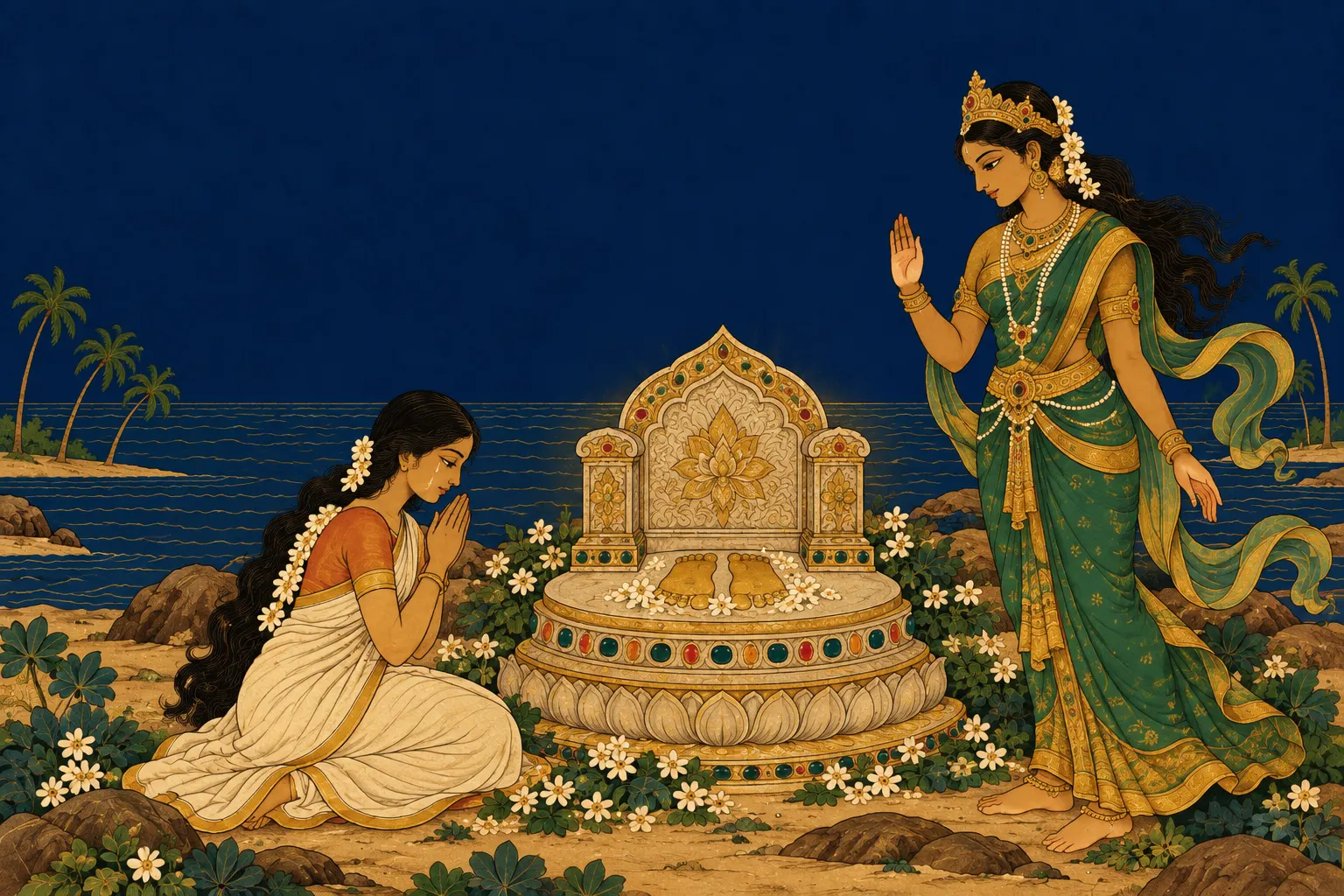
Then the Buddha's seat appeared before her. It shone with radiating light. It was round, of marble — in the translation's measures about four and a half feet high and thirteen and a half feet across in every direction. On it was a square lotus-shaped seat — fit for the Buddha, lord of dharma. Only fragrant trees dropped their flowers on it, none other. No bird went near it to flap its wings. It was set with jewels given by Indra, and it told people the events of their coming births.
The text also tells how it came to be here. In the east, in Naganadu, two kings kept fighting each other for this very Buddha-seat; neither would give up his claim. One day, while the two armies were fighting, a Buddhist sage came between them and said, 'Do not fight — it is mine,' and took it. That is the story of the dharma-seat, revered by the renowned and the holy.
What the seat showed
Seeing the seat, Manimekalai was amazed. She joined her lotus-like hands above her head; tears like pearls fell on her breast. She circled it three times from left to right and touched her forehead to the ground. When she rose, she realised that birth and death are real — and she remembered her past birth.
She said to the seat, 'Everything you said on the bank of the Kayangarai has turned out true.' And the old days came back to her.
*On the bank of the Kayangarai river there was a king named Brahmadharman, who was the brother-in-law of Adipati, king of the eastern country of Kandaram. The seat had told him that in seven days there would be an earthquake and Naganadu would sink four thousand yojanas into the earth. The king had the drums beaten to warn his people, and all set out with their cattle and horses northwards, toward the city of Avanti. On the way they camped on the bank of the Kayangarai — and, just as the seat had said, the country was destroyed. Then all the people came to the seat, bowed at its feet, and it took away all their troubles.*
'At that time,' said Manimekalai, 'I was born in the house of Amudapati, queen of King Ravivarman — and I was named Lakshmi. I was married to Ragulan, son of Nilapati, daughter of Shripati, king of Chitipuram. After the wedding Ragulan and I came to you, and you said, "In eight days a snake will bite Ragulan and you will enter the funeral fire." You also said that in the next birth I would be born in Thavakkali Mudur and my name would be Kavera-kanni; then the goddess Manimekhala would take me in the night to an island in the south, where on another Buddha-seat I would remember my past life.'
Manimekalai's heart grew heavy. She asked the seat, 'Won't you show me where my husband is today? You said a goddess would bring me here and she would tell me who he is.' And she waited for that goddess to come.
The goddess returns
When the goddess Manimekhala saw that Manimekalai had learned her past birth from the seat, she was pleased. She came down from the sky to earth with fragrant flowers — like a blossoming vine. She worshipped the seat and said, 'When all beings in the world are losing their discernment, will not listen to dharma, and the world is tormented by poverty, you rose like a new sun. I bow at your feet.'
Manimekalai bowed before the goddess and asked, 'By your grace I have learned my past birth. Where is my beloved husband?'
The goddess said, 'In your past birth your name was Lakshmi. Once in a flower garden you were having a lovers' quarrel with your husband Ragulan, and, overcome with desire, he bent down at your lotus feet. At that moment the ascetic Chakran was travelling through the sky towards the island of Rattinadvipa and, holding the wheel of dharma in his hand, came down in this very cool grove. You were ashamed that your husband was bowing at your feet while you were bowing to the ascetic. Ragulan was angry — "Who has come?" You closed his mouth with your hand and said, "It is a sage; do not be angry with him; we must bow." The two of you bowed at the ascetic's feet and said, "Though we are not your disciples, we will bring you sweet water and food. Please eat and drink." The ascetic said, "Mother, I will eat. Bring the food. The merit of feeding a sage will wipe out your next birth."
'The prince Udayakumaran, who came to the garden to see you, is that very Ragulan, your husband of the past birth. As he was drawn to you, you too will love him, and you will not be able to forget him. Your mind is like a field where *kandasali* rice grows — it must not turn brackish and spoil. That is why I brought you to Manipallavam, so that you would not fall in love with Udayakumaran.'
Then the goddess told her the story of the sisters. 'Tharai and Veerai were your elder sisters. Both were married to Thuchayan, king of Anganadu. Once he went with his wives to play in the high mountains and camped on the bank of the Ganga. A faultless, wise Buddhist sage named Aravanar came there. You worshipped his feet and asked, "Why did you come?" The sage said, "On this mountain are marks of the lotus feet of the ancient god Buddha. He takes away birth and death, removes the sorrows of all. That is why this mountain is called Pada-pangaya. I have come to circle it and worship the feet. You too should come." By that sage's blessing Tharai and Veerai were born in this birth as Madhavi and Sudhamati.'
Three mantras
The goddess told Manimekalai, 'You know your past birth, dharma, and the teachings of all the religious teachers. But when teachers of doctrines tell you their doctrines they will not tell you much, because to them you will look like only a young woman in bangles. I give you a rare mantra by which you can change form and fly in the sky.'
She was about to go, but turned back. 'I forgot one thing. People's bodies are made of food alone. The mantra I am giving you can take away everyone's hunger.' So saying, the goddess gave her one more mantra and rose into the sky.
Later Manimekalai named the three mantras in her own words: *to take on whatever form I wish; to fly and wander in the sky; and not to go hungry when there is no food.*
Note: Cantos 8–10, from Kausalya Hart's English translation. In Hart's text Canto 10 describes two mantras (changing form and flying; removing hunger); Manimekalai herself lists three in Canto 12, and the prologue (Patikam) also mentions 'three', so all three are given together here. 'Ragulan' (also spelled Rakulan in Tamil transliteration) is a person distinct from the Buddha's son Rahula; the text presents him as a prince. The measurements of the seat, and the likeness between its story of the two Naga kings and the Mahavamsa's account of Nagadipa, are the basis on which some scholars connect Manipallavam with Nainativu (Nagadipa) in Sri Lanka; this is a proposed identification, not a settled fact, and that island today holds places of worship of both Hindus and Buddhists. Names like Kayangarai, Kandaram and Pada-pangaya are the text's own; their geographical identification is not given here.
Source: Tamil epic — the Manimekalai (traditionally by Sittalai Sattanar), Manipallavam