
Chapter 8
The Grandmother's Vow
The grandmother goes to the prince, the prince reaches the temple, and Manimekalai takes the shape of a starving apsaras — by which a king turns his prison into an alms-house
The Grandmother's Vow is chapter 8 of Manimekalai. Source: Manimekalai, Cantos 18–19. It is told in 5 scenes — Chitrapati's vow; Before the prince; At the temple; The prince's vow; In the prison — followed by 10 quiz questions.
Chitrapati's vow
When Chitrapati — Madhavi's mother, Manimekalai's grandmother — learned that Manimekalai had become a nun, her chest burned as if branded with a hot iron. She sighed and thought, 'I will make Manimekalai stop feeding people.'
She said to all the dancing girls of her house, 'Isn't it laughable that Madhavi grieved at Kovalan's death and went into a Buddhist monastery? In this famous city, if anyone says that is all right, it can only be some clever man's joke. We are not faithful wives of good families; when our loved ones die we do not leap into the fire as if bathing in a wide pond. We take wealth from many and live by it. We are not like the yazh of a Panan, useless when he dies. We are like the bee that turns away from flowers without honey. If we gave up our lives and became nuns, people would laugh at us.
'Prince Udayakumaran, like a bee, wants Madhavi's daughter Manimekalai, lovely as Lakshmi. I will see to it that the Amudhasurabhi in Manimekalai's hand falls into beggars' hands, and the prince, getting her, brings her on his golden chariot. If I cannot do this, I shall be like the labourer who, scarred from carrying bricks, wanders around the dance hall. I will not set foot in the dance hall.'
Having made this vow she set out for the prince's palace, drenched in sweat, along the streets of the chariots.
Before the prince
Udayakumaran was sitting in a shining marble pavilion, its pillars of gold inlaid with coral and its roof decorated with pictures in pearl. His throne was made like a chariot drawn by deer. On both sides women fanned him with white chowries.
Chitrapati went and touched the prince's feet. He asked with a laugh, 'Do you think it wrong that Madhavi's daughter Manimekalai has become a bhikshuni?'
Chitrapati smiled. 'Our Kanchi city is famous for its bharatanatyam. A city full of dancers is dear to all lands. Manimekalai is like a blossomed fragrant flower, and you, prince, like the bee that would drink her honey. I have come in haste to say just this.'
To the prince it was as if, in a sinking ship, someone had handed him a boat. He said, 'When I saw Manimekalai in the marble room, she seemed a marble statue to me. Her hands are like *kanthal* flowers, her teeth like pearls, her smile gives men joy. Her dark fish-like eyes conquer spears. I thought that coral statue had stolen my heart. At midnight in a dream a golden goddess showed me a sceptre and said, "Manimekalai has done penance to become a bhikshuni; do not try to have her." I do not know whether it was a goddess or a voice from the sky, but I know that I love Manimekalai.'
Chitrapati said, 'Do not worry. Desire has brought even the gods to grief. Indra, king of the gods, loved Ahalya, wife of the sage Gautama, and the curse of a thousand eyes fell on his body. In the Saravana lake of the Himalaya Agni loved the wives of the seven sages but could not win them; then Agni's wife took the shape of six of the sages' wives, all but Arundhati, and stayed with Agni. Only then was Agni satisfied. You are a prince of the sharp sword — have you not heard these stories?
'Faithful wives guard their virtue in youth; when the husband dies they do not even look at other men. But Madhavi was not born in a line of faithful wives. Madhavi and Manimekalai were born in a family of slave-women, where women sing and dance in assemblies so that people from the whole country may see their beauty. Beside them Kama, with his sugarcane bow and arrows with bees, draws men. With their long fish-like eyes they catch men in a net and steal their hearts the moment they see them. They speak in sweet voices, take all of a man's wealth, and leave him like a bee that has sucked the honey from a flower and flown. Is it not a king's duty to keep such women in check and stop their conduct?'
At the temple
Hearing Chitrapati the prince grew confused and set off in his tall chariot with swift horses towards the temple where Manimekalai was. He saw her — holding a bowl and feeding the hungry, like a goddess of the forest.
Desire rose in him. He thought, 'This clever thief entered my heart and drew me in. Now she does penance in the guise of a thin bhikshuni and feeds people. Why is she begging? She stands there alone — this is the time to tell her my wish.'
He went to Manimekalai and boldly asked, 'O beautiful one, why are you doing penance? Tell me.'
Manimekalai recognised that he was Ragulan — her husband of the past birth. She thought, 'This is my beloved Ragulan. I should bow at his feet; he is my husband from the past birth. My heart is drawn to him, and if he takes my wrist it would not be right for me to refuse what he says.' She trembled, flustered with love, but said, 'If you will listen, I will tell you what I have heard from the wise. This body gives only pain. It is born, grows old, falls sick and dies. I have resolved to do good dharma — that is the life I lead. You are strong as a war elephant; what could women like me teach you about what is right? Now you have heard what I have to say — do as you please.'
She left him and went into the temple of the ancient goddess. She thought, 'Who can understand how men behave?' Inside she worshipped the goddess, praised her, decked with garlands of fresh flowers, then recited the mantra the goddess Manimekhala had given her, took the shape of Kayasandihai, and came out of the temple.
The prince's vow
The prince entered the temple and worshipped the goddess Mudiyal — and saw Manimekalai in Kayasandihai's guise, carrying an alms-bowl. He said to the goddess, 'How shall I recognise Manimekalai? She has changed her form. If you do not take pity on me and show me Manimekalai, I will come here again and again, however many days it takes. I love Manimekalai — her coral-red lips, shining pearl teeth, fish-like eyes lined with kohl, bow-like brows, moon-like face. O ancient goddess Sampapati, that moon-faced one entered your temple. Until you show me grace, I will keep coming, so that I may take her with me from this temple. I touch your feet, and this is my vow.'
As soon as he made this vow, the statue in the temple — made by a skilled sculptor — said, 'O prince, wearing a garland of flowers! You have vowed without thinking. This vow, spoken with the tongue, will not be fulfilled.'
The prince's mind grew troubled, as if he were trapped in a dark room without windows. He thought, 'It is true that the goddess told me to forget Manimekalai. It is also true that Manimekalai carries a bowl and ends hunger. And what the statue said is true as well. I will find out Manimekalai's state later.' He left the temple.
In the prison
Morning came. The sun, king of the day, rose, driving away the darkness. The morning drums sounded.
After the prince left, Manimekalai thought, 'If I go on wandering in this pavilion the king's son will not leave me alone. Everyone here knows that Kayasandihai used to wander suffering from the disease of hunger. I will take her guise and feed the poor. The scriptures say that taking alms is the work of mendicants, and feeding them is merit.'
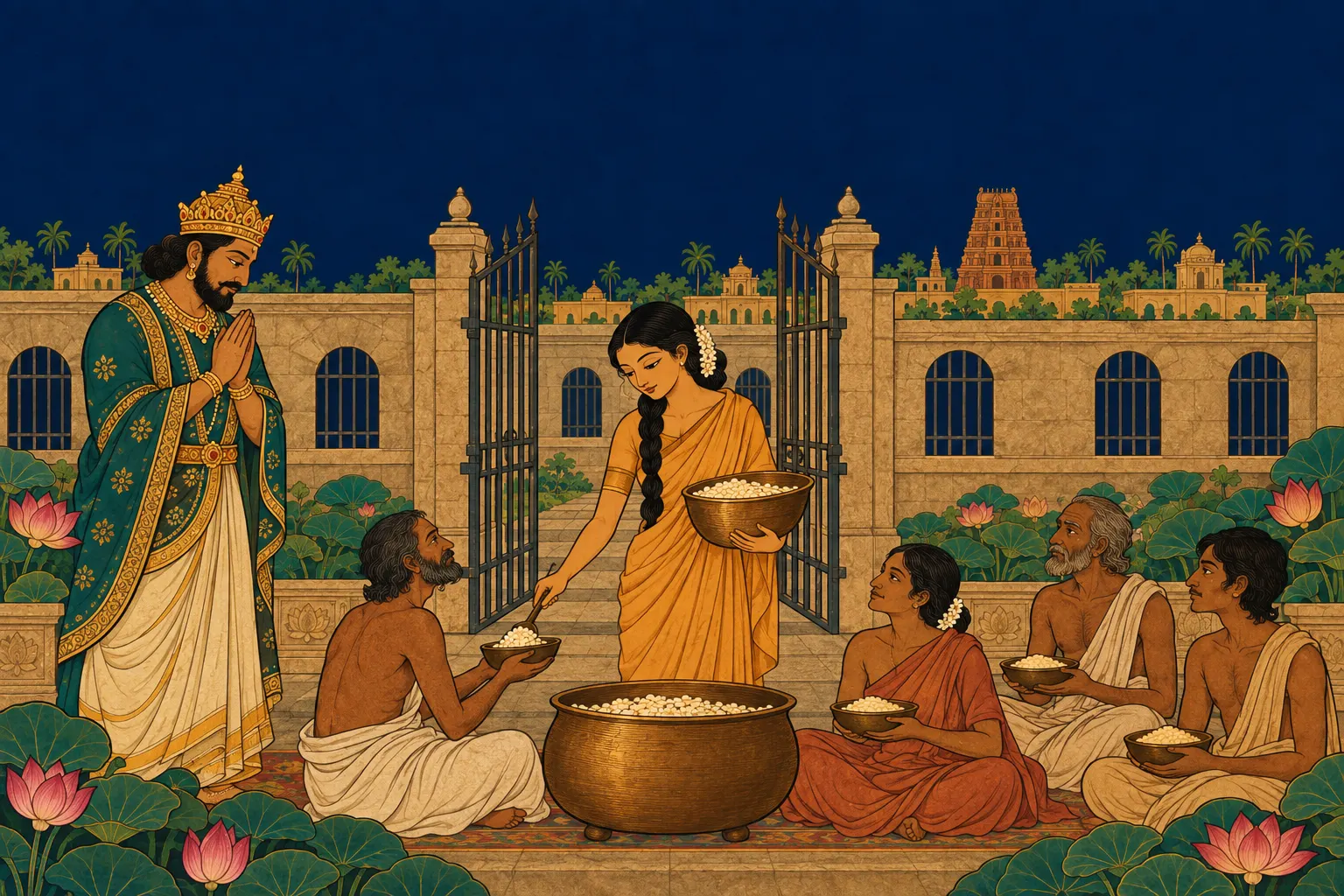
She went to the Mudiyal-kottam and took the Amudhasurabhi that was kept there into her lovely hands. Then, her bangles jingling, wandering here and there, gladly she reached the prison where criminals were punished. The prisoners were sighing with hunger and crying out in distress; she filled their hands with heaps of food.
The guards were astonished. 'She came laughing into this prison where the king with the heroic anklets punishes offenders. The prisoners here, tormented by hunger, she fed handful after handful and ended their hunger. In her hand is only one bowl, yet she feeds so many. We will go and tell the king.'
At that time the king Mavankilli — Udayakumaran's father — was in the beautiful garden with his queen Seerthi (Rajamadevi), where bees hummed like lutes, cuckoos sang, peacocks danced. The king laughed at a peacock's dancing pose; a monkey was swinging its mate on a diamond-set swing; goldsmiths of Magadha, smiths of the Maratha land, craftsmen of Avanti, carpenters of the Yavanas and artisans of the Tamil land together had built him a golden pavilion. The king sat in it on his throne like Indra.
The guards came and said, 'O Chola king, victory to you. An unknown woman, with an alms-bowl, thin and tired, wandering in Puhar, has entered the prison and is giving food to all the hungry.'
The king said with compassion, 'O vine-like woman, come.' Manimekalai stepped aside from the guards, came to the king and said, 'O glorious king, victory to you.'
The king asked, 'You look like an auspicious ascetic. Who are you? Where did you get this bowl?'
Manimekalai said, 'O king with the fragrant garland, may you flourish always! I am a celestial woman wandering the earth, driven here by the queen's cruelty. This alms-bowl was given me by the goddess of the temple. It is a divine bowl and cures the *yanaitti* disease. It is a life-giving medicine for the hungry.'
The king asked, 'What can I do for you, O vine-like girl?'
She said softly, 'Turn this prison into an ashram where compassionate ascetics may live and seek higher truth. May you prosper.'
And the king had the prison closed and made it an ashram — where ascetics might live in the world and seek higher truth.
Note: Cantos 18–19, from Kausalya Hart's English translation. The harsh things said about women and courtesan families in Chitrapati's argument are said in that character's mouth — she is justifying her own plan to bring Manimekalai back; they should not be read as the poet's judgement or this website's. The mythological stories she lists (Indra–Ahalya, and the episode of Agni and the sages' wives) are familiar stories of the Hindu tradition; here they appear only as Chitrapati's argument. Hart's translation calls Agni's wife 'Sukhadevi'; the Tamil text says only 'Agni's wife' — the identification with Svaha comes from the wider Sanskrit tradition, and in this episode the text does not call her by that name. The temple goddess is Sampapati; the text also calls her by honorific names such as Mudiyal and Mudiyol. Ulaga-aravi is not the goddess's name but an open public hall. In Hart's text, in Chitrapati's speech, the name of the city 'Kanchi' appears as a city of dancers; it is not clear from the text whether this is the same Kanchi where the story ends. The list of craftsmen of the king's garden (Magadha, Maratha, Avanti, Yavana) is the text's and points to wide contacts of the time.
Source: Tamil epic — the Manimekalai (traditionally by Sittalai Sattanar), The Grandmother's Vow