
Chapter 7
The First Alms
A young nun with a bowl on the streets of Puhar, a chaste wife whom the fire would not burn, and an apsaras whose hunger had not ended in twelve years
The First Alms is chapter 7 of Manimekalai. Source: Manimekalai, Cantos 15–17. It is told in 5 scenes — A nun in the street; Athirai and Saduvan; In the hills of the Nakka-saranar; Kayasandihai's hunger; The door of Ulaga-aravi — followed by 10 quiz questions.
A nun in the street
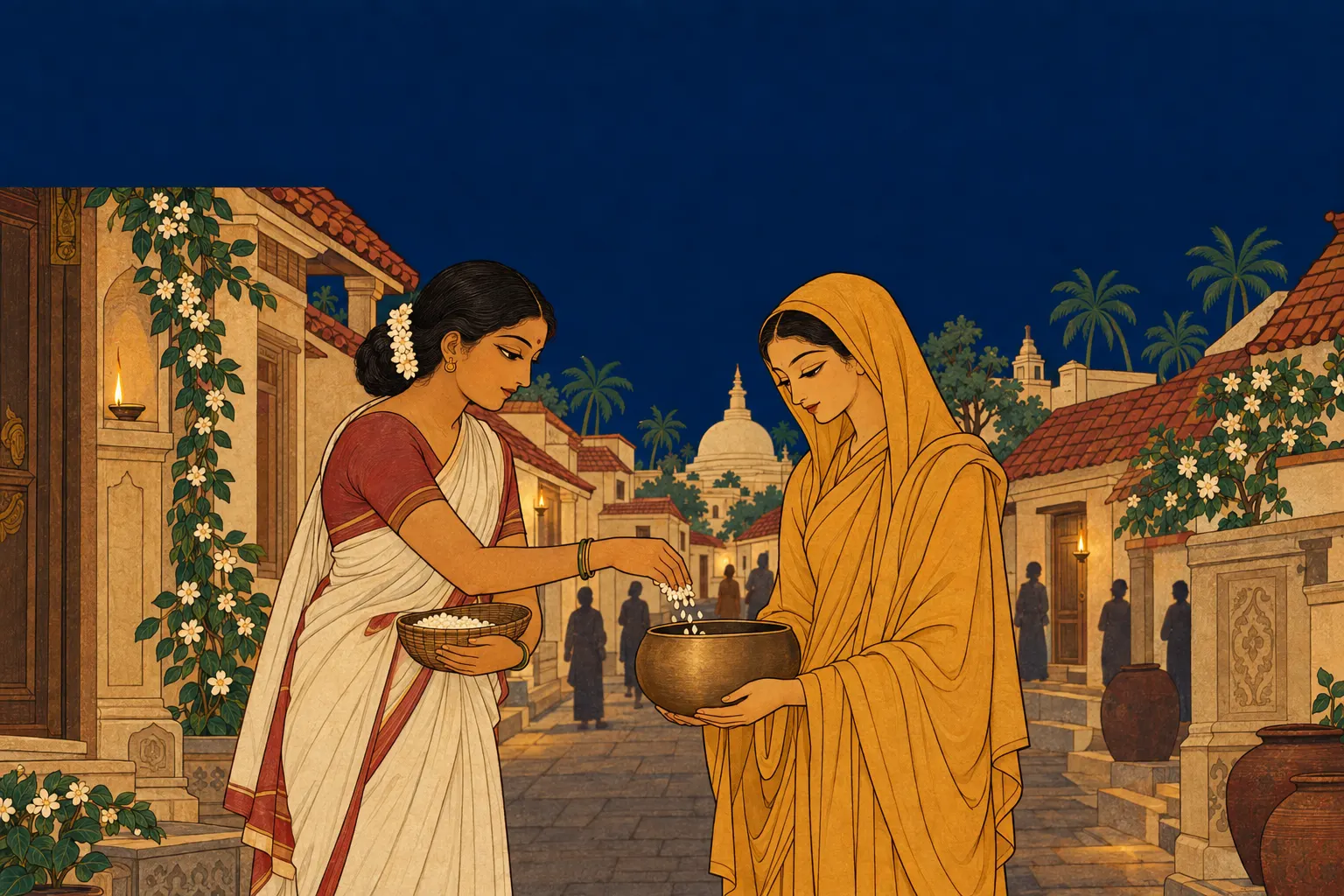
Manimekalai set out, bowl in hand, into the wide streets of Puhar. The streets were very noisy — lustful people, rough people, who went about as if mad; just as Udayana's Brahmin minister Yaugandharayana had gone about the streets of Ujjain disguised as a madman, when Udayana had been imprisoned by Pradyota.
At that moment the very Manimekalai whom Prince Udayakumaran desired, the girl with flowers in her hair, was coming as a nun with an alms-bowl.
Just then an apsaras, Kayasandihai, met her. She was wandering hungry, because a sage had cursed her on the bank of a small river on the Potiya mountain in the south. She saw Manimekalai and said, 'Daughter of Madhavi, you should take alms only from a chaste woman. Athirai is the most faithful of all wives; this is her house. Go in.'
Athirai and Saduvan
Kayasandihai told Manimekalai the story of Athirai.
'Athirai's husband Saduvan lost his way in life. A courtesan entertained him lavishly, and he left his well-dressed wife and went to live in her house. He gambled, gave the courtesan much wealth and lost everything. When he had no gold or wealth left, the courtesan pretended to love him but took an interest in other men and left him.
'Saduvan became poor. He boarded a ship with some merchants to earn wealth in another country. On the way a storm came on the sea and the ship broke up. Saduvan seized a floating piece of wood and reached the shore of the hilly Naga land, where the Nakka-saranar lived. Some others from the ship also survived by clinging to timber and reached Athirai's city.
'Athirai heard from the sailors that the ship had broken in the storm in the night and that Saduvan had lost his life. She called the villagers and said, "Light a fire for me, I will die too!" A pit was dug in the burning ground and a fire lit. She said, "If I enter the fire, all my husband's bad karma will be wiped away." But her clothes did not burn, her bed did not burn; not even the colour of the sandal paste and the flowers in her hair changed. She looked like Lakshmi seated on a blooming lotus and cried out, "I am a sinner — even fire does not burn me!"
'Suddenly a voice came from the sky: "Athirai, listen. Your husband did not die by the waves' blows; he has reached the Naga hills of Nakka-saranar. He will not stay there many years; he will come back here on the ship of the merchant Chandradattan. Do not worry." She stopped weeping and wiped her tears. All the chaste women of the village honoured her; when such women ask for rain, it rains.'
In the hills of the Nakka-saranar
'The waves had thrown Saduvan in the shade of a tree near a tall hill haunted by spirits. Exhausted by the storm, he fell asleep. Some Nakka-saranar came near him and said, "This poor fellow lies alone, he has suffered much. Shall we eat him?" They woke him. He bowed to them and spoke to them in their hunting tongue, which he knew well.
'They said, "You seem clever. Our teacher and leader Gurumahan is here; we will take you to him." Saduvan went with them to their chief. Gurumahan was sitting among toddy pots, meat and dried stinking bones with his wife — the two looked like a male and female bear. Saduvan spoke to him in his own language and made him a friend. Gurumahan let him rest in the cool shade of a tree and asked how he had come. Saduvan said the ship had broken in the storm. Gurumahan told his men, "He has had no food. For this young man bring a young girl, meat and as much toddy as he wants."
'Hearing this Saduvan was alarmed: "These are bad things, I do not want them." Gurumahan grew angry, "If no toddy and no girls, what is there to live for? If there is anything other than these, show us!" Saduvan said, "Faultless good people do not drink the toddy that muddles the mind, and do not kill anyone. It is true that people are born, die and are born again — like sleeping and waking. By good deeds, heaven; by bad deeds, hell."
'Gurumahan laughed loudly: "You say that life leaves one body and goes into another — how does that happen? Explain it to us." Saduvan said calmly: "While a body has life, it feels and knows what happens to it. When life has left, even if you burn it, it feels nothing. From this understand that there is something that feels and leaves the body. This truth is not mine alone — in a dream the life travels hundreds of miles and reaches another place. The life that leaves a body goes into another body because of the karma of past births."
'Gurumahan of the Naga people, with fiery eyes, fell at the feet of the wise Saduvan and said, "If I do not drink toddy and eat meat I do not know how to live. Tell us some good dharma for living faultlessly until death." Saduvan said, "Save those who reach the shore when ships sink. Do not kill and eat them — save them and look after them. Eat only the flesh of old animals that have died naturally. Do not hurt any creature." Gurumahan said, "We will follow your advice. When ships sank near our shore, we used to eat the dead and take their wealth. These are the sailors' things — take what you like: sandalwood, jewels, soft clothes." When the merchant Chandradattan's ship came to that island, Saduvan went with him and returned home, and lived with Athirai doing much charity.'
Kayasandihai told Manimekalai, 'Go and take alms from the divine Athirai.'
Manimekalai reached Athirai's house and stood at her door like a painting. Athirai circled her, bowed and said, 'May the name of hunger be unknown in the whole world.' And food, the unfailing medicine for hunger, filled the Amudhasurabhi; from it Athirai gave alms to Manimekalai.
Kayasandihai's hunger
After this Manimekalai gave food to everyone from the Amudhasurabhi, and wherever she gave there was bustle and noise. People, animals and birds gathered there, more and more. The bowl kept filling — like the treasure of a generous man earned honestly. The food was so plentiful that the hands of those who took it ached.
The apsaras Kayasandihai also saw Manimekalai giving alms and saw that her bowl filled again and again. She came near, bowed and asked for food.
'My hunger is like the stones the monkeys threw into the sea at Rama's bidding on his way to Lanka — the ocean never filled. By the karma of a past birth I am always hungry. You are the healer who can cure me. Free me from this terrible disease of hunger.'
Manimekalai took food from the Amudhasurabhi and put it into Kayasandihai's hands. Her hunger was stilled and she became well.
Kayasandihai bowed and told her story. 'I am from Kanchanapuram in the north, which shines as bright as the world of the gods. With my husband Kanchanan I came from the realm of the vidyadharas to see the Potiya mountain in the south. We stayed on the bank of a river with a waterfall. There came a sage named Viruchikan — in clothes of leaves and with a sacred thread on his chest — carrying in his hand a ripe jamun fruit as large as a palm fruit. He put it on a teak leaf and went to bathe in a pond far off. Through my bad karma I proudly set my foot on that fruit and crushed it.
'The sage returned, wanting to eat the fruit, and found it crushed. He cursed me — "This fruit ripens once in twelve years, and whoever eats it feels no hunger for twelve years. For twelve years I have been hungry, waiting for it to ripen, and you destroyed it. For twelve years you will suffer from the *yanaitti* disease, which gives hunger that never ends. This fruit will ripen again and I will eat it; on that day your hunger will end." Saying this he left.
'My vidyadhara husband came in fear and said, "You are suffering under the sage's curse through no fault of your own. Come with me into the sky." I had forgotten the mantra for the sky-road. He brought sweet fruits, roots and vegetables and gave them to me, but my hunger did not go. My husband did not leave me; he said lovingly, "In Champudvipa, near the Tamil country, many very rich people live who feed the poor. People suffering like you go there. It is far from here, but you can still go by land." I came to this place. On every day of Indra's festival my husband comes to see me and goes back counting the days of the curse.
'O vine-like girl, eating the food of your Amudhasurabhi my hunger has gone. Perhaps the sage meant this very day. I bow to you. Now I will return to the celestial realm. In Chakravala-kottam there is an open hall (ambalam) called Ulaga-aravi where anyone may go. People afflicted with hunger, the sick and orphans stay there hoping someone will help them. You should go there.'
With that, Kayasandihai rose into the sky and returned to the celestial realm.
The door of Ulaga-aravi
After she left, Manimekalai walked alone to the end of the street and worshipped the old goddess's shrine (Mudiyal-kottam) in the Ulaga-aravi, circling it three times — and bowed to the Kanthil-pavai there too.
Coming out she called, 'I carry the Amudhasurabhi, the inexhaustible bowl once held by Aputran. Come, I will give you as much food as you want.'
She was like rain pouring on a bamboo forest scorched by the sun. All the hungry gathered in the temple, and as they ate, a clamour rose.
Note: Cantos 15–17, from Kausalya Hart's English translation. The picture of the Nakka-saranar hill people (toddy, meat, eating drowned sailors) is the text's poet's, and there is no basis in the text for tying them to any present-day caste or community; none is identified here. Read Saduvan's argument for rebirth as this Buddhist poet's own reasoning, not as a summary of a philosophical debate. The text says 'yanaitti' is the disease in which a never-ending hunger comes; it is not held to be the name of any real medical illness. 'Ulaga-aravi' is explained as something like 'a rest-house or alms-hall open to all'; here the text's name is kept. Sampapati is also called by honorific names in the text — Mudiyal, Mudiyol, 'the old goddess'.
Source: Tamil epic — the Manimekalai (traditionally by Sittalai Sattanar), The First Alms