
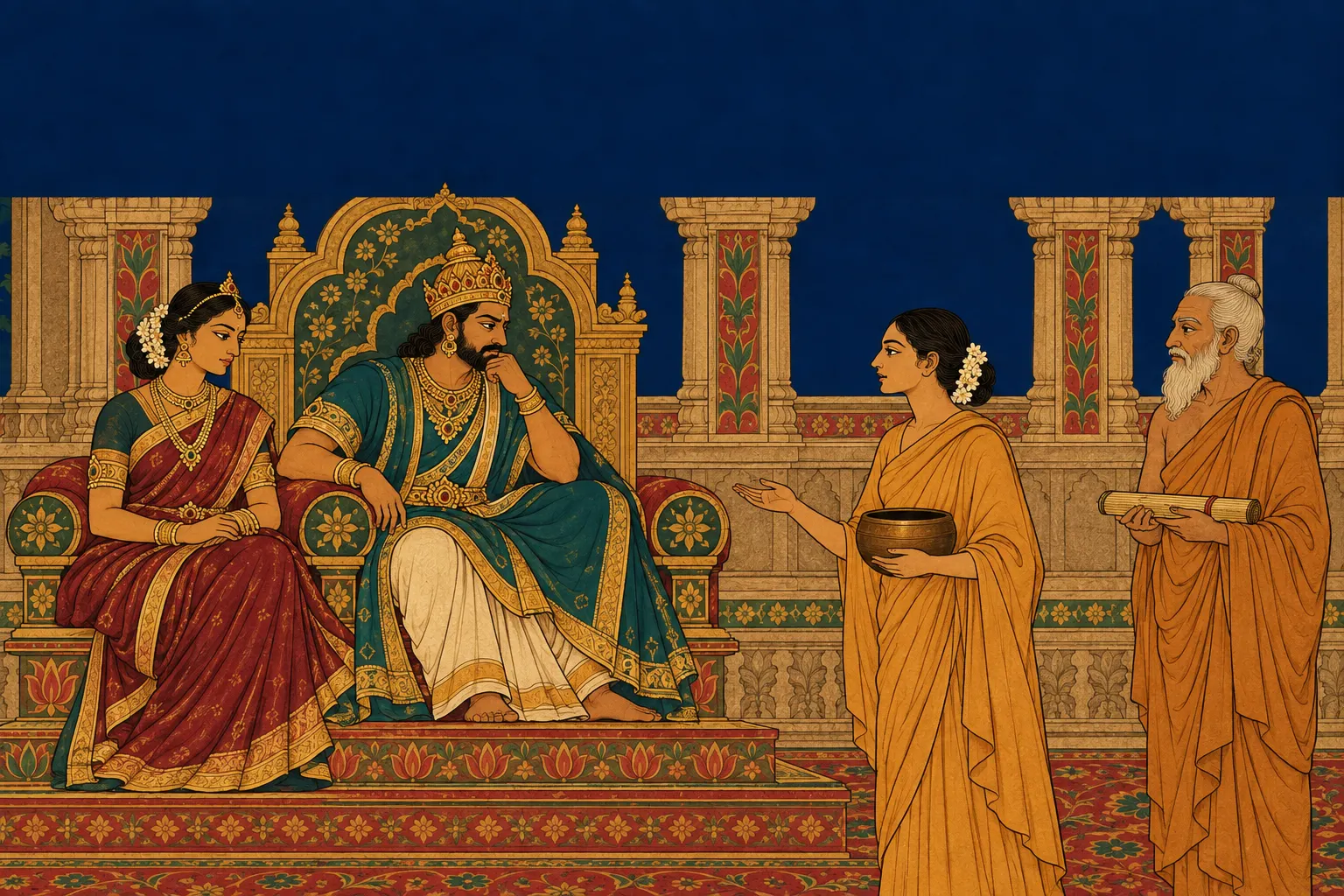
Chapter 10
The King's Justice, the Queen's Schemes
A king who orders his own son to the pyre, a mother who wants revenge, and a girl whom poison, lies and hunger cannot touch
The King's Justice, the Queen's Schemes is chapter 10 of Manimekalai. Source: Manimekalai, Cantos 22–24. It is told in 5 scenes — The morning's news; The king's judgement; The queen's schemes; The grandmother's plea; Aravanar's teaching — followed by 10 quiz questions.
The morning's news
The darkness of night was lifting. People came to worship the goddess Mudiyal at her shrine and told the sages of Chakravala-kottam what had happened to Udayakumaran. The sages asked Manimekalai, 'Do you know anything about the prince?' She told them everything fearlessly.
The sages hid the prince's body and put Manimekalai in another room. Then the sages went to the palace of the king — the prince's father. 'May your white umbrella stay raised high and protect the earth. May your sceptre and wheel never trouble anyone. From ancient times it has happened that people, caught in the game of desire, have approached chaste and good women and done wrong. O king of the line of Nediyon Vishnu, we tell you a story.'
The first story was of Kanthan and Kahandan. The goddess Sampapati ordered King Kanthan to leave the city so that Parashurama should not come before him and destroy him. Worried who would rule the country after him, Kanthan made Kahandan, the son of a dancing-woman, king. 'Since you are not a king's son, Parashurama will not come to fight you. I go to meet the sage Agastya to have the danger removed. Guard the country until I return.' Kanthan went away in disguise.
One day a Brahmin woman named Marudi went to bathe in the Kaveri. Kahandan's younger son saw her alone and, thinking that no one was with her and she could easily be approached, called out, 'Come here.' Marudi thought, 'If a chaste woman asks for rain, it rains. Such a woman does not enter another man's heart. He called me and I have entered his heart. I am no longer fit for my Brahmin husband.' She did not go home but went to a Buddha-sadukkam and said to the deity, 'I have done no wrong against my husband, yet another man has thought of me. Are you not a true god? Give me justice.' A great spirit appeared and said, 'Valluvar says that if a chaste woman who worships no god but her husband asks, it will rain; but you did not follow his word. You listened to others' riddles and idle talk and went to festivals and prayed to gods. Kahandan will hear of this and do justice. In seven days he will learn that his son was infatuated with you, and he will kill him with his sword.' Seven days later Kahandan did just that.
The second story was of Dharmadattan and Visakai, his uncle's daughter. A rumour went round the village that Visakai had made a Gandharva marriage with Dharmadattan. To escape the shame she went to the Ulaga-aravi hall and said to the goddess, 'Goddess of the pillar, wipe out the village's slander.' The goddess said, 'She is a chaste woman; if she asks for rain, it will rain.' Visakai told her mother, 'In the next birth I will become his wife. In this birth I will not marry anyone,' and she went into a Buddhist monastery. Dharmadattan left Kaveripattinam with his parents, went south to Madurai, became a rich merchant and received from the king the title 'Etti' and a golden flower. At sixty a Brahmin told him that a man without a wife does not go to heaven. He returned to his own city. Visakai came to meet him and said, 'Now we cannot even recognise each other. You are sixty, and my fragrant hair has turned grey. I will not be your wife in this birth, but in the next I will be your servant and wife. Youth stays for no one. The greatest help is charity.' The two did a great deal of charity.
One day, as Visakai was walking in the street, Kahandan's elder son saw her and was filled with lust. He tried to take the garland from his head and place it round Visakai's neck, but the hand he raised to take it would not come down from his hair. Hearing this, Kahandan, in anger, killed his son with the sword.
The king said, 'This is not only an old matter — evil things happen even today. Please tell me what you know.'
The king's judgement
A sage said, 'Maharaja, may your sceptre be stained by no evil deed. In this world ringed by the ocean there are five evils: drink, lying, stealing, killing — and, fifth, lust. If lust is removed from the mind the other four go too; and whoever keeps it in his mind goes to hell. Now I will tell you of your son Udayakumaran, who died through his lust for Manimekalai.'
The sage told the whole story — Madhavi's going into the Buddhist monastery; Manimekalai's wish, from childhood, to do penance, beg alms and live in the temple; the prince following her like a shadow; the form of Kayasandihai; Kanchanan's coming at night; and the sword.
Hearing it the king said, 'What Kanchanan did to my son is what I should have done. He did right. A king who does not protect the penance of sages and the virtue of women is not a just king. I do not want other kings to blame me that I did not do justice in order to save my son. I was born in the line of Manu, who did justice by killing his son for a cow. Put my son on the funeral pyre, and the courtesan's daughter Manimekalai in prison.'
So spoke the king whom everyone held to be truly just.
The queen's schemes
Meanwhile the bright-eyed queen Rajamadevi went to an old woman named Vasantavai, who helped kings, princes and queens to cross over their sorrow. The queen fell at her feet, but Vasantavai did not bless her. She said, 'Kings protect their subjects, conquer enemies, take countries. Kings who do not die in war, priests lay on darbha grass after death and cut with a sword. It is a shame when kings of the Chola line die of sickness and not in battle. Your son did not die in any war. How can anyone praise him? Do not grieve in front of other kings — the king, his father, has done justice. And my tongue does not even want to speak of kings who do not die in battle.' And she went away.
The queen thought, 'I will keep my hatred of Manimekalai in my heart, and I will show no one my intentions; I will live as a good woman. Later I will hurt her.'
She said to the king, 'O king of the straight sceptre, Manimekalai is a bhikshuni; the foolish prince was made by Kama to run after her. Sons of kings should not follow evil ways. Udayakumaran was not fit to be a prince. Manimekalai has done no wrong; it is not good to keep her in prison. Free her, she will stay with me. Even if she goes about with her bowl, no one will hurt her.'
The king released Manimekalai and the queen took her to her palace. She said to herself, 'I will see that the people of this city hurt her.' She gave Manimekalai a drink that brings dizziness and unconsciousness, but it had no effect on Manimekalai and she stayed aware, because the mantra the goddess had given protected her.
The queen did not stop. She gave gold coins to an uneducated man and told him to go and tell everyone that Manimekalai had embraced him and the marks of her breasts remained on his chest. The man went to the temple where Manimekalai was. Seeing him, Manimekalai understood he had come to harm her, recited the mantra and took the form of a man. The man saw her in male form, was frightened and thought, 'This is the queens' palace, men cannot come here. I do not know what is happening.' He left the city and ran away.
The queen thought that Manimekalai must not be allowed to live, since she was the cause of her son's death. She shut her in a dark room and told all the servants to give her nothing to eat. But Manimekalai knew the mantra that keeps one alive without food. She recited it and did not go hungry.
When the queen saw that none of her schemes had harmed Manimekalai, she understood that she was an ascetic. She said, 'I did these things to you because my son suffered so much because of you. O you who shine like gold, forgive me.' The queen bowed to her.
Manimekalai told the queen the story of her past life: 'Ragulan was my husband in my past birth, the son of King Nilapati. When a snake bit him, I went into the fire. That same Ragulan was born in this birth in your house as Udayakumaran. How can you call him your son now, and why do you weep for that prince? Are you weeping for his body or for his soul? If for his body, it burned in the burning-ground. If for his soul, it is hard to find out, because it is decided by karma. If you grieve for his soul, you should grieve for all beings. Do you know what that prince did in his past birth?'
She told the story of the cook, and also of Kanchanan and Kayasandihai, and how she knew all this. Then her whole story — from the meeting with the prince in the garden to Aravanar's divine teaching. 'You took me for an enemy and gave me a drink to make me unconscious, but I was saved, because in my past birth I had that mantra. You sent an uneducated thief to me, but I changed my form and he ran away in fear. All your evil deeds could not hurt me. You gave birth to my beloved husband, but you can cross over your grief for a son. Your son's death arose from the karma he carried from before. Dear one, hear my words, which are medicine for your sorrow.'
Then she told the queen two more stories — one of a son who, without knowing it, had a relationship with his mother and gave up his life when he found out, and one of a pregnant doe struck by a hunter's arrow, from whose belly a fawn came; seeing the fawn crying, the hunter flung away his arrows and gave up his life. And she gave a teaching for living: 'Drink, stealing, killing, lying and lust — these five faults bring pain to everyone's life; they should be removed. Mere learning is not enough; those who are wise and without anger are the ones who truly live. Those who give to the poor truly know the road to liberation. Those who feed the hungry know the road to heaven.'
The queen found peace in hearing Manimekalai's words of wisdom. Manimekalai's words gradually cooled the grief that had been burning through her. The queen bowed to her, but Manimekalai did not think this right. She said, 'This is not right. You are worthy of my bow, not I of yours. You gave birth to my beloved husband and you are the king's queen,' and she bowed to the queen.
The grandmother's plea
When Chitrapati learned that the prince had been caught in her own scheme, she went in grief to the queen's palace to free Manimekalai. Falling at the queen's feet she said, 'Many women born in courtesan families have suffered. No one has suffered as I have. The prince had given gold to many women — now he is gone. Madhavi has become an ascetic in a Buddhist ashram. Dancing women should not live like this. And Manimekalai begs from house to house with a bowl. Women are always the cause of trouble. Please hear a story.'
Then Chitrapati told the story of King Nedumudikkilli and Peelivalai. 'In early spring the Chola king stayed in a seaside grove of punnai trees. There he saw a girl alone, beautiful as a peacock, with eyes like mangoes and ears like kuvalai flowers. The king was infatuated with her. She and the king stayed together a whole month, but she told nothing about herself. One day she vanished. The king set out slowly on his chariot to look for her and saw a Jain sage climbing a hill. He bowed and asked, "A girl dear as my life has been lost — have you seen her?" The sage said, "I have not seen her, but I know of her. She is Peelivalai, daughter of Valaivanan, king of the Naga country, and queen Vasamayilai. On the day of her birth the astrologer said she would love a prince of the Sun line and bear a son, but afterwards only the son would come, not she. Now listen: if you do not hold the Dweepa-shanti (Indra's festival), the ocean will swallow this great city you protect. Even Manimekhala cannot stop it, because Indra has cursed this city. You have defeated many kings! Know this is true. Do not let the ocean swallow this beautiful city. Do not forget Indra's festival." Saying this the sage went his way.
'Since that great one left, there has always been some trouble in this guarded city. You are the queen of this land. I am afraid that if Manimekalai gets into danger, her guardian goddess Manimekhala will come to save her and carry her off. Manimekalai is a dancer and was born to dance. Give her to me, I will take her home.'
The queen Rajamadevi said, 'The ascetics have removed from their lives drink, lying, lust, killing and theft. Beautiful vine-like Manimekalai followed those ascetics' advice and gave up household life. She has come to me and stays in this house. Let her remain with me.' And the queen kept Manimekalai with her.
Aravanar's teaching
When Madhavi learned that Manimekalai was with the queen, her heart became like a cloth with dust fallen on it. She went to Sudhamati and told her everything, like a trembling vine. Then Madhavi, Chitrapati and Sudhamati went to Aravanar and bowed at his feet. 'May you all be wise,' he blessed them.
The queen Rajamadevi, with her hands in golden bangles, showed Aravanar a seat and honoured his feet. She said, 'I have not seen you for a long time. By my good karma I have seen you today. May your body live long!'
Aravanar said, 'Lady, listen. Though I have led a life of penance, I am like the setting sun. This is the nature of the world — people are born, grow old, fall sick and die. This is the chain of karma: ignorance, formations/action, consciousness, name-and-form, the six sense-bases, contact, feeling, craving, clinging, becoming and birth. Those who understand these reach liberation; those who do not fall into hell.
'What is ignorance? It is when one does not understand, is confused, and believes things like "a rabbit has horns." In this world six kinds of lives are born: humans, gods, Brahmas, dwellers of hell, animals and ghouls. All are born according to their good and bad karma, and when the fruit of karma comes they receive happiness and sorrow.
'Bad deeds are of ten kinds — three of the body: killing, theft and lust; four of speech: lying, slander, harsh words and idle talk; and three of the mind: hatred, anger and delusion. Good people avoid these; those who do them become animals, ghouls and dwellers of hell and suffer. Good karma is avoiding these ten bad acts, having good character and giving charity. Such people become gods, humans and Brahmas and enjoy the fruit of their good deeds.
'O queens, give up all bad deeds and do good. O Manimekalai, you know your births. When you know all the dharma, I will tell you all that you need to know.'
Having given this teaching Aravanar rose. Vine-like Manimekalai bowed at his feet and said to the queen, the attendants and Chitrapati, 'Do not forget the good things Aravanar has said. If I stay here, all the people of this city will scold me that I came as a misfortune for the prince. I will go to Punniyarajan's country, from there to Manipallavam, then to the city of Vanji to meet the goddess Kannagi and do much charity. Do not worry that I will be in trouble — you are all dear to my heart.'
She circled the Mudiyal-kottam, then rose into the sky, reached a great city ruled by Indra's nephew and stopped in a blooming grove. There she saw a sage, bowed at his feet and asked, 'What is this city called? Who is the king of this country?' The sage said, 'This city is Nagapuram, and Punniyarajan, son of King Bhumisandran, is king of this land. Ever since that son was born to King Bhumisandran, the rain has never stopped, the earth and plants have flourished, and there is no sickness among the people.'
In that blooming grove the sage told her of the greatness of the king garlanded with flowers.
Note: Cantos 22–24, from Kausalya Hart's English translation. This chapter is among the hardest pages of this epic. In the dialogue of the sages and the king the prince's killing is called 'fitting', and the king cites justice done at the cost of his own son; this is the view of that character on kingly duty, which the text praises. Do not read it as present-day legal theory or approval; this website's reading of the text gives no verdict on it. Manu's 'killing his son for a cow' is the Manuneedhi Cholan tradition of the Tamil land, linked to Manu; only the name appears in the text. The stories of 'Kanthan–Kahandan' and 'Visakai–Dharmadattan' in the dialogue are stories within the text; some of their details (the spirit of the Buddha-sadukkam, the mention of 'Valluvar') follow the text. The two sub-tales of the boy and his mother, and of the doe, are given here in brief and their detail is deliberately kept slight. Chitrapati's hard words about courtesan families are that character's. The text names the Chola kings of this stretch separately — Mavankilli in the court scene with Udayakumaran's father (ch. 8), Nedumudikkilli in the Peelivalai story — and they are not blended here.
Source: Tamil epic — the Manimekalai (traditionally by Sittalai Sattanar), The King's Justice, the Queen's Schemes