
Chapter 3
The Marble Pavilion
A maddened elephant, a prince, a locked door — and in the night a sea goddess who carried Manimekalai off into the sky
The Marble Pavilion is chapter 3 of Manimekalai. Source: Manimekalai, Cantos 4–7. It is told in 5 scenes — The maddened elephant; The closed door; Five precepts and a story; Evening, the burning-ground fort, and a goddess; Towards the sky — followed by 10 quiz questions.
The maddened elephant
In the garden of the Ubavanam, Sudhamati was showing Manimekalai everything — bees that hum like flutes, a peacock dancing on the bank before a swan, a cuckoo singing to the peacock's dance. 'Look, Manimekalai, look!'
Meanwhile on a street of the city a mahout struck his elephant with the goad and the elephant went mad. Its name was Kalamegham, and like a black mountain it ran down the street of the chariots. The mahout, the drummers and the crowd fled screaming.
Just then the Chola king's son Udayakumaran came up on his horse. His mark was the Cholas' *atthi* garland. From his chariot he brought the elephant under control. After that he came to the street of the dancers, where his friend Ettikumaran sat as motionless as a painting, a woman in his arms, playing a *makara-yazh*.
'You seem restless even here among these women,' said the prince. 'What is it?'
Ettikumaran said, 'I saw Madhavi's daughter Manimekalai. She was withering, remembering her father Kovalan, like a flower shut in a box. Seeing her, my own heart grew sad and I began to play the yazh. That is my restlessness.'
The prince smiled. 'I will go. I'll put her on my fine chariot and bring her here.' His chariot sped off, like the moon cutting through the clouds.
The closed door
At the garden gate Manimekalai started at the sound of a chariot. She told Sudhamati, 'I overheard Vayandamalai tell my mother that Udayakumaran has told Chitrapati he wants me. It seems that is his chariot. What should I do now?'
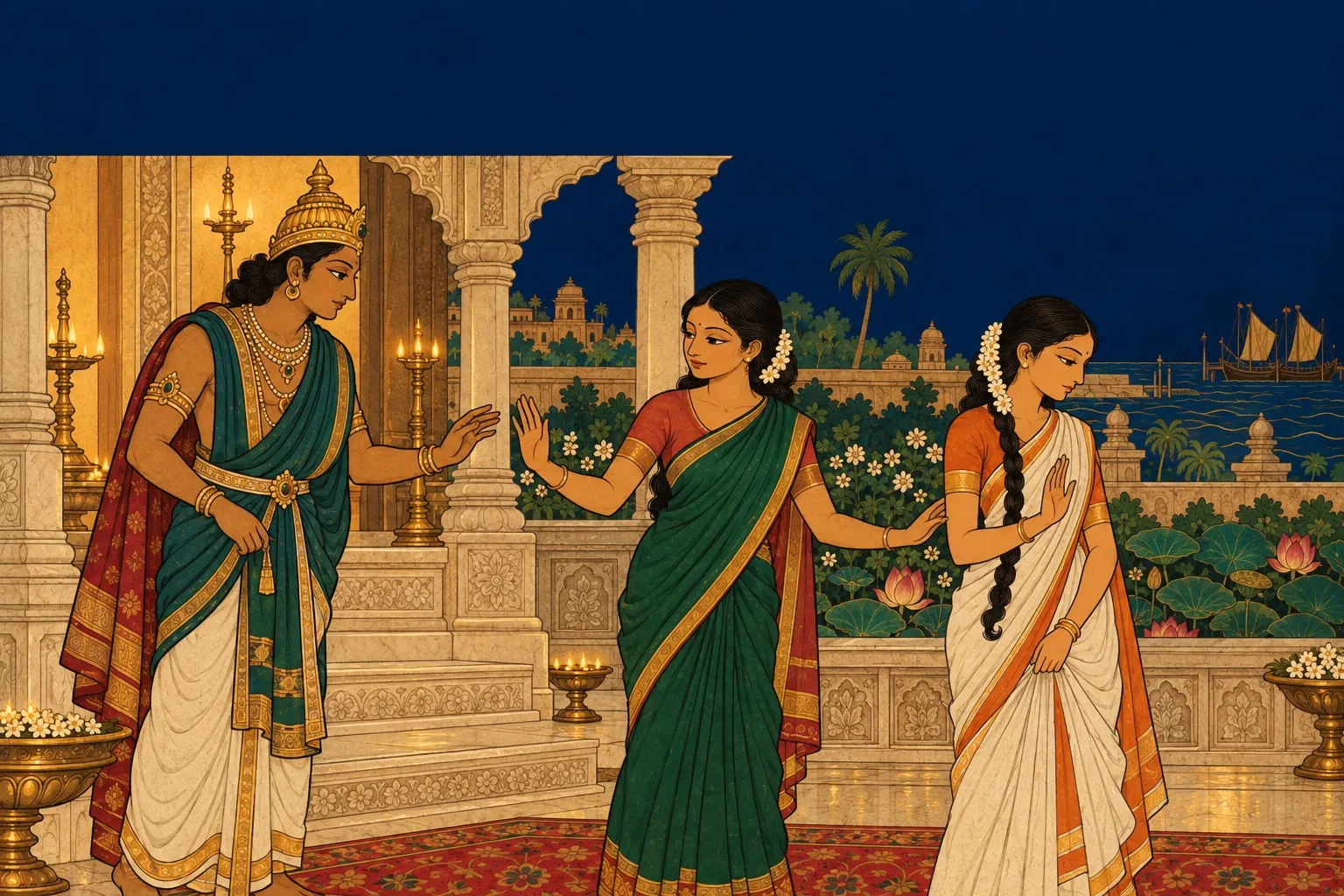
Sudhamati trembled like a frightened pea-hen and said, 'Go into the marble pavilion.' Manimekalai went in; Sudhamati shut the door, moved a little way off and stood.
The prince reached the garden and saw only Sudhamati. 'You are alone. If your friend has come all this way on foot, hasn't her slender waist grown tired? Wouldn't her speech be lisping? Why did she leave the monastery and come here alone?'
Sudhamati answered carefully. 'You belong to a famous line, like King Karikalan — they say that when two old men came to him for justice, he disguised himself as an old man and gave judgement. What can I teach you? But I will say one thing. A person gets a body through karma. Take away its clothes and ornaments and only flesh is left. The body grows old, catches terrible diseases, is full of anger, dangerous as a snake's hole. You are wise — leave Manimekalai alone. She is only a human being too.'
As he listened, the prince's eye fell beyond the marble wall, where Manimekalai looked like a coral doll or a golden vine. Even as Sudhamati spoke, her warning had already lost its hold on him.
Five precepts and a story
The prince laid his hand on the pavilion wall, like a painter touching a picture of his own making. He asked Sudhamati, 'Who is she, really? Tell me.'
'If she does not want the pleasure of your handsome body,' said Sudhamati, 'it is because her fate is to become a bhikshuni. To fall into desire is like a curse for her.'
The prince said, 'Can a rising flood be stopped? Desire is the same. Whether she is a bhikshuni or not, I do not care.' Then, turning back, he asked, 'People in the city say you went away with some celestial man and he left you at a Jain hermitage and went. Why have you two come here alone from there?'
Then Sudhamati told him her story. 'My father was a Brahmin; my mother died earlier. He grew old and began to beg and keep vows. Through my bad karma I got a bad husband and I left him. My father came searching for me, travelling with pilgrims, and reached the shore at Kumari and found me. The tears from his eyes would not stop. He went village to village begging and bringing me food. One day a cow gored him, his entrails spilled out, and the two of us went to a Jain hermitage seeking refuge. The Jain monks said, "You are not fit to stay here," and drove us away. We wandered the streets weeping: "We are orphans — is there anyone kind here?" Then we met a Buddhist monk, with a begging bowl, going house to house for food. He asked me, "Are you in any trouble?" He put his bowl in my hand, lifted my father onto his shoulder and took us to his monastery.'
Having heard it all, the prince said, 'I understand. I will go to Chitrapati and ask how Manimekalai can be won over.' And he left the garden, downcast.
Manimekalai came out of the pavilion. She told Sudhamati, 'He may think I am not a faithful woman, that there is no penance in my heart. I belong to none of the four recognised social orders; none of them stands behind me. Even if he thinks I am a slave-girl, I still do not feel that he has no love for me — my own heart goes towards him too. Friend, is this the nature of desire? If this is it, may its power be destroyed.'
Evening, the burning-ground fort, and a goddess
Evening was settling. At that moment the sea goddess Manimekhala appeared in the guise of a young girl of Puhar. She circled the jewelled seat and bowed to the Buddha's footprint.
She told Sudhamati, 'You and Manimekalai go west, by that small path, to Chakravala-kottam. Ascetics live there; no harm will come to you in the night.'
Sudhamati asked, 'People call it Sudukattukkottam; why do you call it Chakravala-kottam?'
The goddess told her it is a fort next to the burning ground, with four gates, with the heads of those who gave their lives hanging from the trees; there are tombs of great ascetics, of kings, of chaste wives; people burn, bury and drift away the dead; jackals and owls cry; and the waves are never silent.
Then she told the story of Sarngalan. 'Sarngalan was passing through that burning ground with his mother Gothamai. He saw a female ghoul dancing with the head of a corpse and, terrified, said to his mother, "Mother, I will give my life to this old ghoul" — and fell down and died. His mother held her son to her breast and called Sampapati, the city goddess. Sampapati said, "Your son did not die because of a ghoul. It was his fate." Gothamai said, "My husband is blind; give my son back or take me too." The goddess said, "Only the ancient god of the Uzhi, the end of the age, has the power to restore life — not we." Then she summoned all the gods and Brahmas, the sun, moon and stars. All said the boy had died not because of the ghoul but by his own fate. Gothamai grew calm, and died with her son.'
Because of that assembly the place was named Chakravala-kottam — where all the gods and goddesses gathered together.
Towards the sky
As she listened Sudhamati fell asleep. The goddess lifted Manimekalai, flew thirty *yojanas* south through the sky, and set the sleeping Manimekalai down on the sea-ringed island of Manipallavam.
Then she went to Udayakumaran. The prince lay on a soft bed thinking, 'When the night passes, I will have Manimekalai.' The goddess told him, 'Prince, if a king does not rule justly, the stars lose their way; if the stars lose their way, there is no rain; if there is no rain, there is famine. A king should hold his people as dear as his own life. Manimekalai is now a bhikshuni — she too is your subject. Stop thinking of her.'
Then she went to wake Sudhamati. 'Do not be afraid. I am Manimekhala. I came to see Indra's festival. I have left your friend on Manipallavam — she will come back to you in seven days. Tell Madhavi that her daughter has done no wrong. Madhavi knows me — on the day she gave birth to her daughter, Kovalan said, "There is a goddess in the sea," and named the girl after her. One auspicious night I came to Madhavi in a dream and told her that this divine child would be given devotion to the Buddha and would not fall into lust for anyone.'
After that Sudhamati woke, afraid. In the middle of the night the sounds of the burning-ground fort came to her ears — the watchmen's drums, the ironsmiths' songs, the calls at the sacrificial crossroads. By the small western gate she reached the fort's large gate and stood in a corner.
There stood a pillar-statue made by Mayan, the Kanthil-pavai, which tells people their past and future births. It spoke before Sudhamati: 'In a previous birth you were the daughter of Ravivarman, king of Yasodhara, and were married to Duchayan, king of Kacchayam. When you heard of the death of your sister Tharai you fainted, and an elephant trampled you. In the next birth you were born in Kausikan's house. In that birth you were Veerai; Tharai and Lakshmi were your sisters. Tharai has been born as Madhavi, you as Sudhamati, and Lakshmi has become Madhavi's daughter Manimekalai. In seven days she will learn her past and future births on the island, and come back to you in the middle of the night.'
Sudhamati woke trembling. As soon as it was morning she went to Madhavi and told her everything. Madhavi, who had lost her daughter, writhed like a snake that has lost its jewel.
Note: Cantos 4–7, from Kausalya Hart's English translation. Name forms: Sarngalan, Sampapati (the city goddess of Puhar), Chakravala-kottam (the fort near the burning ground; another name is Sudukattukkottam). Sudhamati's story is given in the text in two forms in two places — in Canto 3 with the vidyadhara and in Canto 5 with her father and the Jain hermitage; here both are given in their separate places and one is not merged into the other. The sequence of the two past-birth sisters' deaths is told differently in Cantos 7 and 12 (in Canto 7, Veerai dies by an elephant on hearing of Tharai's death; in Canto 12 Veerai, drunk, walks before an elephant and Tharai falls from a roof on hearing it), so the chapter says only 'sisters'. The Buddhist monk who saved Sudhamati is unnamed in the text. The Jain monks' turning them away is this Buddhist poet's account, not another tradition's own statement.
Source: Tamil epic — the Manimekalai (traditionally by Sittalai Sattanar), The Marble Pavilion