
Chapter 12
From Vanji to Kanchi
An assembly of philosophies heard in the guise of a male ascetic, a rain of bowl-food in famine-dried Kanchi — and the teaching on which this epic ends
From Vanji to Kanchi is chapter 12 of Manimekalai. Source: Manimekalai, Cantos 27–30. It is told in 4 scenes — The assembly of philosophies; Hungry Kanchi; Aravanar's teaching; Penance — followed by 10 quiz questions.
The assembly of philosophies
Taking the form of a male ascetic, Manimekalai reached the place in Vanji where the doctrine-scholars (*samaya-kanakkar*) lived. She went from one teacher to the next and asked, 'Tell me which doctrine you follow.'
First she met the Alavai-vadi, of the Vedic tradition. He said, 'We follow three sages — Vedavyasa, Kirudakoodi and the faultless Jaimini.' And he listed the means of valid knowledge: perception (seeing), inference (knowing by thinking), comparison, scripture, presumption, and the rest. He gave examples: hearing an elephant's sound from the forest and knowing there is an elephant there; seeing a flood in a river and knowing it has rained somewhere; seeing dark clouds and knowing rain will come.
Then the Shaiva-vadi, who held Shiva to be God: 'Shiva's body is made of eight things — sun, moon, the self, earth, water, fire, wind and sky. He creates, runs and destroys everything; no god is his equal.' Then the Brahma-vadi: 'All these great worlds are an egg created by Brahma.' Then the Vaishnava-vadi: 'Narayana is the protector of the world.' Then the Veda-vadi: 'The hands of the Veda-purusha are the six limbs of the Veda, the metres are his legs, mathematics his eyes, etymology his ears, phonetics his nose and grammar his mouth. He depends on nothing, he has no beginning or end. We hold what the Vedas say.'
Manimekalai listened without accepting their conclusions, then moved on to the Ajivika-vadi. He said, 'Our God has limitless knowledge and dwells everywhere. Our books describe five atoms: life and four others — earth, water, fire, wind. It is life that knows how the atoms join and part. Everything is according to karma, and life has six kinds of birth — black, dark blue, green, red, golden and white; after the white birth comes liberation.' This teaching was given as from the book of 'Markali Kosalar'.
Then the Nigantha-vadi (Jain) said, 'Our God is worshipped by Indra. Our books contain the *dharmastikaya*, the *adharmastikaya*, time, space, life, merit, demerit, their fruits and liberation. Everything arises, lasts and perishes by its own nature; it is both permanent and impermanent.' Then the Sankhya described creation in the order from *prakriti* to intellect, space, wind, fire, water and earth, and the twenty-five principles of the *purusha*. Then the Vaisheshika counted six categories: substance, quality, action, generality, particularity and inherence. And last the Bhuta-vadi said, 'As mixing *atti* flowers and sugar makes liquor, so from the combination of elements feeling arises; when they separate it vanishes.' After this comes the statement of the Ulogayata (Lokayata) doctrine: by this doctrine the fruit of karma is in this world alone and there is no rebirth after death.
At this, Manimekalai laughed. 'I have heard many people's doctrines. Whether good or bad I will not say anything against any of them.' But since she knew her past births, she laughed. The Lokayata said, 'Believing in gods and seeing things in a dream are the same — both are plays of the mind.' Manimekalai said, 'If someone says "these are your parents," how do you know they truly are? Unless it feels true from within, how will you believe it? You call this doubt, but you do not say why.'
Hungry Kanchi
After hearing the doctrines in a male form, Manimekalai reached the Buddhist monastery of Vanji. On the way came Vanji's temples, ponds and markets, sellers of fish, salt and betel, potters, goldsmiths, carpenters, pearl-stringers. There she met her grandfather Masattuvan — Kovalan's father, who on hearing of his son's and daughter-in-law's death had become a Buddhist ascetic.
Manimekalai told him everything. Masattuvan said, 'It must be the fruit of good karma that I have lived to meet you. When I heard that your parents had been killed in Madurai, I became a devotee of the Buddha. I understood that household life is an illusion. I began penance.' He told her that those ascetics had told the Chera king Kudakko Ceralatan beforehand that Kaveripattinam would sink into the sea, and also that Kovalan, on the ascetics' advice, had given away crores of wealth to the poor in seven days.
'Aravanar, knowing you would be in Kanchi, went there; your mothers Madhavi and Sudhamati are with him. In Kanchi there is no rain and the people are dying of hunger. There is no one there to feed ascetics and people. In your hands is the Amudhasurabhi, the life-saving medicine. Go to them like rain falling on parched earth.'
Manimekalai bowed to her grandfather and, taking the divine bowl, reached the city of Kanchi, which had once flourished like Amaravati, Indra's city, and was now dry with famine. There she saw the temple built by King Ilangilli, with a green bodhi tree, and stopped in a grove nearby.
A guard went to the king: 'Kovalan's daughter Manimekalai has done great penance; there is no one like her in this world. She has arrived in the Dharma grove like rain after drought. In her hand is the Amudhasurabhi, which can end everyone's hunger.' The king understood that the Kanthil-pavai's word had been true. He went to Manimekalai with his ministers and said, 'I did not know why famine came to this city. Am I not ruling with justice? Is my penance lacking? Are the women here unfaithful to their husbands? You are a good woman — I do not understand why the country is like this. As I was thinking, a goddess said to me, "By your great penance a woman will come here, carrying an alms-bowl that will feed everyone and take away the country's famine. By her grace Indra will order Varuna to send rain and the land will flourish." The goddess went away, and I made this place as she said.'
The king took Manimekalai to the place where he had built a temple for Tivatilakai and the goddess Manimekhala, and a lotus-shaped seat too — 'This is the seat that told me my past births.' Manimekalai took the Amudhasurabhi in her hand and called all the people who speak the eighteen languages — the deaf, the blind, the lame, orphans, the dumb, the sick, ascetics, the hungry, the poor, and the animals and birds too. All gathered and praised her: 'She will take away this disease of hunger!' The Amudhasurabhi gave food like a crop sown in season, fed all like rain. Then Madhavi and Sudhamati arrived with Aravanar in the hall of dharma. Manimekalai washed their feet, gave them tasty food, offered betel and said, 'May the dharma in my mind be freed from the world's illusions and become true.'
Aravanar's teaching
Aravanar heard what Manimekalai said and told her the story of Nedumudikkilli and Peelivalai — the same tale, that the king, searching for his lost son, forsook Indra's festival and Puhar sank into the sea through the curse of the goddess Manimekhala. He said that for this reason he had left Puhar with Manimekalai's mothers and come to Vanji.
By now Manimekalai had heard many doctrines, but hearing them was not enough. She still had to learn how to distinguish sound reasoning from error.
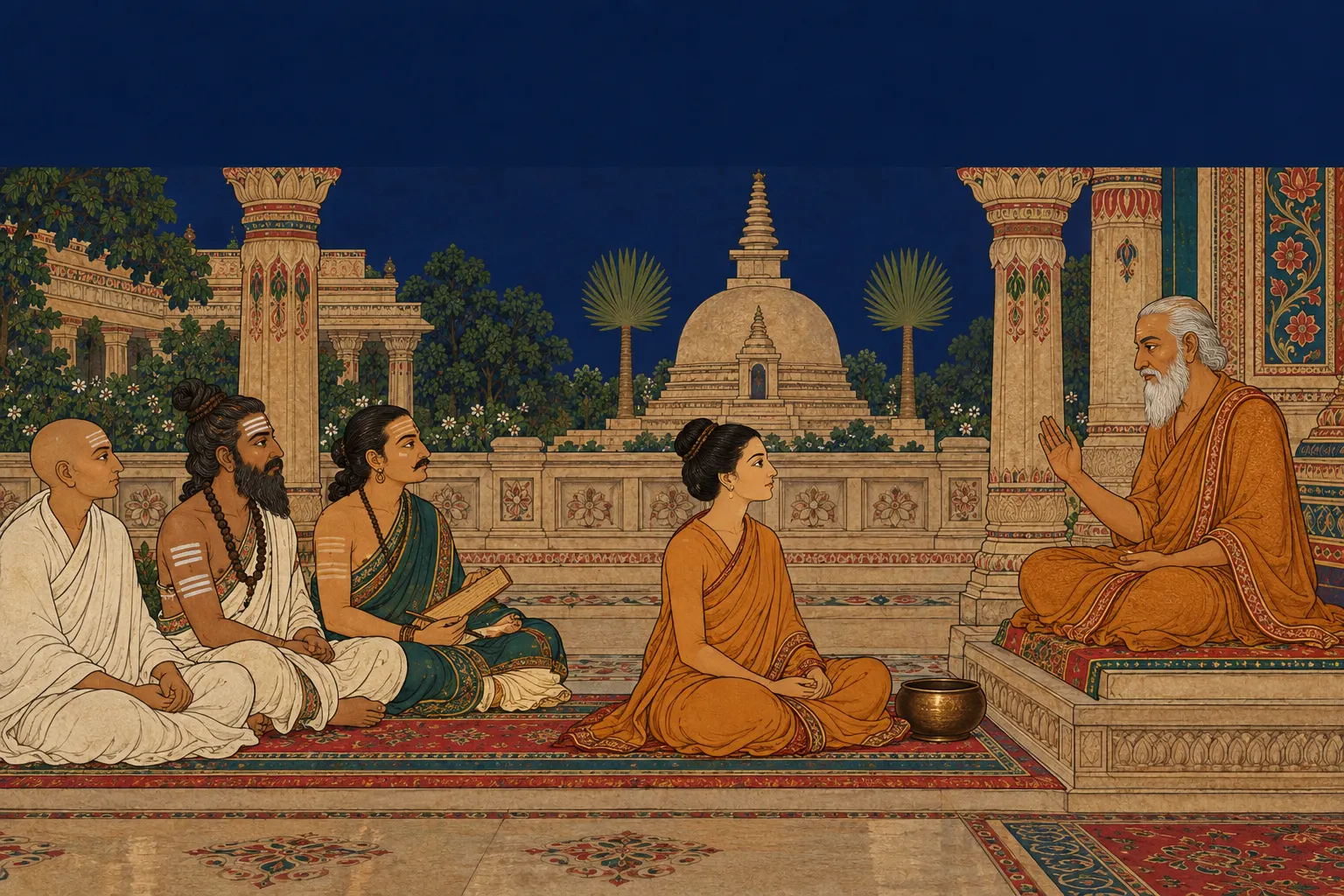
Manimekalai asked, 'Taking a male form I heard the philosophies of many doctrines, but I did not understand them fully. Please explain them.' In reply Aravanar taught her logic — a lesson in Buddhist epistemology, of which the translator Hart writes that the poet rendered it into Tamil from the short Sanskrit text, the 'Nyayapravesa'.
'Take the classic example,' he began. 'The Buddha named only two means of knowledge — perception and inference. An inference has five parts: the *paksha* (the subject), the *hetu* (the reason), the *drishtanta* (the example), the *upanaya* (the application) and the *nigamana* (the conclusion). Say: "There is fire on that mountain" — that is the subject. "Because there is smoke" is the reason. "As in a kitchen" is the example. "And this mountain is like that" is the application; and "where there is smoke there is fire" is the conclusion. But take care: if someone says "wherever there is a donkey there is a courtesan, because the two were once seen together in one place," that is false reasoning.' Then Aravanar told how faults enter the subject, the reason and the example — nine kinds of fault in the subject, three in the reason, ten in the example — 'so that you may know without doubt how to recognise false inference.'
Penance
Having heard the other doctrines and understood the test of reasoning, her journey now came back to the question that had driven this whole story: why is there suffering, and how is one freed from it?
Manimekalai did much charity. She knew her past births. She followed the path of the Buddhist Sangha. She took refuge in the three jewels — the Buddha, the Dharma and the Sangha — and bowed to the Buddha, who had conquered desire and shed the three faults of passion, hatred and delusion.
Aravanar told her how the Buddha came from the Tushita heaven, sat under the bodhi tree and gave teachings that save all beings. He counted the twelve nidanas: ignorance, formations/action, consciousness, name-and-form, the six sense-bases, contact, feeling, craving, clinging, becoming, birth and ageing-and-death. 'From ignorance come formations/action, from formations consciousness, from consciousness name-and-form, and in this order the further links arise. Then, once born, people endure old age, sickness, death, grief and helplessness. If ignorance goes, the formations go; if the formations go, consciousness; and in this order the whole chain breaks.' He taught the four noble truths — suffering, the cause of suffering, the end of suffering and the path to its end; the five skandhas — form, feeling, perception, formations and consciousness; and said that the path to liberation is to know that no being has a fixed self of its own.
At the end he said, 'There are four ways to remove the confusion of the mind: to know that no one else tells the cause of suffering and its end — passion, hatred and delusion are the cause. To see that everything is impermanent, gives pain, has no self, and that hatred must be given up. To give up hatred and keep love, compassion and good deeds. And with these four to drive out the darkness of the mind.'
Aravana Adigal taught Manimekalai these things and made her wise.
Here the text of the epic ends.
Note: Cantos 27–30, from Kausalya Hart's English translation. This part is the most philosophical of the text and is given here in brief; read the descriptions of the various doctrines as this Buddhist poet's presentation, not in those doctrines' own words. Some scholars say the non-Buddhist doctrines are shown as 'incomplete or inferior' in the text; in Hart's translation Manimekalai on hearing them only disagrees, and there is little refutation — that is what is given here. In the list of the twelve nidanas Hart's English renders some terms differently (for instance rendering the Tamil 'unarvu' as 'feeling'); here the standard form is given in the Tamil order (ignorance → formations → consciousness → name-and-form → six sense-bases → contact → feeling → craving → clinging → becoming → birth → ageing-and-death). The Bhuta-vada and the Ulogayata/Lokayata are different doctrines in Hart's text: in the first, feeling arises from the joining of elements; in the second, rebirth is denied. The logic text of Canto 29 is, according to Hart, a Tamil version of the 'Nyayapravesa', traditionally held to be by Shankarasvamin (some say Dignaga); in this summary the full list of its faults is not given, only the basic mountain-smoke-fire example and the faulty donkey-courtesan example. The text does not show Manimekalai's death or nirvana; the prologue's statement of 'penance to cut off rebirth' and the Kanthil-pavai's prophecy are its only hints. In Masattuvan's account the name of the Chera king (Kudakko Ceralatan) and the identity of King Ilangilli of Kanchi, and their relation to the kings of the Silappadikaram, are not clear from the text; they are not resolved here.
Source: Tamil epic — the Manimekalai (traditionally by Sittalai Sattanar), From Vanji to Kanchi