
Chapter 1
Why This Story Is Told
A girl who refuses to dance, and a bowl that never empties — the story that comes after the Silappadikaram, from the pen of a grain-merchant poet
Why This Story Is Told is chapter 1 of Manimekalai. Source: Manimekalai, the prologue (Patikam) and Cantos 1–2. It is told in 6 scenes — The child who was left behind; The grain-seller who wrote an epic; Thirty cantos, one bowl; The opposite of a love story; When it was written; What survived — followed by 10 quiz questions.
The child who was left behind
The Silappadikaram ends with Kannagi becoming a goddess. But inside that story there was also a small girl whose name readers often forget — Manimekalai, the daughter of Kovalan and the dancer Madhavi.
She is the heroine of this epic. Kovalan has been killed in Madurai; Madhavi, in her grief, has become a Buddhist nun; and the daughter is growing up in the city where her mother's and grandmother's generations have lived by dancing.
The story's first scene begins right there: the whole of Puhar is celebrating the festival of Indra, and Madhavi's daughter does not go.
The grain-seller who wrote an epic
Tradition ascribes this epic to Kulavanikan Sittalai Sattanar. 'Kulavanikan' means a grain merchant; he is said to have sold grain in Madurai. Tradition attaches eleven verses in all to his name — ten in the Sangam-era anthologies and one in the Tiruvalluvamalai — and in one of them he praises the Pandya king Nanmaran.
The last lines of the epic's prologue (the Patikam) say that Sattanar told this story of Manimekalai's renunciation, in thirty songs, at the request of the prince-ascetic Ilango Adigal. The prologue may also be a later addition, just as scholars say of the Silappadikaram's prologue. So take it as the tradition's own statement, not as settled history.
Thirty cantos, one bowl
The whole work runs to about 4,861 lines — in the Tamil *akaval* metre — divided into 30 cantos (*kathai*). Its English translator Kausalya Hart arranges it in seven parts, and she says plainly in her introduction that this is not only Manimekalai's tale; it holds many other small stories too — Aputran, Athirai, Kayachandikai, Punniyarajan.
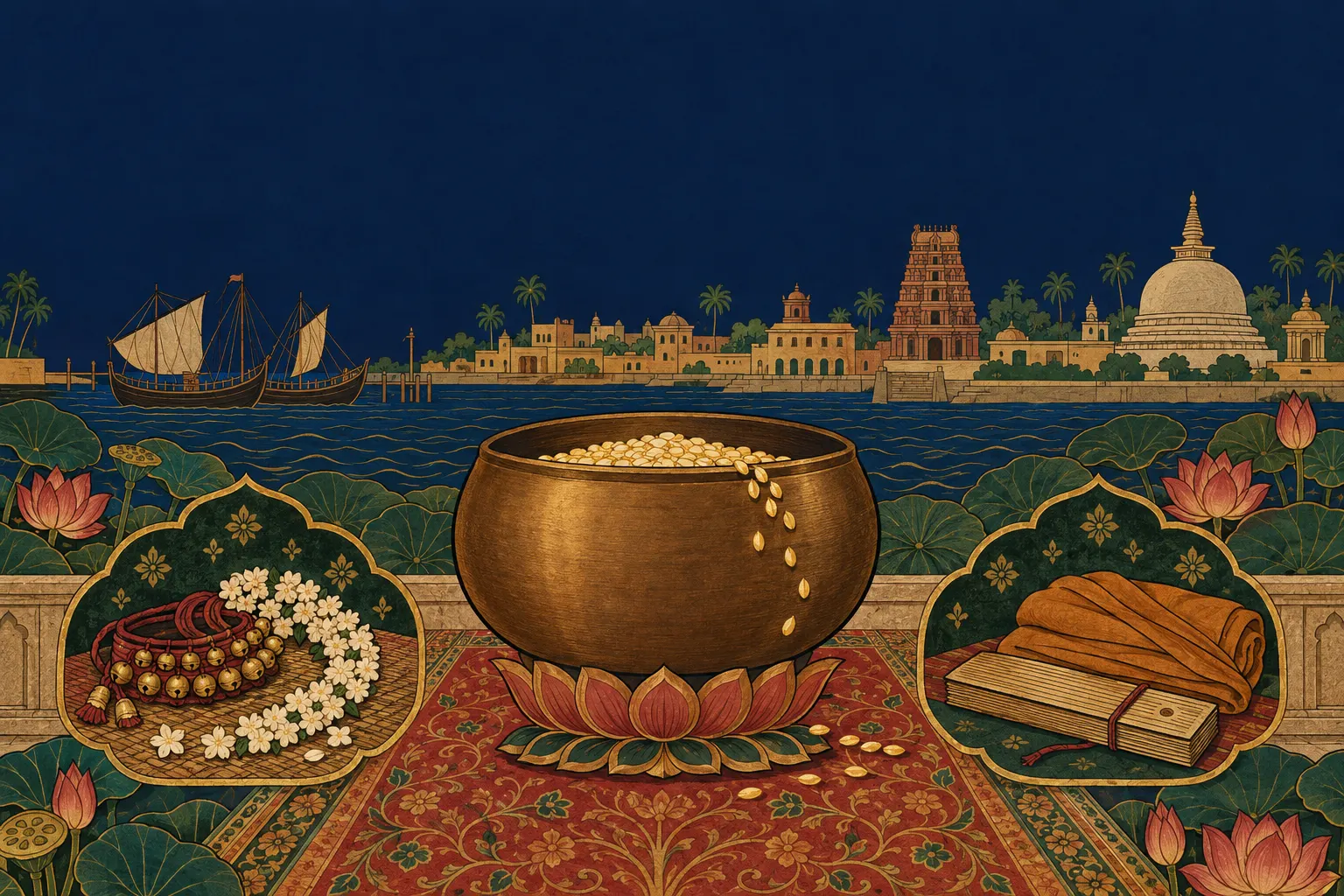
The spine of the story is a bowl — the Amudhasurabhi — from which food never runs out. Through it this epic says something very simple: hunger is a disease, and ending hunger is the highest dharma.
Along the way come a sea goddess, a prince, an island, an ancient Buddha-seat, an apsaras starving under a curse, and, at the end, a whole assembly of the philosophies of the Tamil land.
The opposite of a love story
Critics often call it an 'anti-love story'. The Silappadikaram was a tragedy of a love and its breaking; here a prince pursues the heroine, and she runs from him — but cannot run entirely, because her own heart is drawn to him too. Why that is the case is one of the story's great secrets, answered only much later.
Readers and scholars have not judged the poem in the same way. Kamil Zvelebil judged it 'considerably weaker' than the Silappadikaram — there is no Kannagi here, he felt, and too many miracles and sermons. A critic in 1906 called it 'not an epic poem but a grave disquisition on philosophy'. Other readers prize it for exactly that reason: it gives a glimpse of Buddhism and religious debate in the ancient Tamil land that is found nowhere else.
When it was written
Scholars do not agree on the date. Proposed dates range from the second century to the ninth. Scholars allied to the Tamil tradition generally prefer an early date; on linguistic grounds Kamil Zvelebil judged the middle of the sixth century the most credible, and many modern scholars find that the firmest.
The safest conclusion is: probably around the sixth century, but the date is disputed.
What survived
Manimekalai is one of the very rare, completely preserved Buddhist literary works in Tamil. Older scholarly writing often calls it the only surviving Tamil Buddhist text; present-day research projects describe it as one of two completely preserved Tamil Buddhist texts. There was a time when Buddhism had a good presence in the Tamil land, which faded by about the eleventh century. Many scholars think this book survived perhaps because it was the sequel to the Silappadikaram — its association with the more widely preserved Silappadikaram may have helped it survive. That is a guess, not an established fact.
Scholars continue to disagree about its Buddhist school: some link it to early Hinayana/Theravada tradition, some see Mahayana influence, and some hold that elements of both streams are present together.
This book has a place on this website because its characters are the same as the Silappadikaram's, and because the Vedic, Shaiva, Vaishnava, Ajivika and Jain traditions all speak in its pages. We will not call it a Hindu text — it is a Buddhist Tamil epic — and we will read it as that.
Note: This chapter rests on a reading of the full English translation of the Manimekalai (Kausalya Hart, Project Madurai), together with Wikipedia's *Manimekalai* and *Chithalai Chathanar* articles. Very little is certain about Sattanar's life; 'grain merchant' comes from his title, and his name appears in some verses of the Sangam anthologies (eleven verses in all are attached to him by tradition). The date is disputed between the second and the ninth century. Scholars continue to differ on the Buddhist school (Hinayana/Theravada, Mahayana, or a mixture). 'The only surviving Tamil Buddhist text' is a sentence of older scholarship; present-day research projects describe it as one of two completely preserved Tamil Buddhist texts. On names: the heroine is Manimekalai, the sea goddess Manimekhala — the text gives both the same name, and in later chapters we write them apart in this way.
Source: Tamil epic — the Manimekalai (traditionally by Sittalai Sattanar), Why This Story Is Told