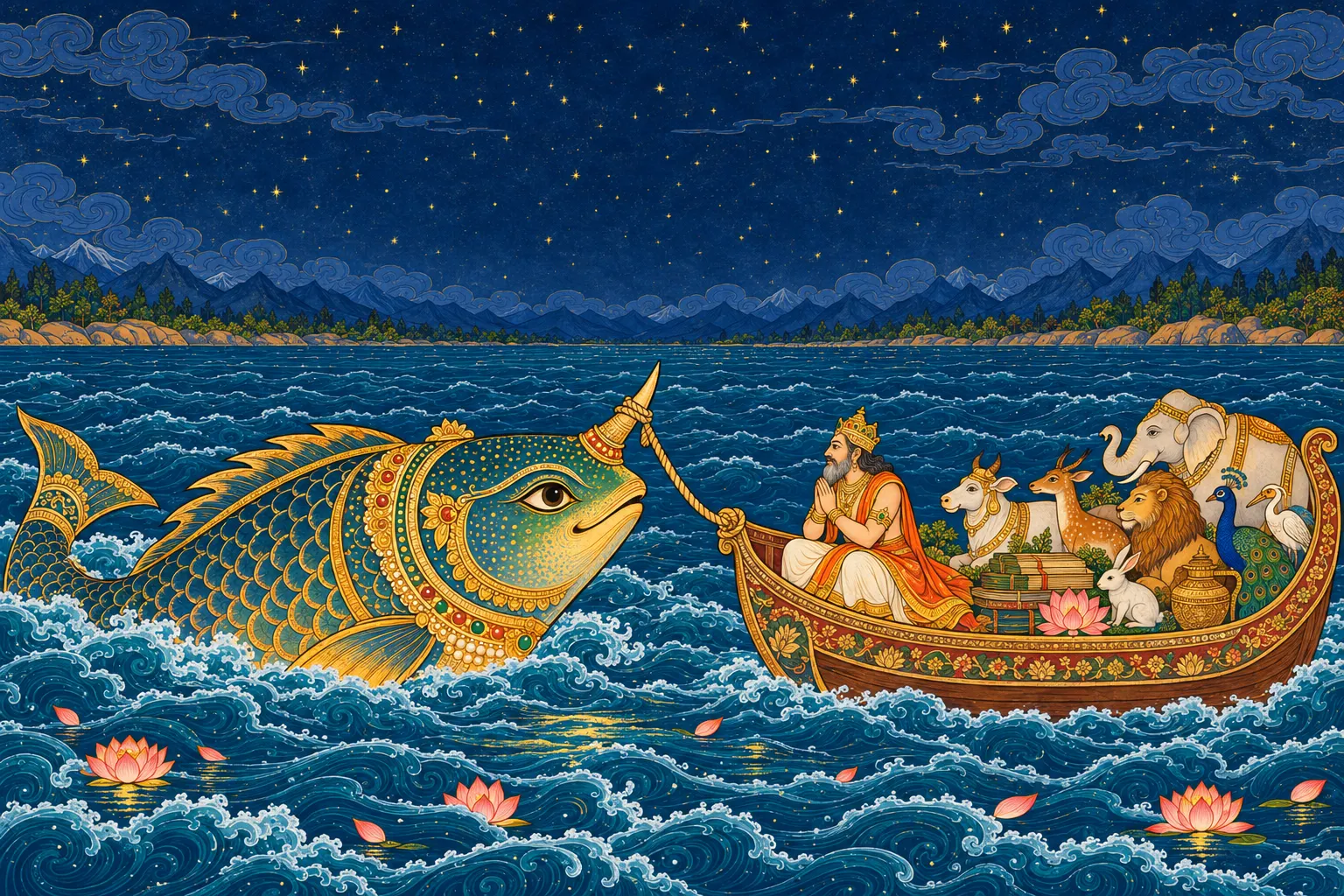
Fate and Effort — Matsya Purana, illustration

Chapter 12

Fate and Effort

Manu asked the Fish whether fate is greater or one's own effort — and the Fish's answer turned out to be the heart of the whole Purana

Fate and Effort is chapter 12 of Matsya Purana. Source: Matsya Purana, chapters 1–3, 164, 221. It is told in 6 scenes — Manu's Questions; Manu's Question; Fate, Effort and Time; Even If It Does Not Come; Stories We Have Heard; The Fish and Manu — followed by 10 quiz questions.

Manu's Questions

In the first chapter we saw Manu climb into the boat tied to the fish's horn. The whole story of the Matsya Purana after that is a long conversation between Manu and the Fish. Suta only repeats it to the sages.

Manu asks, the Fish answers. That is the shape of this Purana. The first question was how creation and dissolution happen, then how Brahma made the world and why he has four faces. When the Fish told the glory of Narasimha, Manu said, "My mind is not satisfied. Now tell me how creation came in the lotus from Vishnu's navel, and when Vishnu slept and when he woke." When the Fish spoke of the duties of kings, Manu asked what the good and bad omens are. Each time he calls the Fish "Lord," and each time the Fish answers him as "king" or "Manu."

Amid this long conversation, Manu asked a simple question that anyone might ask.

Manu's Question

"Lord, which is greater, fate or one's own effort and exertion?" Manu asked the Fish. "I have doubts about this. Please remove them."

"The deeds of a past life are called fate, *daiva*," said the Fish. "So the wise have always held their own effort and perseverance to be greater. A man who does righteous and auspicious deeds every day turns even his ill luck into good. Those who have done good deeds and are full of *sattva* do not get what they wish without their own effort and exertion."

He went on, "People of the *rajas* kind get fruit according to their effort. By effort a man gets what he wants. Those who have done deeds of the *tamas* kind reach their wishes with great difficulty. And those who cannot exert themselves hold fate alone supreme. King, know that men get all their ends by their energy and effort."

Fate, Effort and Time

But the Fish's answer did not end there. "Fate gives fruit joined with the past, present and future," he said, "while effort mostly gives fruit in the present. Fate, effort and time, all three together, give a man his fruit."

"Farming prospers through rain," he added. "And rain comes at a fixed time and not otherwise."

Even If It Does Not Come

"So a man should persevere righteously. Then he gets high fruits even in adversity. And if he does not get the fruit in this life, he is sure to get it in the next."

"The lazy, and those who depend only on fate, never gain their ends. So one should always persevere on the path of righteousness. Lakshmi leaves those who always dream of fate and favours those who exert themselves. So be always active and alert."

Stories We Have Heard

Look back at the stories we have heard, and a common theme begins to emerge.

Manu asked for the power to protect, and the test of it came through the pity shown to one small fish. Hiranyakashipu had a boon, but the merit of the boon ran out. Kacha had nothing, but by service and patience he won Sanjivani. Yayati's youth came back, but his craving did not end, and pride took heaven from him. Harikesha was driven from home and by penance won the rank of lord of the hosts. Maya had a boon, but his people left dharma. Bali was stopped by Shukracharya, and he kept his word. Yama was cursed, and by penance he won the seat of justice. The gods had no nectar, and they churned and won it.

Sometimes fate showed the way, and sometimes effort. But the Fish had said that fate, effort and time go together in giving fruit. This comparison is our own reading; in chapter 221 the Fish speaks of the relation of fate, effort and time, but the idea of joining all the earlier stories is ours.

The Fish and Manu

The Purana calls itself a repetition of this same conversation: what Manu learned from the Fish, Suta tells the sages, and the sages to those who come later.

Note: This chapter follows chapter 221 of the Matsya Purana. The conversation of Matsya and Manu is the basic narrative frame of this Purana, within which conversations of Suta, Shaunaka and other characters also come. The English translation we used ends at chapter 273, so the Purana's last chapters have not been read here.

Source: The Matsya Purana — the English translation by a Taluqdar of Oudh, Sacred Books of the Hindus, vol. 17 (1916–17), Fate and Effort

Now — how much stayed with you?

Fact

According to the Matsya Purana, what is *daiva* (fate)?

  • The will of God
  • The movement of the planets
  • The deeds of a past life
  • The king's command
Read the whole story — The definition of fate

The Fish said that is why the wise hold their own effort to be greater.

Even one with bad luck can make it good by doing good deeds every day.

This came in answer to Manu's question.

What happened?

What had Manu asked the Fish?

  • Whether fate is greater or one's own effort
  • When the flood would come
  • Which god is the greatest
  • What a king should do
Read the whole story — Manu's doubt

He said: I have doubts about this; please remove them.

The Fish explained at some length.

That answer is as useful to an ordinary person as to a king.

Why is that?

What did the Fish say about the lazy and those who sit relying on fate alone?

  • That they are the happiest
  • That fate will give them fruit on its own
  • That they will be kings in the next birth
  • That they never reach their goal
Read the whole story — The fruit of idleness

Lakshmi turns her face from those who go on dreaming of fate.

She favours those who make effort.

That is why the Fish said: always be active and alert.

Who am I?

Without fate and effort I make nothing, but together with them I give fruit. Even farming does not bear fruit without me. Who am I?

  • Rain
  • Time
  • Laziness
  • Charity
Read the whole story — The third companion

The Fish said rain too comes only at a fixed time.

Fate gives fruit joined with past, present and future.

Effort mostly gives fruit in the present.

Put it in order

In what order did the episodes of Manu and the Fish come up in our chosen story?

  • The warning of the flood → climbing into the boat → the account of creation → the Narasimha story → the question of fate and effort
  • The question of fate and effort → the Narasimha story → the warning of the flood → climbing into the boat → the account of creation
  • The Narasimha story → the warning of the flood → the question of fate and effort → the account of creation → climbing into the boat
  • Climbing into the boat → the question of fate and effort → the warning of the flood → the Narasimha story → the account of creation
Read the whole story — The shape of the Purana

The Purana first tells of the flood and creation in its early chapters.

The Narasimha story comes much later, around chapter 161.

The question of fate and effort is in chapter 221, among the chapters on the duties of kings.

Who said it?

"Fate, effort and time, all three together, give a man his fruit." Who said this?

  • Manu
  • Suta
  • Shaunaka
  • The Fish
Read the whole story — The Fish's answer

He explained it through the example of farming and rain.

In the whole Purana every answer is given by the Fish and every question asked by Manu.

Suta only carries it to the sages.

Fact

Of the three qualities, which people did the Fish say get fruit according to their effort?

  • Those of *sattva*
  • Those of *rajas*
  • Those of *tamas*
  • All three equally
Read the whole story — The three qualities

For *sattva*, *rajas* and *tamas* the Fish's answer was different.

But one thing was common: no fruit without effort.

He said this to Manu, addressing him as king.

Interpretation

How have we read the relation of fate and effort in the stories of this Purana? (This is our reading, not a direct statement of the verse.)

  • That fate works nowhere
  • That a boon alone makes everything succeed
  • That a boon or fate gives a beginning, but the end depends on what a person does afterwards
  • That effort changes everything whatever the time
Read the whole story — After the boon

Hiranyakashipu used his boon to torment others and lost.

Kacha won Sanjivani by service and patience.

Take this as our reading; the Purana does not state this conclusion itself.

What happened?

When Manu questions the Fish, by what name does he address him?

  • "Teacher"
  • "God"
  • "Friend"
  • "Lord" or names of Vishnu such as "Janardana"
Read the whole story — After the recognition

In the first chapter Manu had bowed to the Fish as Keshava, Hrishikesha and Jagannatha.

Since then he knows Vishnu in the fish's form.

The Fish answers him each time as king or Manu.

Riddle

I ask questions through the whole conversation of the Purana. I am the Sun's son and was guardian of the boat. Who am I?

  • Vaivasvata Manu
  • Shaunaka
  • Suta
  • Arjuna
Read the whole story — The king who asks

The Purana moves forward by the questions of Manu in the boat.

He once saved a fish out of pity, and the same fish saved him.

Many chapters of the Purana begin with "Manu asked."

Questions about Fate and Effort

What happens in Fate and Effort (Matsya Purana)?

Manu asked the Fish whether fate is greater or one's own effort — and the Fish's answer turned out to be the heart of the whole Purana. The story moves through: Manu's Questions; Manu's Question; Fate, Effort and Time; Even If It Does Not Come; Stories We Have Heard; The Fish and Manu.

What comes after Fate and Effort in Matsya Purana?

Fate and Effort is the last chapter of Matsya Purana.

What is the source for Fate and Effort?

Matsya Purana, chapters 1–3, 164, 221.