
Chapter 4
Devayani: From the Well to the Palace
Pushed into a well by a princess — and the one who made that same princess her maid
Devayani: From the Well to the Palace is chapter 4 of Matsya Purana. Source: Matsya Purana, chapters 27–31. It is told in 8 scenes — The Swapped Clothes; Taunts and a Well; The Hunting King; Shukra Advises Her; Devayani's Answer; Shukra and Vrishaparva; The Princess Becomes a Maid; Yayati Returns — followed by 10 quiz questions.
The Swapped Clothes
When Kacha returned with Sanjivani, the gods welcomed him warmly. They learned the supreme art from him and were deeply content. Then they went to Indra and said, "Today is the day to show courage. Strike down your enemies."
Indra set out with the gods. On the way, in a forest, he saw a group of girls playing in the water, just as Apsaras play in Kubera's garden. Indra took the form of the wind and blew their clothes together in a heap.
The girls hurried out of the water and each put on whatever she found. In the rush Sharmishtha, daughter of Vrishaparva, king of the Asuras, put on Devayani's clothes by mistake.
That simple mistake was about to change both their lives.
Taunts and a Well
"Daughter of an Asura!" said Devayani angrily. "You are my father's pupil. How dare you put on my clothes? You will never prosper. You do not even know the rules of good conduct."
"Your father sits below mine every day," Sharmishtha shot back, "praising him and begging from him. My father sits on a throne and gives, and takes nothing from anyone. You are the daughter of a man who holds out his hand. I am a king's daughter, and I couldn't care less what you think. How dare you speak to me when I am armed?"
And as she spoke, Sharmishtha pushed the startled Devayani into a well. Then, thinking she was dead, she went back to her palace.
The Hunting King
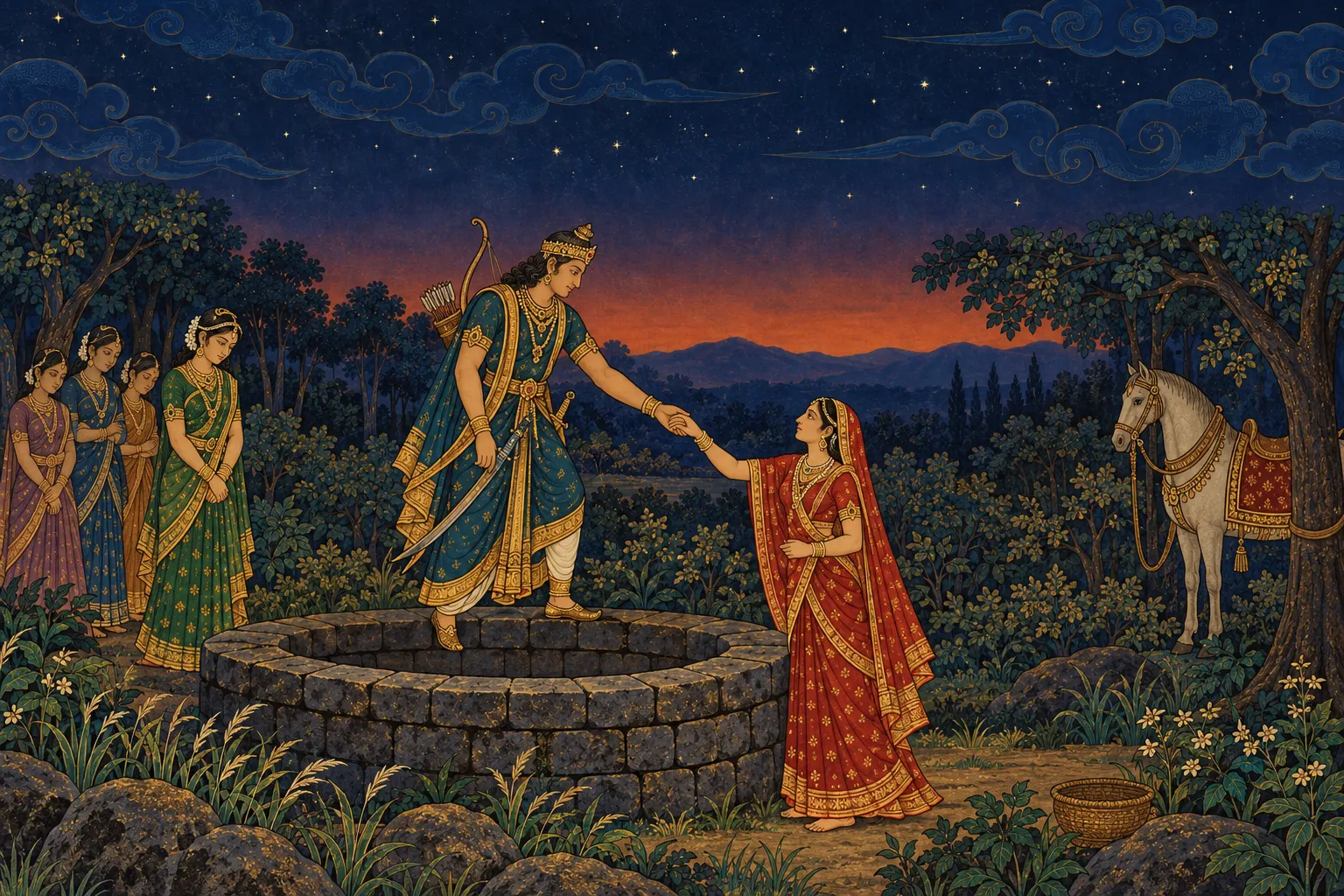
Just then King Yayati, son of Nahusha, came hunting into the same forest. He was thirsty and looking for water. He looked into the well, and inside it he saw a girl bright as a flame.
He called down to comfort her. "Lovely one, whose daughter are you? How did you fall into this well covered with grass? Tell me everything."
"I am the daughter of Shukra," she said, "who with his knowledge raises the Daityas killed by the gods. You do not know me yet. Here is my right hand, its fingers set with rings. Take it and lift me out of this well. I can see you are self-controlled, strong and renowned. Lifting me out is a deed worthy of you."
Yayati learned that she was a Brahmin's daughter, and so he took her right hand and drew her out of the well. Then he bowed to Devayani and went back to his capital.
Shukra Advises Her
Devayani sat weeping in the forest. Her maid Ghurnika came looking for her. "Go and tell my father everything," said Devayani, "and tell him I have made up my mind: I will never set foot in Vrishaparva's city again."
Ghurnika went trembling to the palace and said to Shukra, "Sir, Vrishaparva's daughter Sharmishtha has hurt Devayani."
Shukra was filled with sorrow for his daughter and went to look for her in the forest. When he found her he opened his arms and held her. "Every being receives joy and sorrow according to its deeds," he said. "It seems Sharmishtha has taken revenge on you for something you did."
"Revenge or not," said Devayani, "listen to what Sharmishtha said. She called me a singer in the Daityas' palace. She said I am the daughter of one who praises and begs, while she is the daughter of the king whom your father praises and from whom your father takes gifts. Her eyes were red with anger and her face flushed with pride. I told her that if I am the daughter of one who praises and begs, then I too would try to please her in the same way."
"My daughter," Shukra replied, "you are no beggar's child. You are the daughter of a man whom everyone honours and praises. Vrishaparva knows my power is my penance, and so do Indra and Yayati."
Then he explained, "Devayani, one who calmly bears another's harsh words conquers everything. The wise say that a person who can control his anger is like a skilled charioteer who knows how to rein in his horses. One who throws off anger as a snake sheds its old skin is a true man. Of one who performs many horse sacrifices every month for hundreds of years and one who is angry at no one, the second is greater."
Devayani's Answer
Devayani heard her father but did not agree. "Father," she said, "I know one should think of cause, effect, and strength and weakness. But since childhood I have also learned that one should live among people of good character, not among people whose minds are heavy with sin. Sharmishtha's words still burn within me, like fire kindled by two pieces of wood. I have no wish to live. A person who wants his own good should not live among such low people. Even an enemy of great power is not lower than the one who sits fallen before his own foe."
Shukra and Vrishaparva
Then Shukra, best of Brahmins, went to Vrishaparva, who sat on his throne. Without worrying about the consequences, he said:
"King, sin does not bear fruit at once, as a cow does not bring forth a calf the moment she conceives. But it does bear fruit, as a heavy meal gives pain in the belly after a while. You had Kacha, grandson of Angiras and son of Brihaspati, killed. His remains were mixed into wine and given to me to drink. My pupil was blameless, pure, humble and not fit to be killed. For his killing, and for the hurt to my daughter, you will reap the result. Today I leave you and your family. You do not restrain your proud, ill-mannered daughter, so from today I will count you a Daitya who talks much and does not keep his word."
"Bhargava, I do not believe you are dishonest," said Vrishaparva. "I know your truth and your penance. Be pleased with me. Except for you, there is no one to protect me. If you leave me today I will drown myself in the sea."
"Drown yourself in the sea or wander the world," said Shukra. "My daughter is very dear to me and I cannot bear to see her hurt. Please Devayani. Wherever she goes, I will settle. If you please her, I will guard you as Brihaspati guards Indra."
"The elephants, chariots, horses and all the wealth of the Asuras are yours, Bhargava," said Vrishaparva. "And all that I have besides."
"I will think of myself as master of the Daityas," said Shukra, "when Devayani is pleased."
The Princess Becomes a Maid
Shukra went to Devayani with Vrishaparva and said, "Today your word has come true. I am called master of all."
"Father," said Devayani, "if you are master of the king's wealth, I will believe it when the king himself tells me."
"Devayani," said Vrishaparva, "whatever you wish, however hard, I will do it."
"Then I want Sharmishtha to be my maid, with a thousand girls," said Devayani. "And wherever my father marries me, she must go with me."
"Nurse," said Vrishaparva, "go and bring Sharmishtha to me. I will do what Devayani wants."
The nurse went to Sharmishtha and said, "Rise and save your people from calamity. Because of you Shukra is about to leave his pupils, and Devayani's wish rests on you. You have become her maid."
"I will do what she wants," said Sharmishtha. "I don't want Shukra to leave in anger, and I don't want Devayani to hold what I did against me."
At her father's order, Sharmishtha went to Devayani in a palanquin with a thousand maids. "Devayani," she said, "I have come with a thousand maids to serve you. Wherever your father marries you, I will go with you."
"I am the daughter of one who praises and begs," said Devayani. "You are the daughter of one who is praised. How can you be my maid?"
"It is my duty to bring comfort to my people in distress," said Sharmishtha. "So I will be your maid, and I will go with you wherever your father marries you."
Then Devayani said to her father, "Father, now your knowledge is proved fruitful and unfailing. I will enter the city." Shukra went happily into the city with her.
Yayati Returns
A few days later Devayani went again to the same forest, with Sharmishtha and two thousand maids. Yayati had also come hunting there. He saw two beautiful women surrounded by thousands of others, and he asked, "Who are you two?"
"King, I am the daughter of Shukra, teacher of the Asuras," said Devayani, "and this is my chief maid Sharmishtha, daughter of Vrishaparva, king of the Asuras. Wherever I go, she goes with me."
Yayati was amazed that an Asura king's daughter was a maid. "All this is Brahma's design," said Devayani. Then she asked him for his name and family.
"I studied all the Vedas in my student years," said Yayati. "I am King Yayati, son of Nahusha. I came hunting and wandered here to quench my thirst. Command me as you wish."
"Friend, I am at your service," said Devayani, "with Sharmishtha and my maids. Be my lord."
"You are the daughter of the Brahmin Shukra, and I am a Kshatriya," said Yayati. "A Brahmin's anger is more fearful than a serpent's poison or a blazing fire. A snake bite or a blow takes one life, but a Brahmin's anger devastates a whole country. So I cannot take you without your father's leave."
"King, when my father gives me to you of his own will, then you will accept me," said Devayani. "And I have taken you as my husband already, because you took my hand in the well. There is no question of asking now."
The nurse went and told Shukra everything. Shukra went to the king. Yayati folded his hands and bowed to him, and Shukra spoke to him sweetly. Devayani said to her father that this king had taken her hand in the well and that she would marry no one else. Shukra said to Yayati, "My daughter has chosen you as her husband. Accept her as your chief queen." Yayati asked whether this marriage might bring on him the fault of crossing the order of classes. Shukra assured him that he freed him from that fault. He gave leave for Devayani to become his lawful wife, and said, "Honour Sharmishtha, but never call her to your bed." In this way, with Shukra's leave, Devayani and Yayati were married.
Yayati took Devayani to his capital, which was like Indra's city, and on the queen's advice settled Sharmishtha with her thousand maids in a separate house in the Ashoka grove, giving her clothes, food and ornaments.
For many years King Yayati enjoyed Devayani's company like a god. In time Devayani conceived, and after ten months she gave birth to a son.
Note: This chapter follows chapters 27 to the start of 31 of the Matsya Purana. The part where Shukra gives Devayani to Yayati is incompletely printed in the English translation; it has been matched against the Sanskrit text (30.30–37). The later episode involving Sharmishtha is not part of this retelling.
Source: The Matsya Purana — the English translation by a Taluqdar of Oudh, Sacred Books of the Hindus, vol. 17 (1916–17), Devayani: From the Well to the Palace