
Chapter 7
Harikesha the Yaksha
The Yaksha whose father drove him from home — and who became, in Kashi, a skeleton of bones and then king of Shiva's hosts
Harikesha the Yaksha is chapter 7 of Matsya Purana. Source: Matsya Purana, chapter 180. It is told in 5 scenes — The Yaksha Who Worshipped Shiva; His Father's Scolding; Penance in Kashi; Parvati and Shiva in the Forest; The Yaksha's Boon — followed by 10 quiz questions.
The Yaksha Who Worshipped Shiva
Now the Purana turns to another episode, to Kashi.
The sages said to Suta, "We have heard how Andhaka was killed. Now we want to hear the glory of Kashi. And how did Pingala become Ganeshvara, giver of food to all in Kashi, and guardian of the field?"
"There was a Yaksha named Purnabhadra," said Suta. "His son was Harikesha, virtuous and handsome. But from birth he was a devotee of Shiva. Rising or sitting, walking or sleeping, eating or drinking, his mind was on Shiva every moment. He bowed to Shiva and kept him in his heart."
His Father's Scolding
Harikesha's father Purnabhadra did not like this. "I do not accept you as my son," he said. "Your birth is a misfortune. This life does not suit a Yaksha family. We are Guhyakas, fierce and hard by nature. We hunt, we eat meat. Brahma did not give us the life you are living. It is not right to leave your own path and take another's. Give up this human-like feeling and follow your family's way, or I will think you are the child of men."
Harikesha said nothing. Then Purnabhadra went out quickly and told his son to leave home and go wherever he liked.
Penance in Kashi
At his father's word Harikesha left his home and relatives and went to Kashi. There he did severe penance. He stood with his eyes open, utterly motionless, his senses under control, like dry wood or stone.
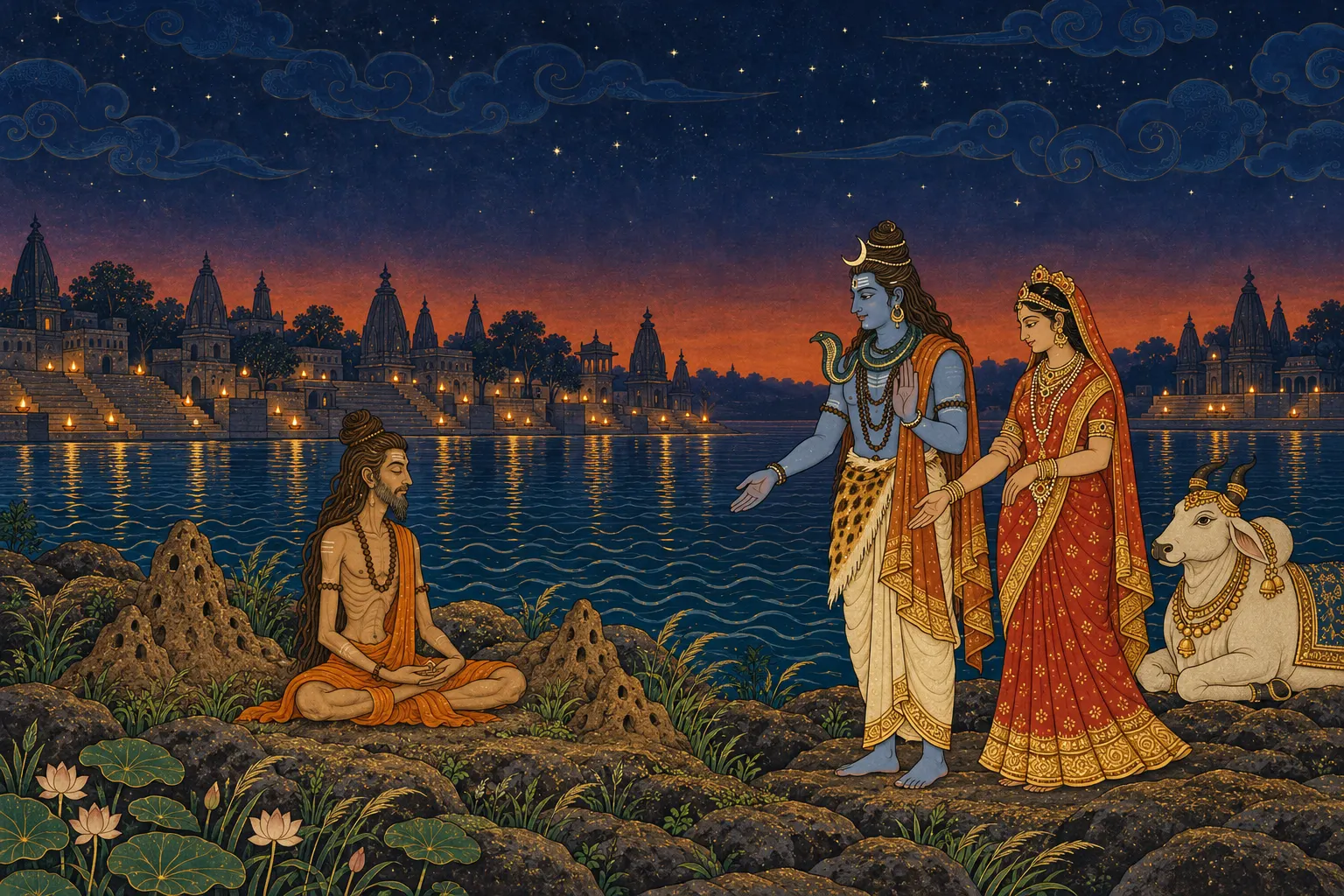
For a thousand divine years he stood like that. Anthills grew all round him. Ants and insects began to eat him. Little by little all his flesh and blood were gone. Reduced to little more than a skeleton, the devoted Yaksha still shone with the whiteness of a conch shell.
Parvati and Shiva in the Forest
In those days Parvati said to Shiva, "Lord, I want to see the woods, gardens and bowers, and to hear the glory of Kashi. Kashi is dearest to you, so its fruit must be very great."
Shiva took Parvati out of Kashi to show her the forest. "Look, dear, what a beautiful garden," he said. "This forest smiles with beds of flowers. Somewhere cuckoos are singing, somewhere peacocks are dancing, somewhere deer are running, somewhere lotuses bloom and bees hum. Somewhere Vidyadharas, Siddhas and Charanas sing, somewhere Apsaras dance. Ashoka, mango, punnaga and kadamba trees are heavy with flowers."
"Lord, you have shown me the beauty of the forest," said Parvati. "Now tell me the glory of Kashi, this Avimukta field. Even after hearing it I am not satisfied."
"This Kashi is my dearest place," said Shiva. "It gives liberation to all. It is the most secret of all secrets. My devotees live here. There are Siddhas here and ascetics with all kinds of marks, practising yoga. I will tell you why I live in this beautiful place, full of lotuses and served by Gandharvas and Apsaras. A devotee who meditates on me and offers all his deeds to me finds here a liberation he cannot find anywhere else."
"I never leave this field," he said, "and I never shall. That is why its name is Avimukta."
Shiva said that what one does not get even by bathing at Naimisha, Kurukshetra, Gangadvara and Pushkara, one gets here. At Prayaga too there is liberation, but Kashi is placed above even that. He named the sage Jaigishavya, who reached the highest accomplishment here. He said that Kubera had become almost his servant, and that later Samvartana, the great sage Vyasa and King Alarka would also come here. Those who die here do not have to return to this world. What a man gets through thousands of births of yoga, he gets here by dying.
The Yaksha's Boon
Then Shiva spoke to Parvati about that Yaksha. "This devotee of mine is now free of sin," he said, "and he will get a boon from me." And he went with Parvati to the place where the Yaksha was doing penance.
Parvati saw his body, in which only white shining bones were left. "The gods say truly that you are very hard," she said to Shiva. "You do not give boons even to such a devotee. In such a holy place it is not right that this Yaksha's son should suffer. Give him his boon quickly. Sages like Manu have said that good comes from Shiva whether he is pleased or displeased."
Then Shiva went to the Yaksha, who bowed. Shiva gave him divine sight, and with it the Yaksha saw Shiva and all his attendants and was very glad. "I give you a boon," said Shiva. "You will see the three worlds, and your body will become like mine. Look at me, and be free of grief and worry."
The Yaksha put his head at Shiva's feet and said, "Have mercy on me." "I have given you the boon," said Shiva.
"Then give me this boon," the Yaksha said again. "May my devotion to you never waver. May I be called lord of your hosts for ever, and a giver of food to the world. And may this holy ground of Avimukta always be before my eyes."
"Yaksha, be free from the pains of old age, disease and death," said Shiva. "You will be Ganapati, lord of the hosts, giver of wealth, worthy of everyone's worship and unconquered. You will be the giver of food to all. You will be guardian of the field, and you will have all the powers of yoga. You will be very brave, righteous, a knower of Brahman, dear to me, three-eyed and holding a mace. Udbhrama and Sambhrama will be your attendants, and they will always obey you."
So Mahadeva made that Yaksha lord of his hosts and went back with him.
Note: This chapter follows chapter 180 of the Matsya Purana. The chapters after it are on the glory of Kashi and Avimukta in detail, but they are chapters of praise, not story, so they are not taken here.
Source: The Matsya Purana — the English translation by a Taluqdar of Oudh, Sacred Books of the Hindus, vol. 17 (1916–17), Harikesha the Yaksha