
Chapter 1
Manu and the Fish
A tiny fish that fell into a king's hand and grew until it filled the sea — and told him a flood was coming
Manu and the Fish is chapter 1 of Matsya Purana. Source: Matsya Purana, chapters 1–2. It is told in 6 scenes — The Question at Naimisharanya; The King's Penance; A Fish in the Water; The Fish's Warning; Who Would Survive; The Boat and the Rope — followed by 10 quiz questions.
The Question at Naimisharanya
A long sacrifice had just ended at Naimisharanya, and the sages sat together telling stories from the Puranas. Suta was among them. Shaunaka and the others turned to him and said, "Tell us once more those nectar-sweet tales you told before. We never tire of them."
They asked, "How did Brahma make this world? Why did Vishnu take the form of a fish? Why does Shiva carry a bowl made of a skull?"
"Listen, then," said Suta. "I will tell you the Matsya Purana, which Vishnu himself spoke in the form of a fish. And the story begins at the moment the fish first appeared."
The King's Penance
In very ancient times there lived a king named Vaivasvata Manu, the Sun's son and the first king of the solar line. He handed his kingdom to his son and went to do penance on a peak of the Malaya hills.
The Purana says that neither sorrow nor happiness could shake Manu's composure. Whatever life brought him, he remained steadfast. His penance lasted a very long time. In the Purana's words, a million years went by before Brahma, pleased, said to him, "Ask."
Manu bowed and asked for one boon only. He did not ask for wealth, or heaven, or a kingdom. "When the hour of dissolution comes," he said, "let me have the power to protect every creature, those that move and those that do not."
"So be it," said Brahma, and vanished. The gods showered flowers from the heavens.
A Fish in the Water
Some time later Manu was in his hermitage, offering water to his ancestors. As he poured it out, a tiny fish slipped into his palm along with the water. The Purana calls it a *shaphari*, a very small, restless fish.
Manu felt pity. "If I put it back in the river," he thought, "a bigger fish will eat it." So he dropped it into his water pot.
A day and a night passed, and the fish grew until it was sixteen finger-widths long. It began to thrash in the pot and cried out, "I have come to you for shelter. Save me."
Manu lifted it out and put it in a big jar. In a single night it grew three cubits long, and the same cry came again: "Save me, I am in your care." He moved it to a well, but the well soon proved too small, so the king set it in a pond. In the pond it grew a *yojana* long, about eight miles. Once again, it pleaded with Manu to save it.
Manu put it in the Ganga, and even there it kept growing. Then he set it in the sea. And in the sea it grew until it very nearly filled the whole ocean.
Now Manu was afraid. He understood that this was no ordinary fish. With folded hands he asked, "Are you a king of the Asuras? Or are you Vasudeva himself? Who else could take so huge a form? O Keshava, I know you now. You are playing tricks on me in the shape of a fish. O Hrishikesha, Lord of the world, I bow to you."
The Fish's Warning
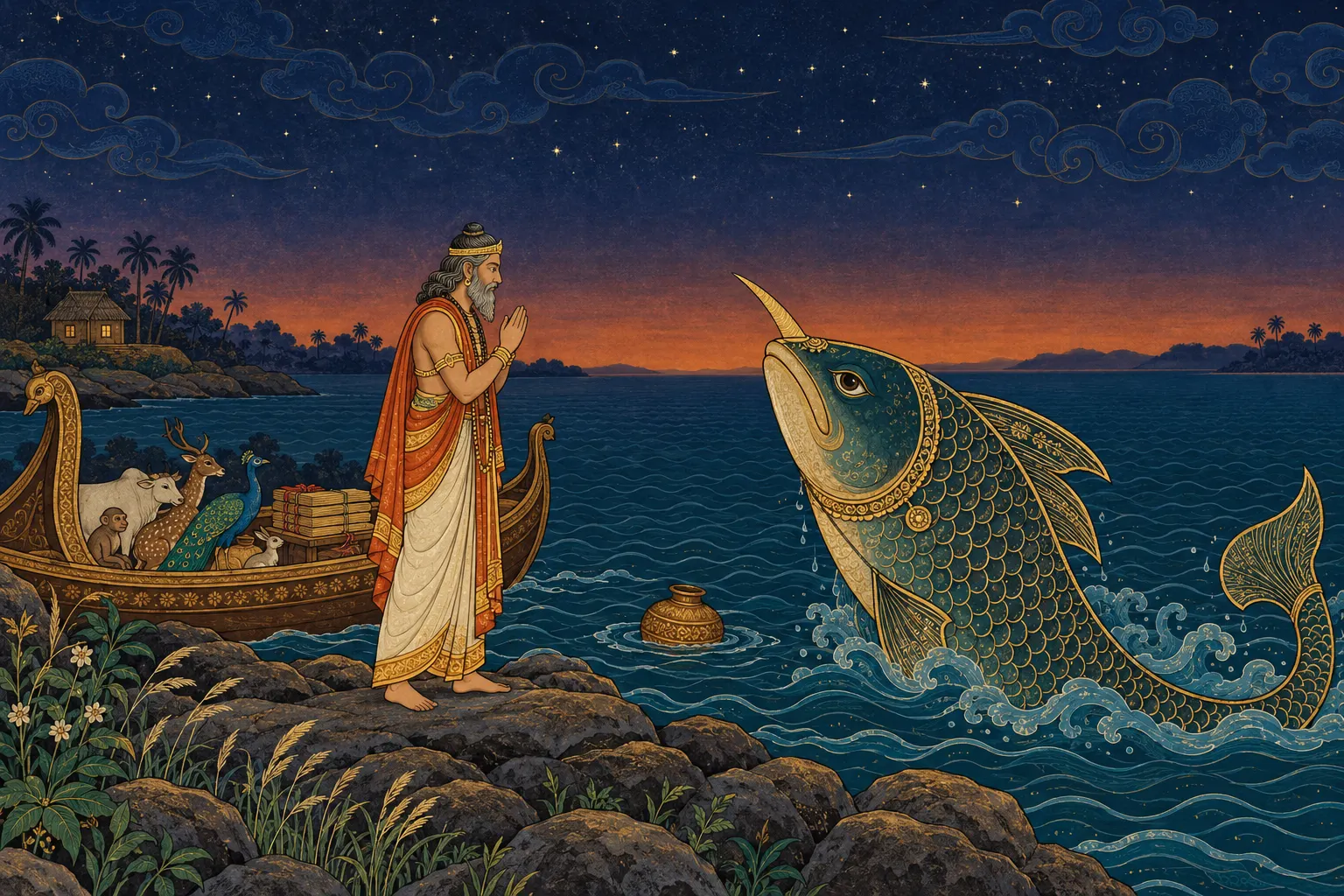
"You have known me rightly, sinless one," said the fish. "In a few days this whole world will be drowned, mountains and forests with it. The gods have built a boat to save living things from that calamity. Into it will go creatures born of sweat, creatures born of eggs, those that sprout from the earth, and those born of the womb. King, be the guardian of that boat. When the wind begins to carry it off, tie it to my horn."
Manu asked when that time would come and how it could be survived. And at the end he asked, "When shall I see you again, Lord?"
The fish told him that from that day no rain would fall for a hundred years, and a terrible famine would come. Then the sun's seven rays would burn seven times hotter and scorch every creature. From below, Shesha would breathe fire from his thousand mouths, and fire would break from Shiva's third eye. The three worlds would turn to ashes, and the stars and planets with them.
From that heat seven clouds would rise, Samvarta, Bhimanada, Drona, Chanda, Balahaka, Vidyutpataka and Shona, and they would rain until the seven seas became one. The whole earth would be a single sheet of water.
"Then," said the fish, "put the seed of creation and the Vedas into the boat, and tie the boat to my horn with the rope I will give you. By my power, all will be saved."
Who Would Survive
The fish named those who would survive when everything else was destroyed: "You, the moon, the sun, myself, Brahma, the holy river Narmada, the great sage Markandeya, the four Vedas, the Puranas, Shiva and all the sciences." The reign of Chakshusha Manu, he said, would end with this partial dissolution.
"And when the new creation comes after the flood," he added, "I will spread the knowledge of the Vedas again."
With that the fish vanished. Manu remained deep in meditation, awaiting the day of the great flood.
The Boat and the Rope
When the flood began, the fish appeared again, this time with a horn. At that very moment Shesha came before Manu in the shape of a rope. By the power of his yoga Manu gathered every kind of living thing and seated them in the boat. Then he tied the boat to the fish's horn with the rope, bowed to the Lord, and climbed in himself.
Here the Matsya Purana gives no account of the voyage. It turns straight back to Suta, who says to the sages, "Now hear the account of creation that the fish told Manu."
Manu had asked the fish how creation and dissolution happen, how the generations of humankind arose, what a *manvantara* is, what the lives of great men were like, what the way of giving is, how the ancestral offering is made, and how the classes and stages of life were divided. Everything said in answer is the Matsya Purana.
And so the whole Purana rests on one tiny fish and the plea it made from a palm: will you save me?
Note: This chapter follows chapters 1 and 2 of the Matsya Purana. The Purana gives no account of Manu's voyage; other traditions, such as the Bhagavata and the Shatapatha Brahmana, tell it in different ways. Only what this translation contains is given here.
Source: The Matsya Purana — the English translation by a Taluqdar of Oudh, Sacred Books of the Hindus, vol. 17 (1916–17), Manu and the Fish