
Chapter 2
Narasimha and Hiranyakashipu
The one who asked that he die neither by day nor by night, nor by any weapon — and a lion that walked into his court
Narasimha and Hiranyakashipu is chapter 2 of Matsya Purana. Source: Matsya Purana, chapters 161–163. It is told in 7 scenes — Eleven Thousand Years of Penance; The Gods' Plea; The Lion Form; Prahlada Sees the Truth; The First Blow; Omens and the End; The Hymn and the Return — followed by 10 quiz questions.
Eleven Thousand Years of Penance
The sages said to Suta, "Tell us how Hiranyakashipu was killed, and the glory of Narasimha."
"In the Satya age," said Suta, "the oldest forefather of the Daityas was Hiranyakashipu. For eleven thousand years he practised severe penance. He bathed by rule, stood neck-deep in water, kept silence and held his senses in check. The Purana says he was very humble. And Brahma was pleased."
Brahma came on his white swan, and with him came the twelve Adityas, the Vasus, Sadhyas, Siddhas, Maruts, Yakshas, Rakshasas, serpents, the directions, rivers, oceans, stars, planets and the seven sages. It was as if the whole world had come to see one ascetic.
"Man of fine vows," said Brahma, "I am pleased with your penance. Ask what you wish."
Hiranyakashipu chose his conditions carefully, determined to leave no possible way for death to reach him. "Let no god, demon, Gandharva, Yaksha, serpent, Rakshasa, man or Pishacha be able to kill me. Let the curses of sages never touch me. Let me not die by any weapon, by stone, by tree, by anything wet or dry. Let me die neither by day nor by night. And let me be the sun, the moon, the wind, fire, water, sky, stars and the ten directions, and anger, desire, Indra, Varuna, Yama and Kubera."
"I grant you all these boons," said Brahma. And he went back to his own world.
The Gods' Plea
When the gods, serpents, Gandharvas and sages heard what boons had been given, they hurried to Brahma. "By your boon this demon will kill us all," they said. "Please find some way. You are the root of everything, the maker of the gods and of the ancestors."
Brahma soothed them gently. "Penance must bear its fruit," he said. "But when his merit is spent, Vishnu will kill this demon."
The gods went back. And Hiranyakashipu, with his boons in hand, grew drunk with pride.
He began to torment the sages who were quietly following dharma in their hermitages. He conquered heaven and brought the three worlds under his hand. He even took the gods' share of the sacrifice for himself. The hermitages where good people lived were exactly where he threw all his force.
At last the Adityas, Sadhyas, Vishvadevas, Vasus, Indra, Yakshas, Siddhas and great sages went to Vishnu. "Narayana," they said, "we have come to you for shelter. Kill Hiranyakashipu and save us."
"Put away your fear and go back to heaven," Vishnu answered. "I will destroy this proud demon with all his followers and give you back the kingdom of heaven."
The Lion Form
Then Vishnu took hold of the sacred syllable Om, and with it went to the demon's city. His radiance was like the sun and the moon. He took the form of Narasimha, the lower half a man and the upper half a lion.
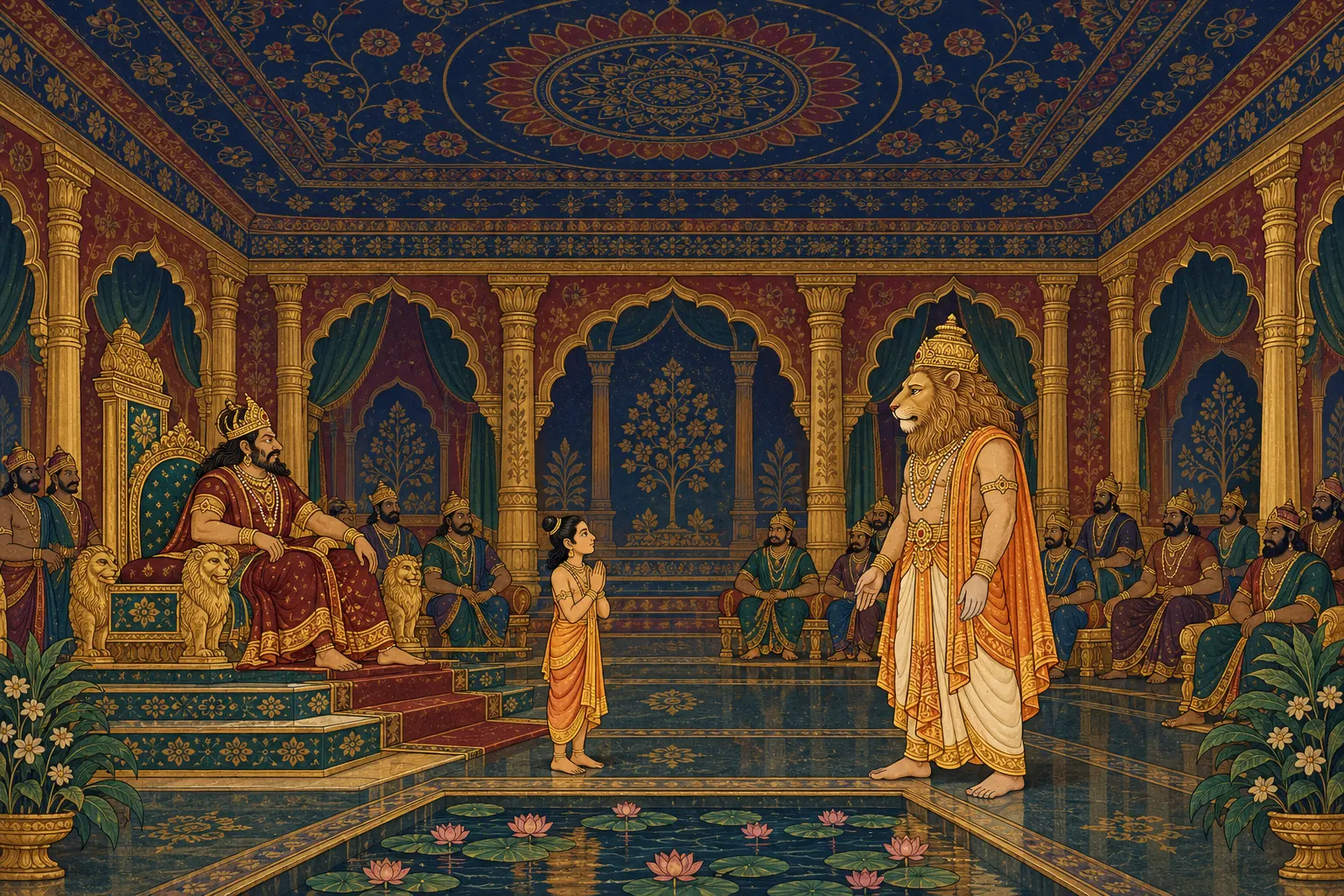
Before him stood Hiranyakashipu's magnificent royal court.
The hall was a hundred *yojanas* long and fifty wide. It moved through the sky and could go wherever it pleased. Within it there was no old age, no grief, no pain. There were pools made by Vishvakarma, golden trees set with jewels, awnings of blue, yellow, white and black, and flowering creepers that rippled like rows of clouds. There was no scorching sun, no cold, no hunger, no thirst. Swans, cranes and cuckoos sang. The hall outshone the sun and the moon with its own light.
In the middle, on a golden throne, sat Hiranyakashipu. Hundreds of women waited on him. Gandharvas sang, and Apsaras such as Vishvachi, Menaka, Rambha and Urvashi attended him. Thousands of the sons of Diti sat around him, with names like Bali, Virochana, Narakasura, Prahlada, Dashagriva and Ghatodara. All had won boons, all were strong, and none feared death.
The Purana says no one had ever seen or heard of splendour like his.
Prahlada Sees the Truth
And into that very court walked Narasimha.
The demons stared in astonishment at the towering figure, its body gleaming like a mountain of gold. But Prahlada, Hiranyakashipu's son, saw with his divine sight that this was no lion. As a coal lies hidden in ashes, Vishnu himself was hidden in the lion.
"Father, king, forefather of the Daityas," said Prahlada, "I have never heard of this shape, nor seen it. How strange it is! Where has it come from? That terrible lion form tells me it has come to destroy the demons."
Then he said, "Look, everything is within this form. All the gods, the oceans and rivers, great mountains like the Himalaya, the moon, the stars, the sun, the Vasus, Kubera, Varuna, Yama, Indra, the Maruts, Gandharvas, sages, serpents, Yakshas, Brahma and Shiva. All that moves and does not move is turning in his head. You are there too, and Jambha and all the Daityas, and I, and your hundreds of halls, and the three worlds. The whole universe is inside this form."
The First Blow
Hiranyakashipu heard him and did not understand. "Seize this strange lion," he told the Danavas. "If you cannot catch it, kill it where it stands."
The Danavas rushed at him. Narasimha gave a great roar and opened his mouth, and the hall fell to pieces. Hiranyakashipu advanced, boiling with rage.
He showered Narasimha with weapons, the way a man pours ghee onto a fire: the club, the discus of time, the Brahma weapon, the thunderbolt, the trident, the spear, the Pashupata, the Narayana weapon, and as many more as the Purana counts. As the summer sun covers the Himalaya with its rays, so he covered Narasimha. The Danavas hurled spears, nooses, swords, rocks and burning trees. Narasimha did not move one step. He stood as firm as Indra's thunderbolt.
The Danavas came in every shape, some like donkeys, some like crocodiles, snakes or vultures. They poured arrows on him, but nothing touched him. They threw blazing discs, and Narasimha caught them and swallowed them, and their glare went out like the sun behind a cloud. Hiranyakashipu hurled a thunderbolt as bright as lightning, and a single roar from Narasimha broke it, and it fell like a shooting star.
Then came rocks, then water, then fire together with wind. Indra put out the fire with rain. Then the demon spread a deep darkness over everything.
In the darkness the Danavas began to arm themselves again. But Narasimha blazed out like the sun, and they saw three lines on his forehead, like the mark of a trident, like the Ganga flowing in three streams. All the Daityas' illusions vanished.
Omens and the End
The Danavas ran to Hiranyakashipu. He was burning with rage and had made up his mind to destroy everything. Just then darkness covered the world, and winds as of the end of time began to blow. The sun turned pale. The moon went into eclipse with the stars. Meteors fell from the sky and clouds rained blood. Trees flowered and bore fruit out of season. The statues of the gods sometimes winked, sometimes laughed, sometimes wept. Rivers flowed backwards. And every sign said the gods would win and the demons were finished.
The whole world shook. Even thousand-hooded Shesha shuddered.
Then Hiranyakashipu bit his lip and rose. He took up his club and trident. The Purana says that with his stride he shook the Ganga, the Yamuna, the Godavari, the Kaveri, the Indus, the great mountains Meru and Mandara, and many countries. Roaring like clouds, he rushed at Vishnu.
In that moment Narasimha leapt, took the support of Om, and tore him apart with his sharp claws.
And the earth, time, the moon, the sky, the stars, the sun, the planets, the directions, the mountains, rivers and oceans were all filled with joy.
The Hymn and the Return
The gods, sages and Gandharvas together praised Vishnu. "You are Brahma, Rudra, Mahendra, the maker and the destroyer," said Brahma. "The wise call you the highest god, the highest mantra, the highest dharma, the highest Brahman, the highest state."
Brahma returned to his own world. Instruments sounded everywhere and Apsaras danced. Vishnu went to the northern shore of the Milk Ocean, set up his Narasimha form there, and then took back his old form. Seated on Garuda in a splendid eight-wheeled chariot, he returned to his own world.
Then Manu said to the fish, "I have heard the glory of Narasimha, but my thirst is not quenched. Tell me how creation was made in the lotus that grew from Vishnu's navel." And the fish answered, "This is what the sage Vyasa saw by his penance."
Note: This chapter follows chapters 161–163 of the Matsya Purana. In Prahlada's role in this episode he mainly recognises Vishnu and describes his vast form. The long story of his devotion and of his father's cruelty to him, which is in the Bhagavata, does not appear here.
Source: The Matsya Purana — the English translation by a Taluqdar of Oudh, Sacred Books of the Hindus, vol. 17 (1916–17), Narasimha and Hiranyakashipu