
Chapter 11
The Churning of the Ocean
A mountain for a churning-stick, a serpent for the rope — and when poison came out first, Shiva held it in his throat
The Churning of the Ocean is chapter 11 of Matsya Purana. Source: Matsya Purana, chapters 249–251. It is told in 6 scenes — How the Gods Became Immortal; To Bali; The Churning; What Came Out; Shiva's Throat; Nectar and Mohini — followed by 10 quiz questions.
How the Gods Became Immortal
The sages said to Suta, "We are not satisfied with hearing the glory of Narayana. Tell us, how did the gods become immortal? What penance did they do, whose grace did they win?"
"With the help of Narayana and Shiva," said Suta.
"It was long ago. When the gods and Asuras fought, the gods were killed in hundreds. But when Asuras were killed, Shukracharya, son of Bhrigu, brought them back to life with the Sanjivani mantra, which Shiva himself in his pleasure had given him. So the Asuras came forward fearless to fight the gods, and Shukra stood their dead army up again. Even Indra and Brihaspati were helpless, and the gods were deeply downcast."
Then on the peak of Mount Meru, Brahma spoke to the gods. "Follow my advice," he said. "Make peace with the Asuras for now. Then churn the Milk Ocean and bring out the nectar. Win Varuna to your side and then ask Vishnu for help. For the churning-stick take Mount Meru and for the rope the serpent Shesha. Make Bali the leader of the work, and ask Kurma, the tortoise form, in Patala to be the base."
To Bali
The gods went to Patala and said to the Asura king Bali, "Bali, be hostile no more, we are like your servants. We have to churn the Milk Ocean for nectar. For that Shesha must be the rope. By your grace we shall become immortal."
"Gods, I will do as you say," said Bali. "I can churn the Milk Ocean even alone. One who does not do good to an enemy who comes from afar is ruined in this world and the next. I will give you my full support."
Then all went to Mandara mountain. "King of mountains," they said, "we must churn the ocean for nectar. Help us." "I will be the churning-stick," said Mandara, "but someone must be my base, and Shesha must coil round me."
Then Kurma said proudly, "I could carry the three worlds on my back. What is this Mandara to me?" And Shesha said, "I can coil round the three worlds. What is it to coil round this mountain?"
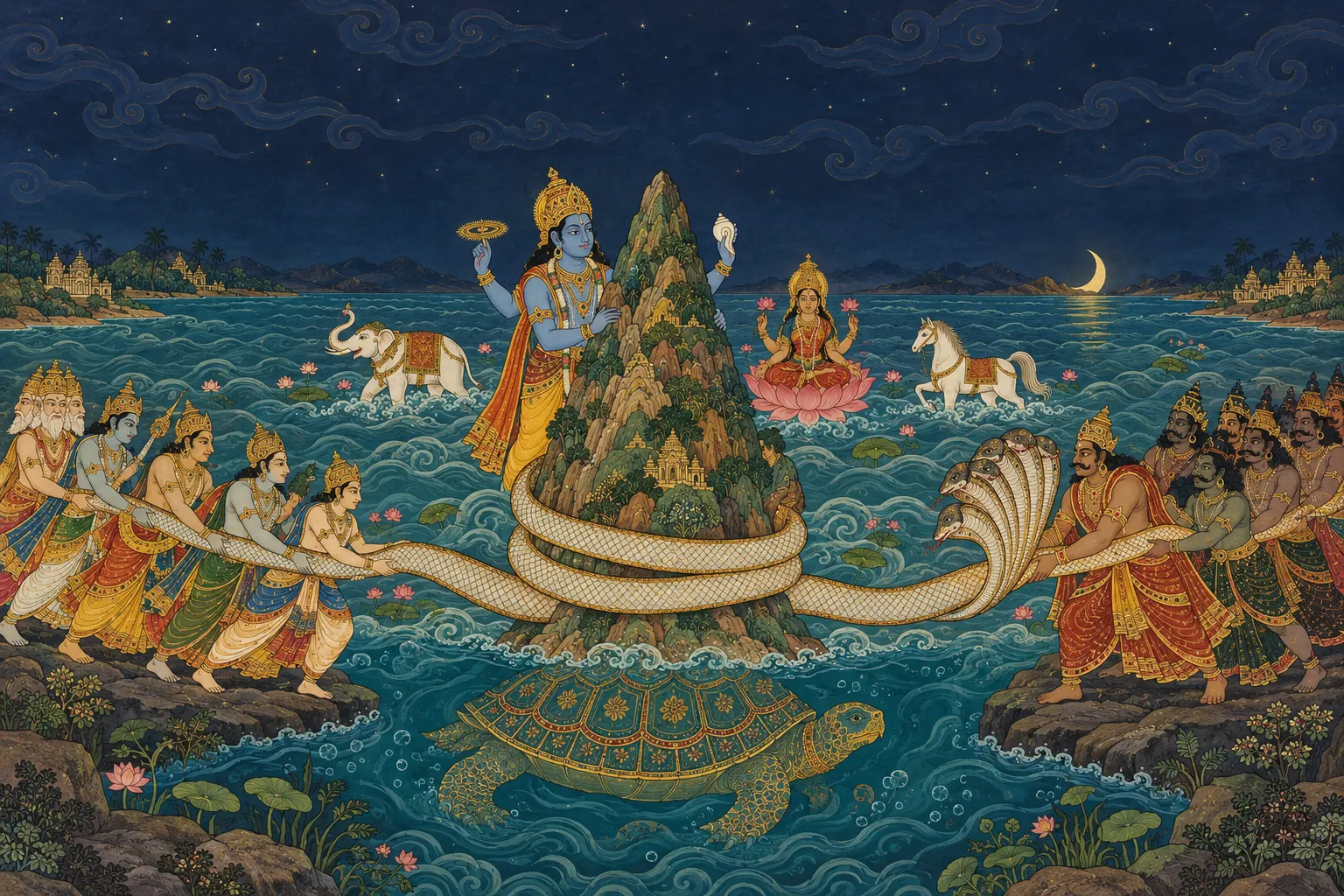
The gods and Asuras threw Mandara into the Milk Ocean. Shesha coiled round it. Kurma placed himself under the mountain as its base. But the mountain did not turn. It only floated.
Then the gods, with Bali, went to Vaikuntha. There Vishnu lay in deep meditation in yellow robes, Lakshmi at his feet, Garuda's wings fanning him. They folded their hands and praised him and said, "Lord, hold the mountain with one arm and lead the churning yourself."
"Did you have any trouble on the way?" said Vishnu. "Tell me why you came." "We are churning the ocean for nectar," said the gods, "but without you nothing can be done. If you lead, we will succeed."
The Churning
Vishnu came to the place where Mandara was floating. Shesha was wound round the mountain. The gods took the rope at the tail end, and Asuras like Rahu at the head end. Vishnu held Mandara with all four of his arms. Bali held Shesha's thousand heads with his left hand and his body with his right.
When all were tired, Indra sent rain and a cool breeze. Even so, when Brahma saw them slacken, he called out, "Keep churning! Those who persevere surely win the highest prosperity."
They put out all their strength again. As Mandara, a thousand *yojanas* high, turned, the elephants, boars, *sharabhas* and other animals that lived on it, and its trees, fell into the sea. The trees rubbed together and a fire like lightning rose and covered the whole mountain. Indra put it out with rain. The resin of trees and the juice of herbs fell into the sea, and by that potent sap the gods felt themselves almost immortal. As the mountain churned the depths, the waters turned milky. Soon, rich ghee began to rise from the swirling ocean.
The gods said to Brahma, "We are exhausted and the nectar has not come. Without Narayana we will not get it." Brahma prayed to Narayana. "I give strength to the weary," said Vishnu. "Turn Mandara steadily and carefully."
What Came Out
Then they churned with full force, and first from the ocean rose the moon with its cool rays. Then Lakshmi in white clothes, then goddess Sura. Then the horse Uchchaihshravas, then the divine Kaustubha jewel, which Vishnu took to his chest. Then the Parijata tree with golden clusters.
Then the sky filled with smoke, which spread everywhere and gave everyone a terrible headache. All sat down on the shore, half senseless. The smoke turned into the fire called Badavanala. Then mosquitoes, flies, scorpions and many kinds of poisonous creatures came out. Then deadly poisons like Halahala, so strong that their fumes scorched the mountain peaks.
Then the gods and Asuras saw a terrible blue form in the sea, tall as a mountain, roaring like clouds, breathing fire. This was Kalakuta. Its fumes made everyone afraid, and even Vishnu turned dark.
"Who are you?" Vishnu asked it. "Where have you come from? What do you want?"
Kalakuta thundered like a drum, "I am Kalakuta poison, born from the terrible churning of the sea. I was born to kill the gods and Asuras. Either they swallow me, or they go to Shiva."
Shiva's Throat
Hearing this the gods and Asuras, with Brahma and Vishnu in front, went to Shiva. Ganesha stopped them at Shiva's door and, with Shiva's leave, let them in. Shiva lived in a cave in golden Mandara, its steps studded with jewels and its pillars of cat's-eye gem.
They praised Shiva and said, "We churned the ocean for nectar. Kalakuta came out and will destroy us. We cannot swallow it. We have come to your shelter. Please drink it out of mercy."
"I will drink Kalakuta," said Mahadeva. "And if you have any other difficult task, I will do it too."
The gods and Asuras were filled with delight, tears in their eyes. Then Shiva set out on his buffalo, swift as the wind, and the gods and Asuras followed on their own vehicles. Shiva's matted hair had turned tawny from the fire of his third eye. Reaching the sea shore he saw Kalakuta.
He went to a shady spot and drank it holding it in his left hand. The gods and Asuras roared with joy and danced and sang. Brahma prayed. When the poison settled in Shiva's throat, everyone, including Bali, said, "Lord, the poison looks terribly beautiful on your lotus-white throat, like a garland of black bees. Let it stay there."
"Very well," said Shiva. "I will not let it go down. I will keep it in my throat." And he went home. The gods and Asuras began to churn again.
Nectar and Mohini
In the churning Dhanvantari, the physician and maker of Ayurveda, came out. Then wine, nectar, and the cow Surabhi, who removes everyone's fear. Vishnu received Lakshmi and the Kaustubha jewel. Indra received Airavata, and the finest horse went to Surya. Dhanvantari was accepted as the giver of health. Varuna took the umbrella that emerged from the ocean, Indra received the earrings, and Vayu received the Parijata tree.
After this Dhanvantari appeared in a beautiful form holding a white water pot full of nectar. The moment the nectar appeared, gods and demons alike cried out, "It belongs to us!" Then Vishnu took the form of an enchanting maiden. He bewildered the Asuras, and in their confusion they placed the pot of nectar in Vishnu's hand and ran to fight the gods. Vishnu cleverly set the pot before the gods, and the gods began to drink the nectar.
An Asura named Rahu took the form of a god and sat down to drink with the gods. The Sun and Moon pointed him out to the gods. The nectar had just reached Rahu's throat when Vishnu cut off his head with his discus. The head of the mountain-like Asura fell and shook the earth, but the nectar was already in his throat, so the head stayed alive and became immortal. That is Rahu. Since then Rahu is the enemy of the Sun and Moon and takes revenge on them even today at eclipses.
Then Vishnu gave up the maiden's form and struck the Asuras with his weapons. The battle raged until evening. Then Nara and Narayana came to the battle. Narayana saw the bow in Nara's hand, remembered his Sudarshana discus, and at once Sudarshana came down from heaven. Narayana sent it against the Asuras, who were beaten and fled.
The gods worshipped Mount Mandara and put it back in its place with sounds of joy. Gladly they went back to their worlds, having put the nectar most carefully in Vishnu's charge.
Note: This chapter follows chapters 249 to 251 of the Matsya Purana. The churning is also in the Bhagavata, Vishnu Purana and Mahabharata, with a slightly different order and details; here, for example, Mandara is the stick and Kurma is the base under the mountain. In the original, during the churning there is an account of creatures dying and wine being made from their remains, which is left out here.
Source: The Matsya Purana — the English translation by a Taluqdar of Oudh, Sacred Books of the Hindus, vol. 17 (1916–17), The Churning of the Ocean