
Chapter 8
Tripura: Three Cities and One Arrow
Three cities floating in the sky that only one arrow could bring down — and Shiva wept after he loosed it
Tripura: Three Cities and One Arrow is chapter 8 of Matsya Purana. Source: Matsya Purana, chapters 129–140. It is told in 11 scenes — Three Ascetics; Three Cities; Maya's Dream; To Shiva; The Chariot of the World; Narada Comes; The First Battle; The Well of Nectar; The City in the Sea; One Arrow, and Shiva's Tears; What Was Left of Maya's House — followed by 10 quiz questions.
Three Ascetics
Now the story turns to Shiva's most famous war.
The sages asked Suta, "Why is Shiva called Tripurari? How was the fort of Tripura built, and how was it turned to ash by a single arrow?"
"Long ago," said Suta, "there was a Danava named Maya. He had a wonderful power of craft, called *maya*. Beaten by the gods, he began severe penance. Two other Danavas joined him, Vidyunmali and Tarakasura. The fire of the three grew so great that they looked like three fires, or like the three worlds themselves. In winter they stood in water. In summer they sat with fires burning around them and the sun blazing overhead. In the rains they stood on one leg in the open sky. They ate roots and fruits, worshipped with flowers, and took food only every other day."
The three worlds began to scorch in the heat of their penance, and Brahma appeared. "Children, I am pleased," he said. "Ask what you wish."
"In the old Tarakamaya war the gods beat us and killed us without mercy," said Maya. "Since then they bear us enmity. We fled and wandered, and found no shelter anywhere. We want to build a fort that they cannot break."
Brahma granted the boon, and vanished like wealth found in a dream.
Three Cities
Maya made his plan. "I will build a fort that no god can bring down even with a single arrow," he thought. "There will be three cities, each a hundred *yojanas* long and a hundred wide. They will be built in the Pushya yoga. And whenever the moon, the Pushya star and these three cities come into one line, whoever seizes that very moment can bring them down with a single arrow. With myself, Taraka and Vidyunmali inside, who but three-eyed Shiva can destroy these cities?"
He built the fort. It had assembly halls, broad roads and lanes, a temple of Shiva, ponds and stepwells, gardens. The cities moved so high that they were like Mandara and Meru. They had three walls, one of gold, one of silver and one of iron. Each fort had hundreds of gates with flags flying. From the houses came the sound of bells and the smell of flowers.
When Diti's strong sons heard that Maya had built such a city, they came in hundreds and thousands to live there. The three cities filled up with Asuras. Maya met everyone's wishes by his craft.
Maya's Dream
One morning Maya sat in his hall on a golden throne, with Taraka and Vidyunmali on either side. "Last night I had a terrible dream," he told the Asuras. "Four women, three of them terrifying and blazing with anger, entered Tripura. They began to torment the people and entered into the bodies of the Asuras. The whole city was drowned in darkness and all of you, with your houses, sank into the sea. I saw an owl, a fair woman on a donkey, and a man with a red mark on his forehead, three-eyed and four-footed. The man was chasing the woman. Then I woke."
"I do not know what disaster this dream means," he went on. "But if you take me as your king, put away jealousy, desire, anger and envy, hold to truth and self-control, live like sages and worship Shiva. Perhaps these will turn the evil aside. I see plainly that three-eyed Rudra is angry with us."
But hearing this the Asuras only grew angrier. The Purana says they were already walking towards their ruin. They gave up the path of dharma. They began to hate Brahmins, left off worship, left off honouring their teachers, and quarrelled with one another. Even though Maya forbade them, they would not stop. They laid waste gardens like Nandana, broke the sages' hermitages, and destroyed the dwellings of the gods.
To Shiva
The world shook with fear. The Adityas, Vasus, Sadhyas, Maruts and ancestors went to Brahma. "The Danavas of Tripura, protected by your boon, are tormenting us," they said.
"The boon I gave Maya has now run out, and his end is not far," Brahma said. "This city will not fall to showers of arrows, only to one arrow. And I see no one among you who can bring it down with one arrow. Only Shiva can do this, who overturned Daksha's sacrifice. Go to him."
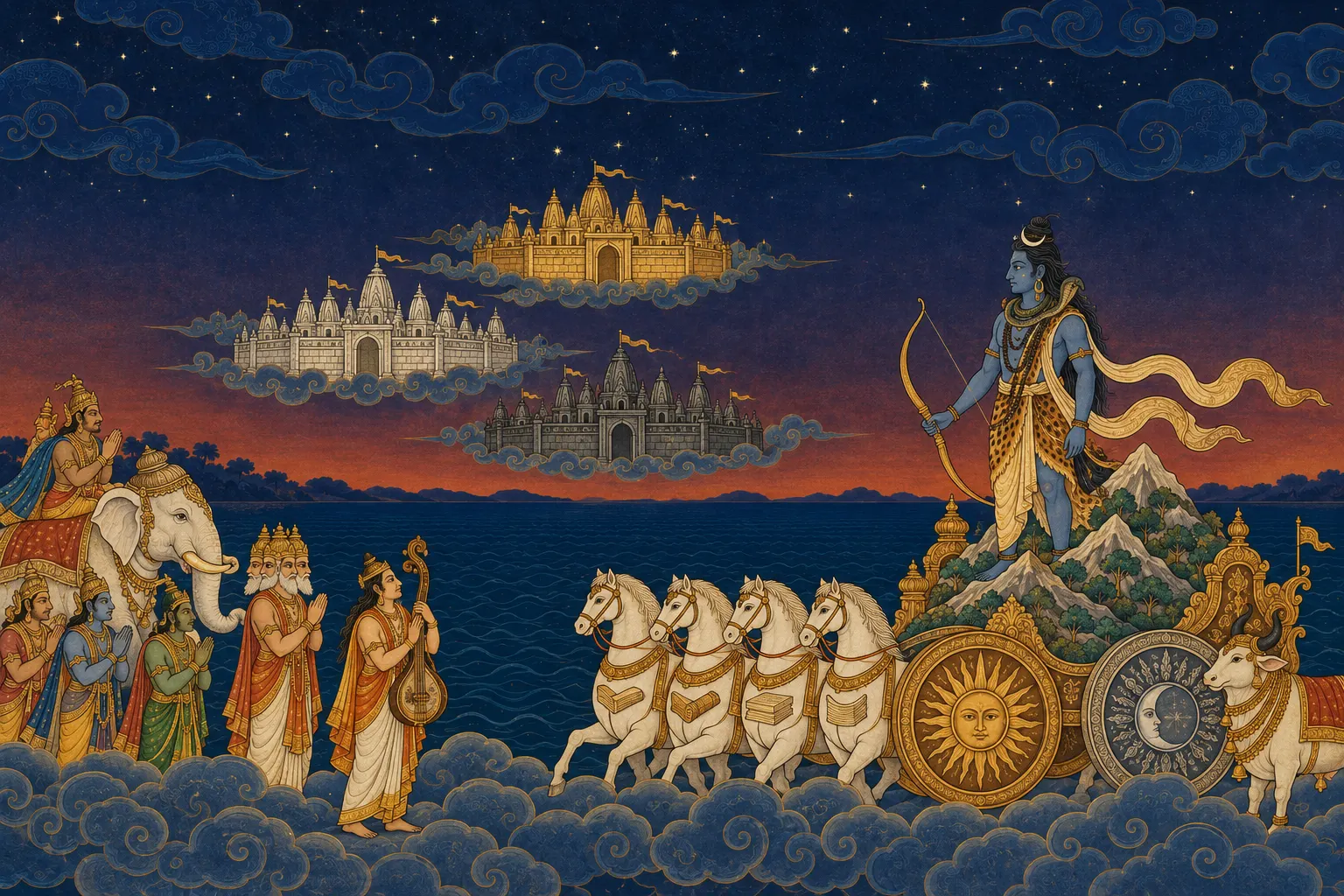
They all went to Kailasa. They saw Shiva sitting with Parvati and Nandikeshvara, in radiance like a thousand suns, with the moon on his forehead and three eyes. The gods praised him.
"What is the cause of your trouble?" said Shiva. "Tell me, I will do it all." "Maya has built Tripura, and the Danavas there hold us as slaves," they answered. "They have laid waste Nandana, taken our horses, and our chariots and elephants as well."
"Put away your fear," said Shiva. "I will turn Tripura to ash. But you must make a chariot for me."
The Chariot of the World
The gods quickly built the chariot and put the whole creation into it. The earth became its base, Mount Meru its seat, Mandara its axle. The sun and moon became its wheels, one of gold and one of silver, and the two fortnights their rims. The four Vedas became the four horses. Rivers like the Ganga, Indus, Sarasvati and Sarayu became the poles of the chariot. Serpents like Vasuki became arrows. Nandikeshvara sat on his bull holding the staff of the banner. Shukra and Brihaspati looked after the wheels, and Shesha guarded the chariot. Indra came on his elephant, Kubera on his serpents, Yama on his buffalo. Shiva's hosts, the Pramathas, like mountains and fire, followed behind.
When Shiva took his seat, the hosts shouted, "Well done, well done!"
Narada Comes
In Tripura bad omens were already appearing. Just then the divine sage Narada arrived. All the Danavas stood to greet him, washed his feet, and offered him durva grass, rice, honey and milk.
"Sage, terrible signs are appearing in our city," said Maya. "Without any wind, banner-poles break and flags fall, courtyards and gates tremble as if in an earthquake. From every side we hear 'kill, cut.'"
"Hear the cause of these omens," said Narada. "Dharma means that which holds up. Whoever abandons dharma is surrounded by trouble. Shiva is coming towards your city on his chariot, which holds all the worlds. If you want good, come to his shelter with your children and family."
Having said this, Narada went back to Mahadeva.
"Do not fear," Maya told the Asuras. "We are born of heroes, we have sons and grandsons, and we have done our work. Now fight the gods. If we win we get heaven and Indra's kingdom." Then he went with a heavy mind to his palace, bathed, worshipped Shiva and asked his shelter. The Purana says that Shiva granted that wish.
The First Battle
The gods and Pramathas advanced on Tripura. Indra's army roared like clouds. The Daityas came out of the city. Arrows flew from both sides. The Asuras cried, "Victory to Taraka!" and the gods cried, "Victory to Indra! Victory to Shiva!"
The Pramathas pushed the Danavas back. Vidyunmali struck Nandi, but Nandikeshvara struck him down with a spear. Tarakasura came like a mountain and began to crush the gods' army. Maya saw that his army was tiring and told Taraka to withdraw, and they all went into the city.
In the city Maya thought, "No fort is so strong that it can resist Time. Only Mahadeva is beyond Time. But I will try one thing."
The Well of Nectar
By his craft he made a huge well, sixteen miles long and eight wide, with steps, filled with water clear as moonlight and sweet as nectar. Lotuses grew on it with swans floating, and golden birds sang. He bathed the body of Vidyunmali in it, and he rose up alive, like a dying flame when ghee is poured on it.
As he rose Vidyunmali asked, "Where is Shiva? Where is Nandi?" Maya embraced him and said, "Without you I want neither kingdom nor life. This well brings the dead Danavas back to life." The Danavas came out to fight again, and whoever fell was thrown into the well and returned with a shining body. Their cry was: "Fight, don't fear, the well will bring the dead back to life!"
Shankukarna told Shiva, "Lord, the Danavas die again and again and rise again, like dry crops turned green with water. There is a well of nectar in their fort."
Just then the earth shook under the weight and Shiva's chariot began to sink. Shiva and Brahma were distressed. Brahma got down and by his power raised the chariot. Vishnu in yellow robes became a bull and lifted the chariot with his horns, as a good son lifts his family.
Then Vishnu in the form of a bull entered the city and drank all the nectar in the well, and left it empty as the sun drives away darkness. Then he came back and bellowed before Shiva.
Now the Asuras could not rise again after dying. Struck by the Pramathas, they fled and went inside the city.
The City in the Sea
When the guards told Maya that some god in the form of a bull had dried the well, Maya cried, "Alas, we are ruined!" He lifted the city and carried it into the sea. He thought, "The sea will check Shiva's army, and we will fight there."
Shiva said to Brahma, "Take the chariot to where the Danavas have gone." The gods lifted the chariot and weapons and came to the western sea. There the battle began again and the water of the sea turned red. Indra held the eastern gate and Skanda the northern. Tarakasura was killed.
Then Maya said to the other Danavas, "The moment when the moon and the Pushya star come into line with Tripura is the one I had to ask for in the boon, because in it a single arrow can bring this fort down. If Shiva cannot shoot in that moment, Tripura will never fall. So let us play such a trick that they do not get that moment."
That night the moon rose and there was singing and music in the Danavas' houses. The Purana says it was their last night.
One Arrow, and Shiva's Tears
In the morning the gods' army surrounded the city again. Shiva advanced with Indra, Varuna and Kubera. Vidyunmali fought Nandikeshvara and was finally struck down by Nandi's spear. Maya troubled many gods with his craft, but under the gods' blows the Danavas fled back into the city.
At that moment the Pushya star came over Tripura along with the moon. The moment they had waited for had come. Three-eyed Shiva loosed the arrow made of the power of three gods and three fires. The sky turned red as molten gold.
And as soon as he had loosed it, Shiva groaned, "Alas, shame on me!" and began to weep. Nandikeshvara asked, "Lord, why are you weeping?" "My devotee Maya will perish today," said Shiva.
Hearing this, Nandikeshvara dashed like the wind, entered the city before the arrow reached it, and said to Maya, "The time of the city has come. Leave with your house and your people." That devotee of Shiva came out.
Then the arrow burned the three cities as fire burns a heap of straw. The palaces, gates and gardens burned and fell into the sea with a great roar. Tall houses broke like mountains and went into the water. The Purana says Tripura was now only a name.
What Was Left of Maya's House
Maya's own house was saved with great difficulty and settled in the sea. When Indra heard this he cursed it: "The house of Maya will never be safe; like fire it will not be fit to live in." The Purana says that people of conquered countries still see that remnant.
Maya prayed to Shiva for a direction in which to live, and Shiva made a new direction for him. Indra grew calm and went back to his own world. The gods and Pramathas held each other's hands and danced, bowed to Brahma and Shiva, and returned to heaven.
Suta said that whoever reads or hears this tale of victory will win success in all his undertakings by Shiva's grace.
Note: This chapter follows chapters 129 to 140 of the Matsya Purana. The burning of Tripura is also told in the Shiva Purana and elsewhere; here Maya's dream, the well of nectar, Vishnu as the bull and Shiva's weeping are taken from the Matsya Purana's text.
Source: The Matsya Purana — the English translation by a Taluqdar of Oudh, Sacred Books of the Hindus, vol. 17 (1916–17), Tripura: Three Cities and One Arrow