
Chapter 6
Yayati's Fall and Ashtaka
A king falling from heaven, and the gift of four kings that he refused to take
Yayati's Fall and Ashtaka is chapter 6 of Matsya Purana. Source: Matsya Purana, chapters 35–42. It is told in 7 scenes — Penance in the Forest; Heaven and Indra's Question; The Pride That Cost Him Heaven; A Voice from Below; A Tour of Worlds; Four Kings, Four Gifts; Golden Chariots — followed by 10 quiz questions.
Penance in the Forest
Having handed the kingdom to Puru, Yayati went to the forest as an ascetic. He gave his other sons different offices of the kingdom, and himself lived on fruits and roots. With his mind mastered and his anger held back, he kept his fire-rite and gave water to the gods and ancestors by rule. Any guest who came he gave forest fruit, and he himself ate the grains gleaned from harvested fields. So he spent a thousand years.
Then for three years he drank only water and kept silence. Then he sat among fires. And for six months he stood on one leg. The power of his penance became known even in heaven.
Heaven and Indra's Question
After his death Yayati reached heaven. The Sadhyas, Maruts, Vasus and gods welcomed him. By his merit he reached Brahma's world as well and stayed there many years.
One day he went to Indra's world. "King," said Indra, "tell me truly. When you crowned Puru, who took your old age and wandered the world, what did you tell him?"
"With the advice of my ministers and my people," said Yayati, "I gave Puru the kingdom and said, 'You are king of the country between the Ganga and the Yamuna. Your brothers will rule neighbouring lands under you.' And I gave him these teachings: One without anger is greater than one full of it. Those who endure injury patiently are greater than those who retaliate. As a man is above animals, so the learned are above the ignorant. One who forgives the person who abuses him burns that angry person and takes all his merit. Never say a bitter word that hurts another. Bitter words pierce like arrows, so always speak sweetly, honour your elders, and curse no one."
The Pride That Cost Him Heaven
"Now tell me," Indra asked again, "about the penance you did in the forest after leaving your kingdom."
And Yayati said, "I do not consider the penance of gods, men, Gandharvas and great sages equal to mine."
"King, you do not know the greatness of great souls," said Indra. "You have looked down on those who are your equals or better. By this sin your merit is gone, and you have lost the right to stay in these worlds. Today you must fall."
"If I have lost my merit by belittling the gods, sages, Gandharvas and men," said Yayati, "then let me fall from heaven among good people."
"You will fall among good people," said Indra, "and there you will regain your lost place. Learn from this never to despise those who are your equal or better."
Yayati was thrown down from heaven.
A Voice from Below
Ashtaka, who lived in the middle region and knew the highest dharma, saw him falling. "Young man, handsome as Indra, bright as fire, like the sun among the planets, who are you?" he called. "Seeing you fall from the sun's path, we are all confused, wondering whether our own time to fall has come. Put away fear, grief and confusion. In the company of the good, no one will insult you. It is for the good to support the fallen. As fire is lord of heat, the earth lord of all that sprouts, the sun lord of light, so a guest is lord of good people."
"I am King Yayati, son of Nahusha and father of Puru," he answered. "Because I despised all beings, Indra threw me down from the world of the gods and Siddhas. And I do not bow to you, because I am older. Among the twice-born, one who is greater in learning, penance or age is honoured."
"Age is a kind of greatness," said Ashtaka, "but among the twice-born one who is greater in wisdom and penance is truly called greater."
"They say it is a sin to break courtesy, and the good do not copy the wicked," said Yayati. "I had much wealth, earned by my own effort. A wise man looks to the good of the self. He should regard everything in the world as under the rule of fate, and not despair when things go against him. He should regard joy and sorrow as under the Supreme Being, not in his own hands. I hold fate to be supreme, so I am neither confused by fear nor weighed down by sorrow. I will go where my fate takes me. All beings born in the world, whether born of sweat, of eggs or from the earth, and even stones, grass and wood, return to their own nature when their time is complete. Joy and sorrow are both impermanent. Understanding this, a person should not fall into useless grief."
A Tour of Worlds
"You speak of dharma like a learned man," said Ashtaka. "Tell us, which worlds have you been to?"
"First I was king of a vast empire," said Yayati. "By my merit I then lived in the world of Mahar for a thousand years. After that I rose to Indra's beautiful city, a hundred *yojanas* wide with a thousand gates, and stayed there another thousand years. Beyond it lay the world of Prajapati, which even the gods and guardians of the world cannot reach. I lived there a thousand years too. By the will of the God of gods I went on to win many more worlds and lived in them as I pleased, honoured by handsome gods as bright as the gods themselves. Last of all came the garden Nandana, where flowers bloomed and the faces of Gandharvas and Apsaras charmed the mind. I spent a million years there. Then a fierce attendant appeared and shouted, 'Cast him out! Cast him out!' In that instant I fell from heaven. As I dropped from Nandana I heard the gods say, 'This virtuous king Yayati is falling, his merit lost.' So I begged them to let me fall at a holy place, among good people."
Four Kings, Four Gifts
"King," said Ashtaka, "are there worlds in this heaven for me too? Tell me."
"As many forests as there are in your kingdom, full of cows and horses," said Yayati, "so many worlds are yours in heaven."
"Then I give you all those worlds of heaven and sky, because you are falling," said Ashtaka. "Reach them quickly."
"King, I am not a Brahmin, so I cannot accept a gift," said Yayati. "I too gave gifts to Brahmins all my life. Except for a Brahmin, no man of any other class, however poor, accepts a gift. How can I now do what I never did before?"
Then King Pratardana asked, "Are there places for me too in the world of the gods?" "King," said Yayati, "you poured a stream of ghee and honey on the fire, so you have many worlds." "Then I give them all to you," said Pratardana. "I cannot do now what I never did before," Yayati replied.
Then Vasuman asked, and Yayati told him that his worlds shone like the sun's radiance. "Take them from me, even for a small price," said Vasuman. "Even as a boy I never made such a false sale," said Yayati. "No wise man does." "Then take them as a present," said Vasuman. "I will not go there."
Then Shibi, son of Ushinara, asked. "You never spoke ill of anyone, in mind or in word," Yayati told him, "so you have vast worlds that shine like lightning and ring with music." Shibi too said, "Take them." Yayati gave him the same answer: it did not seem right to go into worlds given by others.
"You do not accept any one of our worlds, given separately," said Ashtaka. "Then together we choose to go to hell and give you all our worlds."
"You are truthful and noble," said Yayati. "You should speak proper words. I will not take the fruit of deeds I have not done. I cannot accept the reward of deeds I have not performed, however generously you offer it. The words with which you offered them will themselves bring you great reward."
Golden Chariots
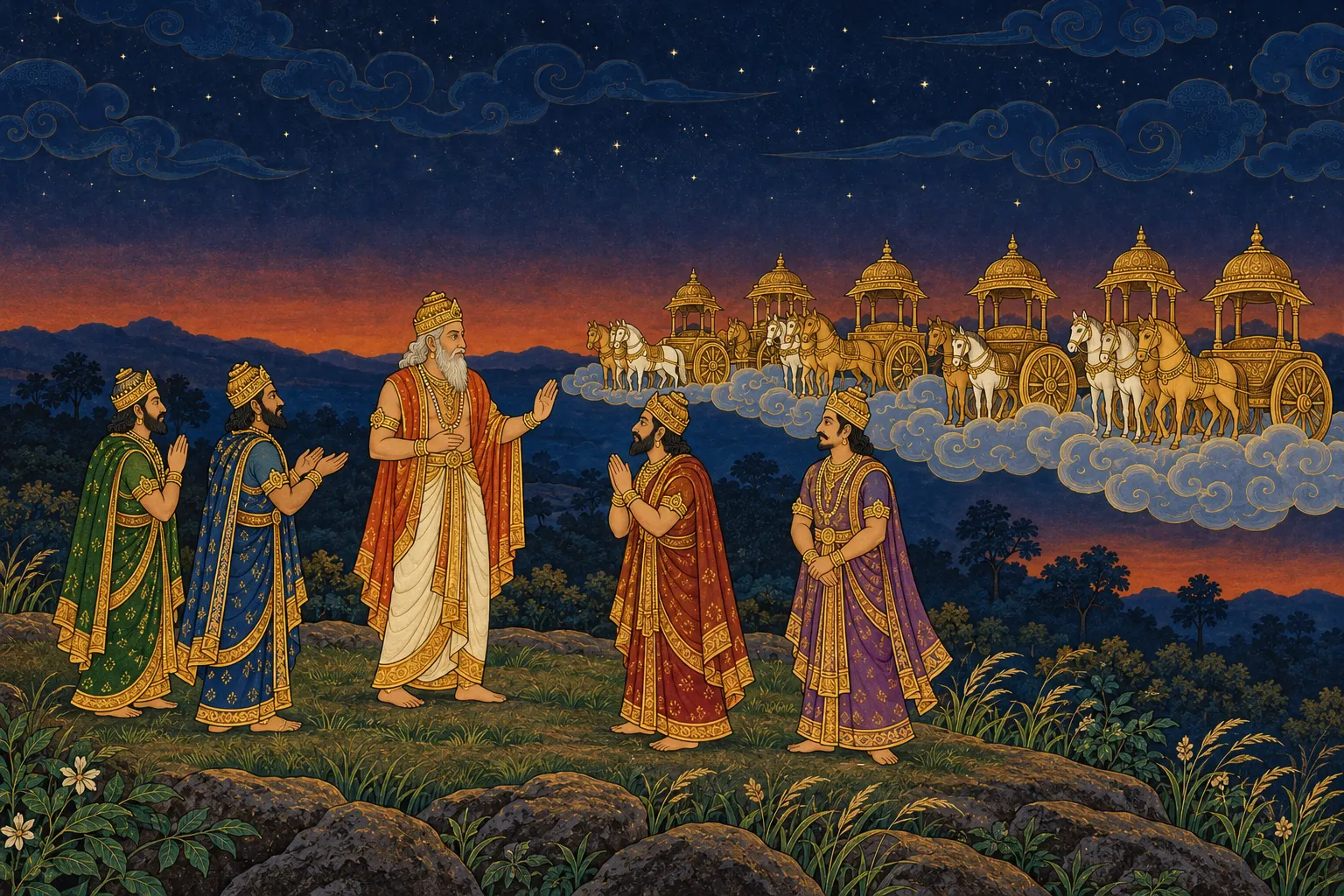
Then Ashtaka saw five golden chariots in the distance, bright as flames. "Whose are these?" he asked.
"These chariots are for you and me," said Yayati. "You are fit to sit in them and go with me to heaven."
"King, sit in the chariot and go to heaven through the sky," said Ashtaka. "We will go when our turn comes."
"All of you are fit to go to heaven even now," said Yayati, "because you have won it. This is your spotless road."
They climbed into the chariots and rose towards heaven. The Purana says they shone like heaven and earth covered in dharma. Ashtaka saw that Shibi was ahead of all, in the chariot with the fastest horses. He asked why.
"Because Shibi gave away everything in order to win heaven," said Yayati. "Shibi, son of Ushinara, is greater than all of you. He is generous, pure, truthful, harmless, humble, patient, gentle, and he looks on all with an equal eye."
Ashtaka then asked his grandfather, who looked like Indra, out of curiosity, who he was and where he had come from, for he had seen no Brahmin or Kshatriya who had done such high deeds. Then Yayati told of his deeds and said that truth is the road to heaven. All gods, sages and worlds are honoured only because of truth.
So, because of his daughter's sons, Yayati was saved from the fall, and filling the earth with his fame he reached heaven again.
Shaunaka said to King Shatanika, "This is the story of Yayati, and you were born in his line, which is called the Kaurava line." Shatanika was delighted and gave Shaunaka jewels, bows, gold and clothes. Shaunaka gave all of it to the Brahmins and vanished from the spot.
Note: This chapter follows chapters 35 to 42 of the Matsya Purana. In chapters 38–39 Yayati also speaks of the womb, rebirth and hell; those are not story, so they are not taken here. The passages missing from the English translation have been matched against the Sanskrit text (38.6–10, 14, 17).
Source: The Matsya Purana — the English translation by a Taluqdar of Oudh, Sacred Books of the Hindus, vol. 17 (1916–17), Yayati's Fall and Ashtaka