Chapter 2

The Swan's Message

A golden swan carried a king's words to a princess — and flew back to tell the king what her answer had been

A swan in the garden

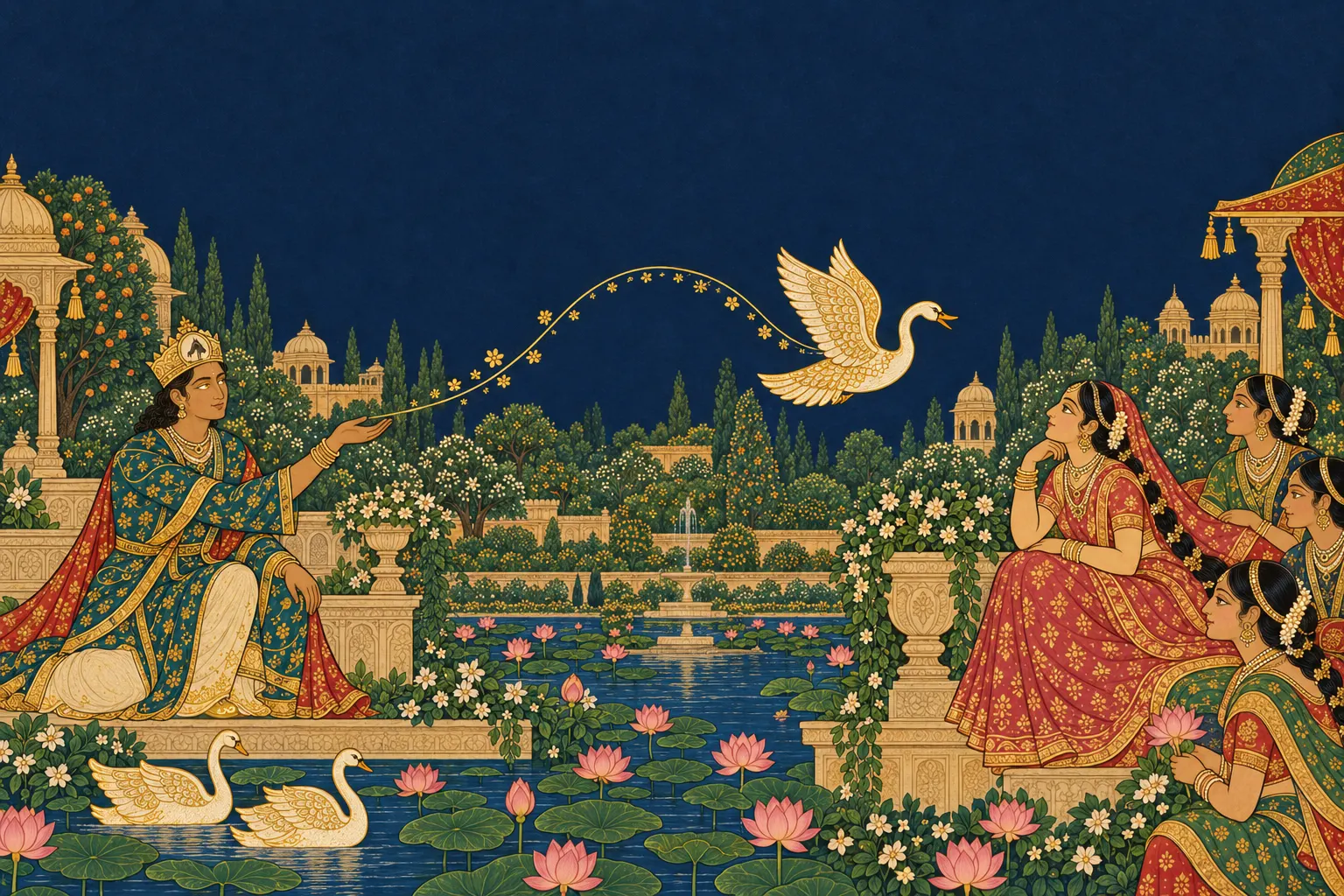
One day Nala was walking in his garden. A flock of swans with golden feathers landed there. In play, Nala caught one of them.

The swan spoke — "Let me go, my king. In return I will go to Vidarbha and praise you to Damayanti so well that she will think of no one else."

Nala let it go. The swan flew off — straight toward Vidarbha.

What the swan said

Damayanti was in her garden with her companions when the golden swan landed. It said — "My lady, there is a king in this world named Nala. In looks he rivals the Ashvins, in virtue he has no equal. If you became his wife, this birth of yours would be fulfilled."

Damayanti listened, and stayed silent for a while. Then she said — "Go, and tell Nala the very same thing."

The swan flew back to Nishadha and delivered Damayanti's message to Nala.

What was left behind

From that day on, Damayanti had no interest in food, no sleep came to her. She sat by her window, forgot to speak with her companions, stayed lost somewhere far away.

Her companions told King Bhima of her state. Bhima saw that his daughter was now of an age when marriage ought to be considered. He had her swayamvara announced.

Messages went out to distant kingdoms. Word of Damayanti's swayamvara reached even the gods.

Note: This episode falls in the opening sections of the Nalopakhyana. A message carried by a swan is one of this story's most famous scenes — Raja Ravi Varma's painting "Hansa Damayanti" (1899) is a well-known depiction of this very moment. After the announcement of Damayanti's swayamvara, the story moves directly to the day Nala himself sets out for Vidarbha — in the next chapter. The English dialogue lines are flowing paraphrases of the Sanskrit verses, not word-for-word translations.

Source: Mahabharata, Vana Parva — Nalopakhyana, The Swan's Message

Now — how much stayed with you?

What happened?

What did Nala catch in his garden?

  • A golden peacock
  • A parrot
  • A swan with golden feathers
  • A deer
Read the whole story — A swan in the garden

A flock of golden-feathered swans landed in Nala's garden.

In play, Nala caught one of them.

On being released, the swan promised to carry word of Nala to Damayanti.

Who said it?

"Let me go, my king. In return I will go to Vidarbha and praise you to Damayanti." — Who said this?

  • The swan, to Nala
  • Nala, to Damayanti
  • Damayanti, to her companion
  • Bhima, to Nala
Read the whole story — A bargain, a promise

Nala had caught the swan.

The swan offered, in exchange for its freedom, to carry word of Nala to Damayanti.

Nala let it go, and it flew off toward Vidarbha.

What happened?

What did the swan tell Damayanti?

  • That Nala was already married
  • That Nala was an ordinary king
  • That Nala himself was coming to meet her
  • That Nala had no equal in looks or virtue, and marrying him would fulfil her birth
Read the whole story — The swan's praise

The swan compared Nala to the twin Ashvins.

It said marrying Nala would make Damayanti's birth worthwhile.

Damayanti listened in silence, then asked the swan to carry the same message back to Nala.

What happened?

What happened to Damayanti after hearing the swan?

  • She danced with joy
  • She lost interest in food and sleep, and stayed lost in thought
  • She grew angry at the swan
  • She set out for Nishadha at once
Read the whole story — Love's first sign

Damayanti was changed after the swan's visit.

Neither food nor sleep interested her anymore.

Her companions reported this state to King Bhima.

Why is that?

Why did King Bhima announce Damayanti's swayamvara?

  • Because he saw his daughter was of marriageable age, and her mind was elsewhere
  • Because Nala had sent a marriage proposal
  • Because a sage had told him to
  • Because neighbouring kingdoms had demanded it
Read the whole story — A father's decision

Damayanti's companions told Bhima of her state.

Bhima saw that his daughter was of marriageable age.

He had the swayamvara announced, and messages went out far and wide.

Fact

How far did word of Damayanti's swayamvara travel?

  • Only to neighbouring kingdoms
  • Only within Nishadha
  • Only to sages
  • To distant kingdoms, and even to the gods
Read the whole story — News of a swayamvara

Bhima sent word to kingdoms far and wide.

This news reached even the gods.

This is where the next part of the story begins.

What happened?

Where did the swan return to with Damayanti's message?

  • It stayed on in Vidarbha
  • Nishadha, to Nala
  • Some other kingdom
  • Heaven
Read the whole story — The message returns

The swan heard Damayanti's answer.

It flew back to Nishadha.

It delivered Damayanti's reply to Nala.

Whose son?

Whose son was Nala — recall it from the last chapter?

  • King Bhima's
  • The sage Damana's
  • Virasena's
  • King Rituparna's
Read the whole story — Virasena's son

Nala was the son of Virasena, and king of Nishadha.

This was stated in the previous chapter.

This chapter shows how Nala and Damayanti reached each other — without ever meeting.

Why is that?

Why did Damayanti ask the swan to carry the same message to Nala as well?

  • Because she was afraid of the swan
  • Because her father had ordered it
  • Because she wanted the swan gone quickly
  • Because hearing the swan's words had drawn her toward Nala in the same way
Read the whole story — The same feeling on both sides

The swan praised Nala, and Damayanti listened in silence.

Her own mind had already turned toward Nala.

That is why she asked the swan to carry the same words back to him.

Riddle

I have golden feathers. A king caught me, and in his place I carried his praises to a princess. What am I?

  • A swan
  • A peacock
  • A parrot
  • A pigeon
Read the whole story — Love's first messenger

Nala caught a golden swan in his garden.

In exchange for its freedom, the swan carried Nala's praises to Damayanti, and flew back again.

This same swan begins the story of Nala and Damayanti, which leads on to the swayamvara.