Chapter 9

Recognition

The sound of a chariot convinced a queen, but conviction was not enough — she had to test whether the dark-skinned Bahuka was truly the king she had lost

Recognition by sound

The chariot reached Kundina. Damayanti heard its sound from the palace terrace — and it seemed to her exactly the sound Nala's own chariot used to make. But before her stood only the dark-skinned, short Bahuka — no swayamvara was underway, no other king had arrived.

Rituparna was startled to find this. He asked Bhima about it, and turned the conversation aside as he left.

Keshini's test

Damayanti sent her companion Keshini to Bahuka, to find out who he was. Keshini asked — "Who but Nala could have such knowledge of horses?"

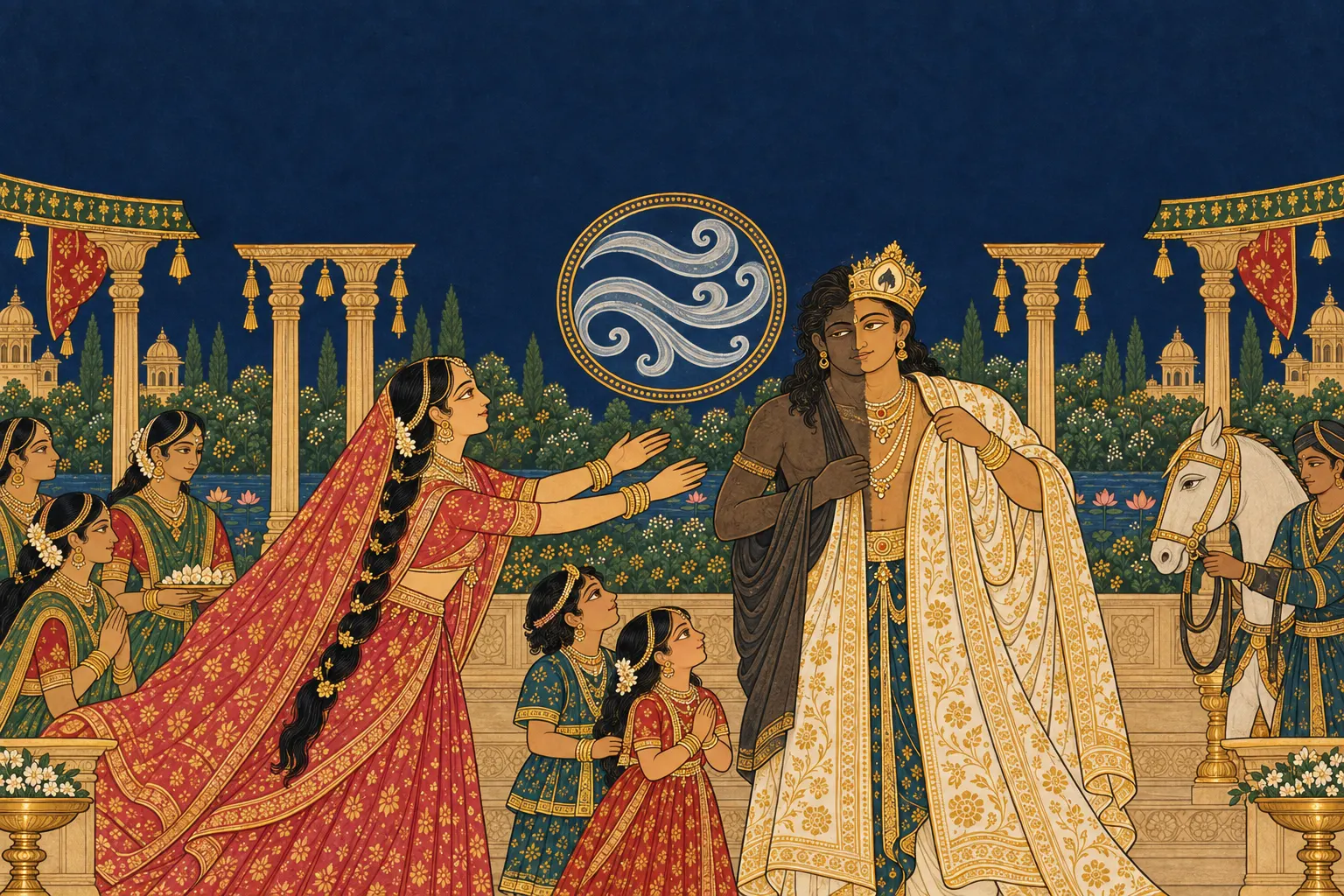
Bahuka answered with things that only Nala could have known. Keshini returned and told Damayanti a few more signs — the doorway had risen slightly as he approached it, and water and fire seemed to appear at his wish, instantly. Damayanti had him cook a meal — the taste was exactly Nala's. Then the children were brought before him, and tears streamed from Bahuka's eyes.

Vayu's testimony

At last Damayanti came forward herself and questioned Bahuka. Nala told her the whole story of Kali's influence — how Kali had entered him, and how he had at last been freed.

Vayu, the wind god himself, testified from the sky to Damayanti's purity. At that very moment Nala put on the divine garment Karkotaka had given him — and instantly his true form returned. After three years apart, Nala and Damayanti stood before each other again, in their true forms.

From Kundina to Nishadha

Rituparna learned the whole story, and gave Nala his blessings. In return, Nala handed over to him the remaining part of his own mastery of horses.

After staying a few days in Kundina, Nala returned to Nishadha with his army. He challenged Pushkara once more to a game of dice — this time on the strength of akshahridaya, without Kali or Dvapara in play. Nala won. He spared Pushkara's life, saying that what had happened was Kali's doing, not Pushkara's fault — and gave him back a share of the ancestral kingdom, along with what he needed to live.

Brihadashva's teaching

Here Brihadashva brings the story to a close, and says to Yudhishthira — "I now teach you this same akshahridaya, just as Rituparna taught it to Nala." Yudhishthira learned that skill.

The shape of the story shows a sharp contrast: uncontrolled gambling, under Kali's influence, costs Nala everything he has; later, knowledge of the game itself gives him mastery over that same game, and in the end Brihadashva gives that very skill to Yudhishthira as well. It can be read as the difference between knowledge and uncontrolled attachment — this is one reading, not Brihadashva's own stated conclusion.

Note: This chapter closes the Nalopakhyana. The scenes of recognition — the sound of the chariot, Keshini's test, the divine signs, the tears before the children, Vayu's testimony — all appear in the text in this order. At the end of the story Nala spares Pushkara's life, refuses to hold him at fault, and gives him back a share of the ancestral kingdom along with what he needs to live — this is clear in the text. The children's names vary a little between different retellings, though the translation used here gives them as twins. The story's final contrast — uncontrolled gambling versus knowledge of the game — is this text's own reading, not Brihadashva's own word-for-word conclusion. The English dialogue lines are flowing paraphrases of the Sanskrit verses, not word-for-word translations.

Source: Mahabharata, Vana Parva — Nalopakhyana, Recognition

Now — how much stayed with you?

What happened?

What was Damayanti's very first feeling about Bahuka, on reaching Kundina?

  • She recognised him at once
  • She took him for a stranger
  • The sound of his chariot reminded her of Nala
  • She took him for an enemy of Nala's
Read the whole story — A first glimpse

Damayanti heard the chariot's sound from the palace terrace.

It seemed to her exactly the sound Nala's chariot used to make.

But before her stood the unattractive Bahuka, so she resolved to test him further.

What happened?

Who did Damayanti send to learn Bahuka's identity?

  • Her companion Keshini
  • Her brother
  • She went herself
  • King Bhima
Read the whole story — A first test

Damayanti sent Keshini to Bahuka.

Keshini asked him questions about knowledge of horses.

Bahuka's answers held things that only Nala could have known.

Fact

What divine signs did Keshini report to Damayanti about Bahuka?

  • Glowing marks on his body
  • Light shining from his eyes
  • Flowers blooming under his footsteps
  • The doorway rising slightly as he approached, and water and fire appearing at his wish, instantly
Read the whole story — Divine signs

Keshini noticed the doorway rise slightly as Bahuka approached it.

Water and fire seemed to appear at his wish, instantly.

These marvels deepened Damayanti's suspicion — and recalled the divine boons granted after the swayamvara.

What happened?

What did Bahuka do when the children were brought before him?

  • Refused to recognise them
  • Tears streamed from his eyes
  • Stayed calm
  • Immediately showed his true form
Read the whole story — Before the children

Damayanti had Bahuka cook a meal, and its taste was exactly Nala's.

Then the children were brought before him.

Tears streamed from Bahuka's eyes — the deepest sign yet of who he was.

Who said it?

Who testified from the sky to Damayanti's purity?

  • Vayu, the wind god
  • Narada
  • Brahma
  • Indra
Read the whole story — Testimony from the sky

Nala told Damayanti the whole story of Kali's influence.

Vayu testified from the sky to Damayanti's purity.

Right after this, Nala put on the garment Karkotaka had given him, and his true form returned.

What happened?

How did Nala get his true form back?

  • Karkotaka himself appeared there
  • Through Damayanti's tears
  • Through Rituparna's blessing
  • By putting on the divine garment given by Karkotaka
Read the whole story — The garment's secret

Karkotaka had earlier given two divine garments; at the reunion, Nala puts on one of them and regains his old form.

After Vayu's testimony, Nala put on that garment.

His true form returned instantly — after three years apart.

What happened?

What did Nala do with Pushkara, on returning to Nishadha?

  • Forgave him unconditionally
  • Challenged him to dice again, won on the strength of akshahridaya, then forgave him and gave him a share of the kingdom
  • Drove him out of the kingdom
  • Went to war with him
Read the whole story — A second game, a different outcome

Nala challenged Pushkara to dice once more.

This time there was no Kali, no Dvapara — only the knowledge of akshahridaya.

Nala won, and forgave Pushkara, giving him a share of the kingdom as well.

What happened?

What does Brihadashva teach Yudhishthira as he closes his story?

  • The mastery of horses
  • The art of cooking
  • Akshahridaya
  • The strategy of war
Read the whole story — A skill gained from the story

Just as Rituparna taught Nala akshahridaya, Brihadashva teaches that same skill to Yudhishthira.

This is the close of the story, where the listener receives something solid as well, not just comfort.

Yudhishthira learned that skill.

Why is that?

How can the story's two losses-and-wins at dice be read together — whose conclusion is this?

  • It is Brihadashva's own direct, word-for-word teaching
  • Because Yudhishthira feared dice
  • Because the game of dice had since been banned
  • It can be read this way: uncontrolled gambling brought Nala down, while knowledge of the game gave him mastery over that same game
Read the whole story — The difference between knowledge and uncontrolled attachment

The first time, Nala lost despite his own fondness for dice, because Kali and Dvapara were in the game.

The second time, he had akshahridaya, and no divine interference.

This lesson reads that difference as knowledge versus uncontrolled attachment — as one reading, not as Brihadashva's own word-for-word teaching.

Riddle

I am the moment a dark, unattractive charioteer became a king again — after three years of separation, through a single divine garment. What am I?

  • Nala's true form returning
  • Nala's coronation
  • Damayanti's second swayamvara
  • Pushkara's defeat
Read the whole story — The return of a form

After Vayu's testimony, Nala put on the garment given by Karkotaka.

His true form returned instantly.

This is the emotional peak of the story — after three years, Nala and Damayanti stood before each other again, in their true forms.