
Chapter 1
Why This Story Is Told
A king who had lost everything at dice is told this story, in exile, in the forest — that coming back from ruin is not impossible
A question in the forest
Yudhishthira had lost everything at dice — his kingdom, his wealth, even the twelve years of forest exile were the dice's doing. He sat in the Kamyaka forest, defeated and worn down.
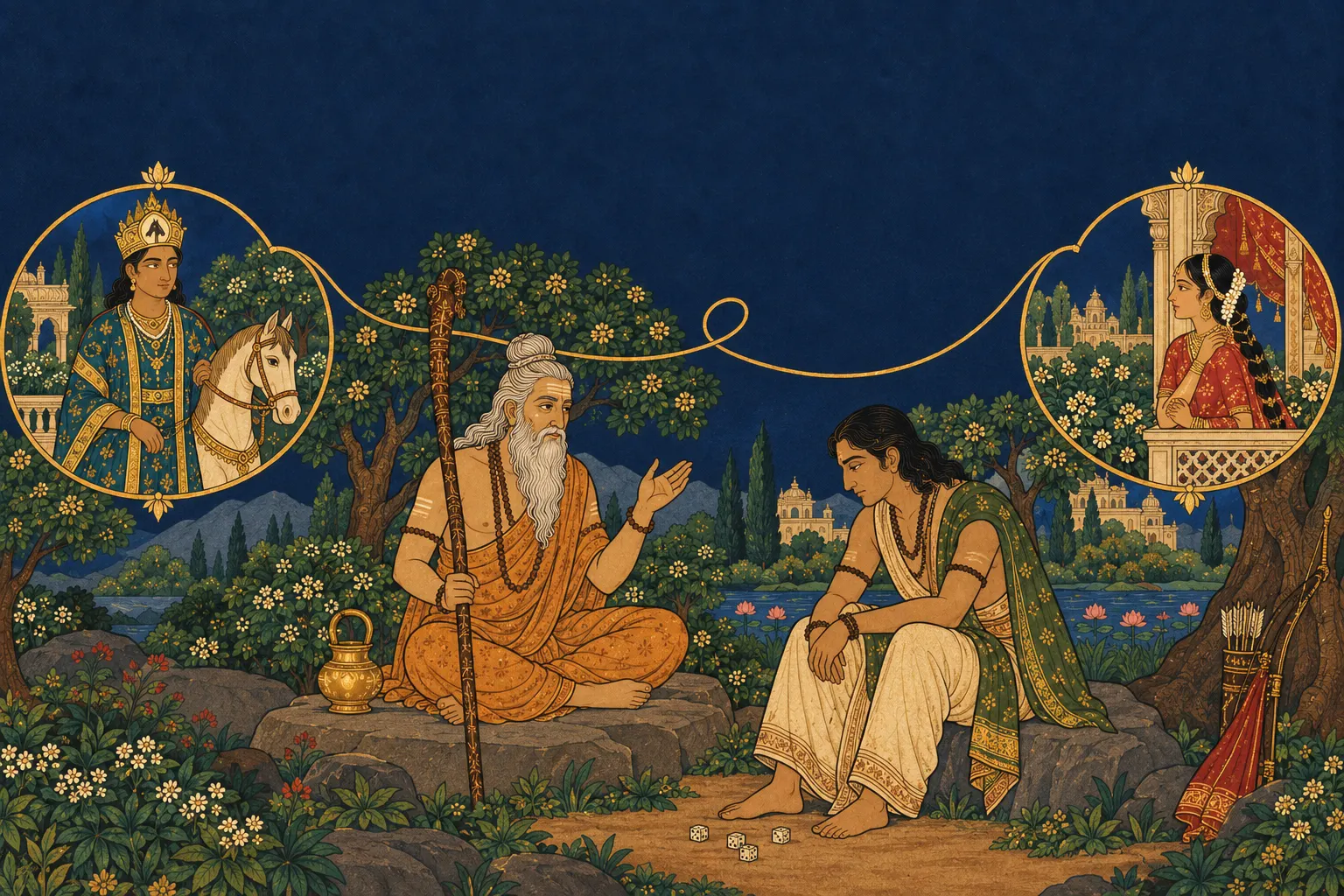
Then the sage Brihadashva arrived. Yudhishthira asked him — had there ever been a man more unlucky than himself, brought down like this by dice?
Brihadashva smiled. "There was a king," he said, "who lost everything at dice just as you have — his kingdom, his wealth, even his wife's company. But he came back. His name was Nala."
The king of Nishadha
Nala was king of the Nishadha country, son of Virasena. He was masterful with horses, fond of the game of dice, and gifted in many other ways too — the story ahead shows his extraordinary skill at cooking as well. He was so handsome that people compared him to the twin Ashvins.
Just as far away, in the country of Vidarbha, King Bhima had a daughter — Damayanti. Bhima had gone childless for years, until the sage Damana granted him three sons and this one daughter. Damayanti's beauty was spoken of in kingdoms far beyond her own.
The two had never once seen each other. But each kept hearing of the other — from courtiers, from travellers, from talk that drifted on the wind — until a single name had settled in each of their minds.
For a defeated king
Brihadashva said to Yudhishthira — "Nala too lost his kingdom and his happiness, my king — and in the end got them back. Listen to his story."
This is that story — of love, of a swan, of a curse, and of a king who came home again.
Note: This story appears in the Vana Parva of the Mahabharata as the Nalopakhyana — sections 52 to 79 in Ganguli's translation. The sage Brihadashva tells it to Yudhishthira after his loss at dice and departure into exile. At the very end of the story, Brihadashva also teaches Yudhishthira the secret of dice (akshahridaya), just as Nala later learns it from Rituparna. The names of Damayanti's brothers vary a little between translations; the sage's name is given here as Damana. The English dialogue lines are flowing paraphrases of the Sanskrit verses, not word-for-word translations.
Source: Mahabharata, Vana Parva — Nalopakhyana, Why This Story Is Told