
Chapter 4
Aja and Indumati
On the Narmada an elephant took an arrow and turned into a gandharva — and in Vidarbha a princess walked past a row of kings and garlanded Aja
Aja and Indumati is chapter 4 of Raghuvamsha. Source: Raghuvamsha, canto 5 (verses 36–76), cantos 6 and 7 (Kalidasa). It is told in 5 scenes — The Invitation from Vidarbha; The Elephant on the Narmada; The Svayamvara; The Garland; The Wedding and the Ambush — followed by 10 quiz questions.
The Invitation from Vidarbha
When Aja came of age, the goddess of royal fortune longed for him but waited for his father's leave, like a well-bred daughter waiting for her father's word. Just then a messenger arrived from Bhoja, king of Vidarbha. Bhoja's sister Indumati was to choose her husband at a svayamvara, and he wanted Aja to come.
Raghu thought the alliance a good one, and his son was of an age to marry. He sent Aja off with an army. On the road, royal tents were pitched, villagers brought gifts, and it all felt like a pleasure-trip through gardens.
The Elephant on the Narmada
A halt was made on the bank of the Narmada. Then a wild elephant came out of the water — the humming of bees over the river announced him. The powerful scent of his musth was so strong that the army's tame elephants broke their ropes and bolted, chariots overturned, horses ran, and warriors were busy looking after the women.
Aja knew the rule from the scriptures: a king should not kill a wild elephant. So he did not draw the bow far; he shot a single arrow at the elephant's forehead, only to turn him back.
The moment the arrow struck, the elephant's shape fell away. In its place stood a radiant figure adorned with a garland, ringed with light. "I am Priyamvada," he said, "son of the gandharva king Priyadarshana. Through arrogance I offended the sage Matanga, and by his curse I became an elephant. He said I would be freed the day Aja of the Ikshvaku line struck my forehead. You have freed me. If I gave nothing in return, my release would be wasted. Take this missile of mine, called Sammohana, the Stupefier. Whoever uses it wins without killing the enemy."
Aja sipped the water of the Narmada, faced north, and received the missile with its mantras. The two became friends for no reason either could name — then one went off to Chaitraratha's garden, the other to Vidarbha.
The Svayamvara
Bhoja came out beyond the city to receive Aja, as the sea with its waves goes out to welcome the moon, and he entertained him so lavishly that people took Aja for the host and Bhoja for the guest.
At dawn the young bards woke Aja: "The night is over, prince. The Creator has divided the world's burden in two: your father carries one end, and your glory carries the other."
In the svayamvara hall the kings sat on their thrones. At the sight of Aja, every other king gave up hope of Indumati, as if the God of Love had recovered his body. When Indumati came in — in a litter, among her friends — the kings tried each in his own way to hide their feelings. One twirled a lotus, one straightened his garland, one drew lines on a golden footstool with his toe.
A doorkeeper named Sunanda led her from king to king and named each one. The king of Magadha, Parantapa, whose sacrifices kept Shachi's hair untied. The king of Anga, whom the nymphs of heaven were said to desire. The king of Avanti, neighbour of Mahakala, where the breeze blows off the Shipra. Pratipa of Anupa, of Kartavirya's line, in whose prison Ravana had once been held. Sushena of Shurasena, who wore a jewel given by the serpent Kaliya. Hemangada of Kalinga. The king of the Pandyas, whose well-being the sage Agastya himself asked after.
Indumati passed each of them, and as a house on the road goes dark when a moving lamp is carried past at night, each king's face grew pale. Tradition says that for this simile Kalidasa is also called "Dipashikha Kalidasa" — Kalidasa of the lamp-flame.
The Garland
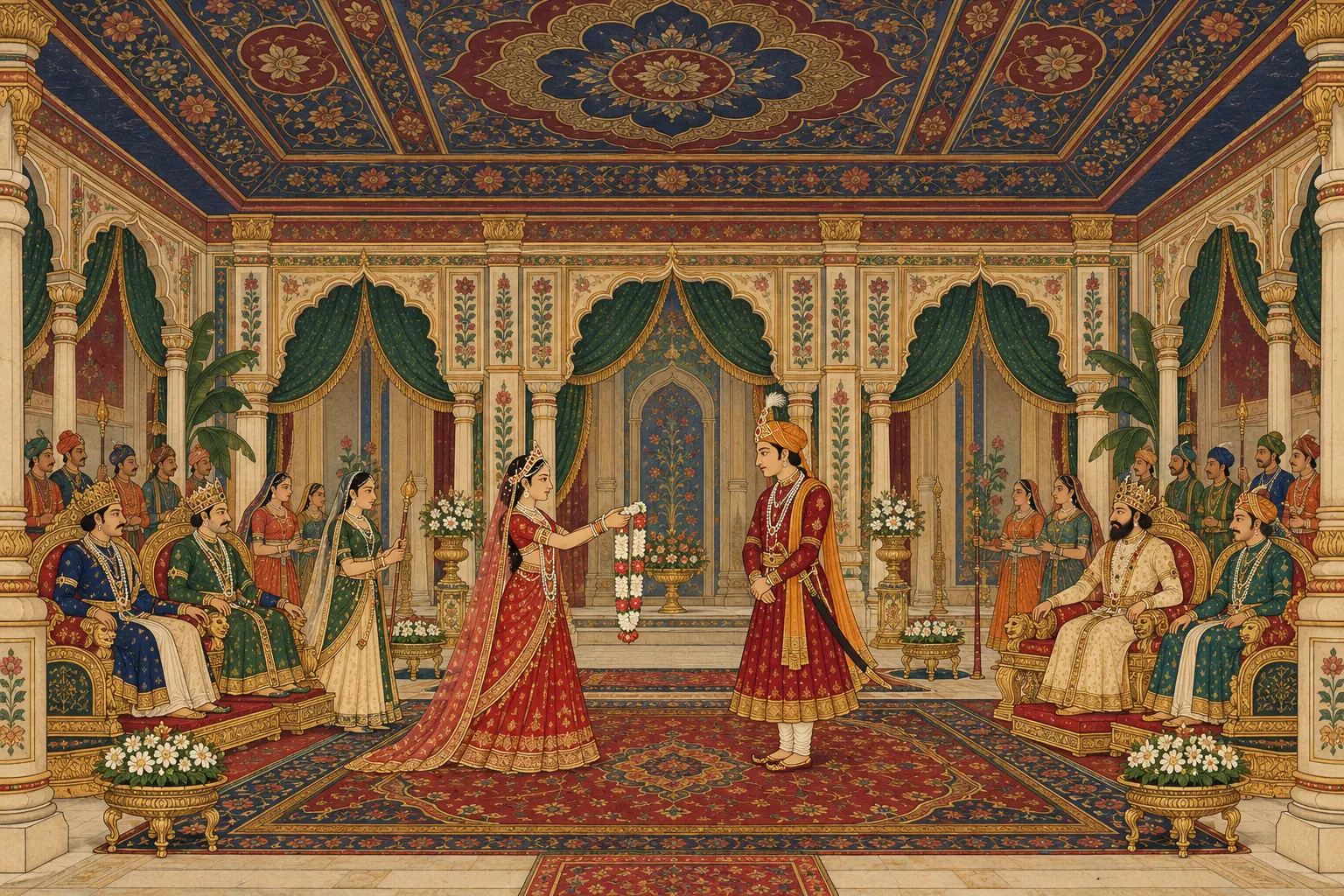
When she reached Aja, her mind stopped moving to any other king, as a swarm of bees that has reached a mango tree in flower goes to no other tree. Sunanda gave the line of the Raghus: Kakutstha, then Dilipa, then Raghu, then this Aja.
Indumati was too shy to speak, but her body betrayed what her lips could not say: the hair stood up on her skin. Sunanda teased, "My lady, let us go on to the next." Indumati knit her brows and looked at her. Then she had her nurse place the garland on Aja's neck.
Aja wore it as if Indumati's arms themselves had been thrown around his neck. The people of the city said: "Here is moonlight joined to the moon, freed from the clouds — and the river meeting the sea that is fit for it."
The Wedding and the Ambush
The marriage rites were done. Bhoja's priest joined the bride and groom before the fire, and they walked around it, like day and night circling Meru, each following the other. When their hands met, the bridegroom's skin bristled and the bride's fingers grew damp.
The other kings left smiling outwardly and seething within, and lay in wait on the road. Bhoja walked three nights beside Aja before turning back. A little farther on, the kings blocked Aja's path. He entrusted Indumati to his father's minister and rode out to meet the kings' army himself.
The battle was fierce — dust so thick that it covered the sun, and warriors knew one another only by the names written on their arrows. Aja's army gave ground now and then, but he did not. Then he loosed the Sammohana missile the gandharva had given him.
Every king fell asleep. Weapons slipped from their hands, crowns rolled onto their shoulders. Then Aja blew his conch. His own soldiers came back and found him standing among his sleeping enemies, like the moon's reflection among closed lotuses.
With arrows dipped in blood he wrote on the banners of those kings: "Your glory has been taken by Aja. Your lives have been spared — out of mercy." Then he went to Indumati, who was frightened, and said, "Look, now even a child could disarm these enemies." Kalidasa says her face lit up with joy. Too shy to congratulate her husband herself, she did it through her friends' words.
Raghu welcomed his victorious son and his daughter-in-law home.
Note: This chapter covers canto 5 verses 36–76, then cantos 6 and 7. "Dipashikha Kalidasa" is a tradition's name for the poet, not Kalidasa's own, and its historical origin is not certain. The names of the kings' countries (Anupa, Shurasena, Pandya and others) are Kalidasa's.
Source: Kalidasa's Raghuvamsha (from M. R. Kale's English translation, with Mallinatha's commentary), Aja and Indumati