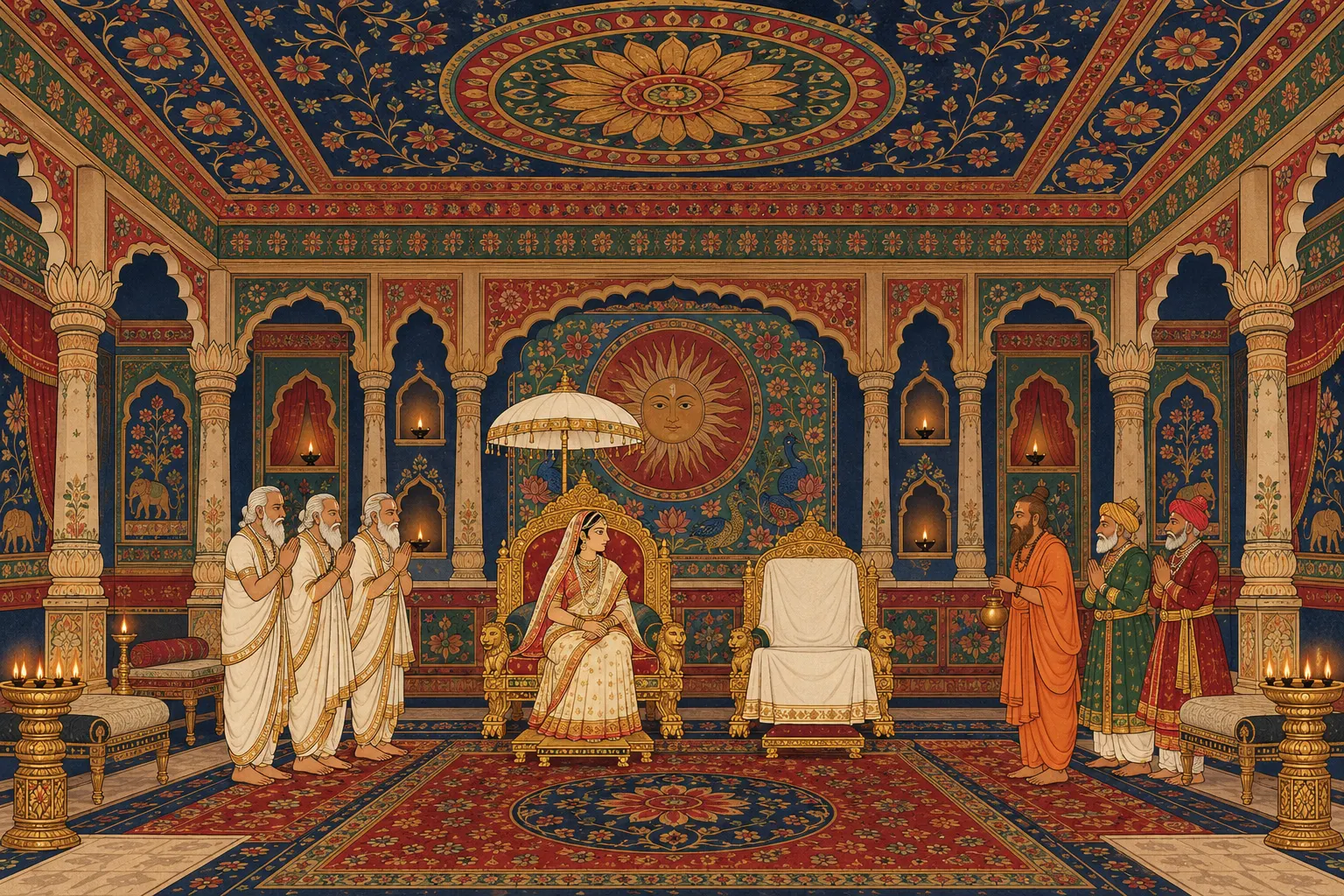
The Last Kings — Raghuvamsha, illustration

Chapter 12

The Last Kings

A line that went on for many generations after Rama — and whose last king Kalidasa leaves at the moment a pregnant queen sits on the throne

The Last Kings is chapter 12 of Raghuvamsha. Source: Raghuvamsha, cantos 18 and 19 (Kalidasa). It is told in 4 scenes — A List of Names; A Six-Year-Old King; Agnivarna; The End of the Line — followed by 10 quiz questions.

A List of Names

Atithi's son was Nishadha, as strong as Mount Nishadha. Nishadha's son was Nala, who had a share of fire in his glow — not that Nala whose story is known with Damayanti. Nala's son was Nabhas, then Pundarika, then Kshemadhanvan, then Devanika, whose name was heard even in heaven. Then Ahinagu, Pariyatra, Shila, Unnabha, Vajranabha, Shankhana, Vyushitashva. Then Vishvasaha, and Vishvasaha's son Hiranyanabha, a part of Vishnu. Hiranyanabha's son was Kausalya, Kausalya's was Brahmishtha, Brahmishtha's was Putra, and Putra's son was Pushya.

Kalidasa runs through this list quickly, yet gives each name a line. Of one he says that even in youth he kept away from bad habits. Of another that he blushed to hear himself praised. Of another that he stood as tall as Mount Pariyatra.

Pushya handed the kingdom to his son, learned yoga from Jaimini, and was freed from the fear of rebirth. After Pushya came Dhruvasandhi, who died by a lion's hand in the middle of a hunt.

A Six-Year-Old King

After Dhruvasandhi's death his ministers seated his young son Sudarshana on the throne — the only branch of the family left. He was only six years old. Kalidasa says the line was like a sky with a new moon, or a lake with one lotus.

When he rode on an elephant with a mahout through the royal road, the people of the city gave him the same respect they had given his father. A cloud the size of an elephant's calf, meeting the wind, still covers the quarters. As the gem "Mahanila" gets its name from its brightness, so, though a child, he was called Maharaja.

His command ran to the edges of the sea. Even ornaments were heavy for his tender body, and yet he bore the great yoke of the earth. He picked up the sciences he had studied in a past life as though remembering them.

When he grew up, ministers from his side of the family showed him pictures of princesses and had him marry them. In Kalidasa's phrase they became the queens of Sudarshana, rivals to Lakshmi and Earth.

Agnivarna

In old age Sudarshana gave the kingdom to his son Agnivarna and went off to Naimisha forest to do penance. There he bathed in holy waters, slept on kusha mats and lived in a hut in place of a palace.

Agnivarna got without effort a kingdom his father had built. For some years he ruled himself, then left everything to his ministers and spent his youth on women.

Kalidasa writes at great length here, but, keeping to propriety, the matter is this: he began to stay within his palace, and his people had to long to see him. Out of regard for his ministers, now and then he showed only a foot through the lattice of a window, and the servants bowed to it and went away.

His nights passed in dance, music, wine and divided love, and his days too were like nights. Kalidasa says he could not bear even a moment without sensual pleasures.

The queens often sulked, he coaxed them, and then it all began again. He found so many new ways to enjoy himself that each earlier festival paled beside the next.

The End of the Line

Foreign kings did not attack his realm, for his ancestors' glory still held. But a disease entered Agnivarna's body — rajayakshma, consumption — as the moon was seized by consumption under Daksha's curse.

The physicians advised restraint; he did not listen. The illness wasted his body, his face grew pale, his voice faint. The line became like a night sky holding only the faintest sliver of the moon, or a pond drying in summer, or a lamp with its wick almost burned down.

The ministers told the city that the king was performing a rite to obtain a son, so that the people would not know. The king had no son. At last the illness extinguished his life, as a sudden gust puts out a dying lamp.

The ministers, with the family priest, secretly lit a pyre in the palace garden itself, on the pretext that a ritual for his cure was being held. Then they called together the leading citizens. The king's pregnant lawful wife was chosen as ruler of the kingdom.

And the unborn child, heated by the tears at the king's death, was cooled by the water of the coronation. The queen sat on a golden throne and governed her husband's kingdom with the advice of the old hereditary ministers, and her orders were never disobeyed — like the earth keeping a handful of seed hidden in her, as an oyster hides a pearl.

Here Kalidasa stops.

Note: This chapter follows cantos 18 and 19. The kings' names in canto 18 are interesting but without story, so they are given here in one line. The description of Agnivarna's indulgence in canto 19 is very detailed; only its gist is kept. The Raghuvamsha ends here. Some scholars think the poem is unfinished; others think it was deliberately left so.

Source: Kalidasa's Raghuvamsha (from M. R. Kale's English translation, with Mallinatha's commentary), The Last Kings

Now — how much stayed with you?

Fact

At what age did Sudarshana become king?

  • Sixteen
  • Three
  • Six years
  • Twelve
Read the whole story — A child king

The ministers seated on the throne the one surviving branch of the family.

Kalidasa says that even at six the people respected him as they had his father.

The comparison is that a cloud the size of an elephant's calf still covers the quarters with the wind.

What happened?

What happened after Agnivarna died?

  • The ministers quietly lit a pyre in the garden and gave the kingdom to the pregnant queen
  • His brother became king
  • The kingdom went to a neighbouring king
  • Lava took Ayodhya
Read the whole story — An ending without noise

The ministers had hidden the news of the king's illness.

So even the funeral was in the palace garden.

After that the queen was crowned, and Kalidasa's poem stops here.

Interpretation

Why did Kalidasa describe Agnivarna at such length? Scholars debate it. How should we read it? (This is our reading.)

  • The poet liked indulgence
  • The poet's poem was not completed here
  • Agnivarna was the poet's patron
  • The poet shows that a line whose kings chose liberation in the forest ends, in the end, sunk in pleasure
Read the whole story — Beginning and end

In canto 1 Kalidasa says the Raghus went to the forest in old age and gave up the body in yoga.

Agnivarna is the opposite example.

That is why many readers take it as a warning about the line's decline.

Who am I?

In old age I gave the kingdom to my son and went to Naimisha forest to do penance. My name means "good to look at." Who am I?

  • Agnivarna
  • Sudarshana
  • Dhruvasandhi
  • Pushya
Read the whole story — The child-king in old age

Sudarshana became king at six.

In old age he gave the kingdom to his son Agnivarna.

He went to Naimisha forest, where he lived as an ascetic.

Put it in order

Put these kings in order from father to son.

  • Atithi → Nishadha → Nala → Nabhas → Pundarika
  • Nishadha → Atithi → Nala → Pundarika → Nabhas
  • Nala → Nishadha → Atithi → Nabhas → Pundarika
  • Pundarika → Nabhas → Nala → Nishadha → Atithi
Read the whole story — Five generations

Canto 18 begins with Atithi's son Nishadha.

Then come Nala, Nabhas and Pundarika.

The same list is found in the Puranas, with some differences in the order of names.

Who said it?

"The king is performing a rite for the birth of a son" — who said this, and why?

  • The queen, so that neighbouring kings would not attack
  • The physicians, so that the king could rest
  • The priest, so that the sacrifice could go on
  • The ministers, so that the people would not learn of the king's illness
Read the whole story — A pretext

The king could not be seen because of his illness.

The ministers said he was at a rite.

Because of this the kingdom went on without fear.

Fact

Whose son is the Nala of canto 18, and how is he different from the Nala of Damayanti?

  • Rama's son, and the same Nala as Damayanti's
  • Nishadha's son, and he is a different Nala from Damayanti's
  • Atithi's son, and the same Nala as Damayanti's
  • Kusha's brother, and the same Nala as Damayanti's
Read the whole story — Two Nalas

The Nala of the solar line is Nishadha's son.

Damayanti's Nala is king of the Nishadha country, a son of Virasena.

In Puranic tradition this likeness of names often causes confusion.

Interpretation

The poem stops with a pregnant queen on the throne. How should we read this? (This is our reading.)

  • The poet's final answer that the line was destroyed
  • That the remaining cantos were lost
  • As an unfinished note, in which there is both hope for the line's continuing and the end of its great story
  • That the queen's story continues in later cantos
Read the whole story — Toward the end

The poem stops not at the king's death but at the queen's coronation.

That leaves the rest of the story to the reader.

This reading is ours; the verses say nothing else.

What happened?

What does Kalidasa give as the cause of Agnivarna's illness?

  • A sage's curse
  • A wound from a battle
  • An enemy's poison
  • Excess of pleasure, which he did not give up despite the physicians' advice
Read the whole story — Rajayakshma

The disease is named rajayakshma (consumption).

Kalidasa compares it to the consumption that seized the moon under Daksha's curse.

He shows the illness as the result of indulgence, not of a curse or a war.

Riddle

I am not a king but a queen. I got the kingdom when my husband was gone and the heir was in my womb. Kalidasa stops his poem on me without giving my name. Who am I?

  • Agnivarna's queen
  • Sudakshina
  • Kumudvati
  • Indumati
Read the whole story — The queen without a name

Kalidasa calls the queen not by name but "lawful wife."

She was with child, and the ministers gave her the kingdom.

The poem stops there.

Questions about The Last Kings

What happens in The Last Kings (Raghuvamsha)?

A line that went on for many generations after Rama — and whose last king Kalidasa leaves at the moment a pregnant queen sits on the throne. The story moves through: A List of Names; A Six-Year-Old King; Agnivarna; The End of the Line.

What comes after The Last Kings in Raghuvamsha?

The Last Kings is the last chapter of Raghuvamsha.

What is the source for The Last Kings?

Raghuvamsha, cantos 18 and 19 (Kalidasa).