
Chapter 6
Dasharatha: Curse and Boon
A king shot an arrow into the dark and killed the only son of a blind old couple — and in the curse he received, he found the boon he had longed for
Dasharatha: Curse and Boon is chapter 6 of Raghuvamsha. Source: Raghuvamsha, cantos 9 and 10 (Kalidasa). It is told in 5 scenes — Dasharatha; Spring and the Hunt; By the Tamasa; A Curse That Was a Boon; The Sacrifice and the Payasa — followed by 10 quiz questions.
Dasharatha
Kalidasa says that in the world there seemed to be only two who lifted the weariness of the weary — Indra, who gave rain in its season, and Dasharatha, who gave wealth in his. In his kingdom no disease came, and as for an enemy's insult, it was not even imaginable.
Dasharatha had conquered the entire earth from a single chariot. He was impartial like Yama, generous like Kubera, a punisher like Varuna. He never bent his head before Indra, and he never told a lie, not even in jest.
He had three queens, princesses of Magadha, Kosala and Kekaya. Kalidasa adds that he had fought alongside Indra and relieved the fears of the gods' wives.
Spring and the Hunt
Then spring came. The sun turned north, cuckoos called and ashoka flowers opened. Kalidasa describes the season at great length — blossoms, bees, swings, cuckoos. The king held a festival, and then a wish for the hunt came into his mind.
He went into the forest, where there was a herd of deer. A doe stepped in front of her stag, and Dasharatha, though his arrow was fully drawn, let it go — for in her eyes he saw his queens' eyes. Nor would he shoot a peacock, since its spread tail reminded him of his queen's braided hair.
Yet the king forgot his duties and lost himself in hunting. One night he stayed alone in the forest on a bed of flowers and leaves, by the light of glowing herbs.
By the Tamasa
The next day, chasing a deer, he got separated from his companions, and his foaming horse brought him to the banks of the Tamasa, where ascetics lived.
From the water came a sound — a pot being filled. Dasharatha took it for an elephant's trunk and shot an arrow in the direction of the sound.
At that moment a cry rose from the forest — "Alas, father!" It went into the king's heart like an arrow. Searching among the reeds, he found a young sage's son lying on the ground beside a pot, wounded by the arrow. The king got off his horse. He asked, "Who are you?"
In broken words the boy said that he was an ascetic's son, not a Brahmin, but of another varna — one apart from the twice-born. He said, "My parents are blind. Take them water."
Dasharatha carried him, arrow and all, to his parents. He told them everything and confessed his crime. Weeping, the blind couple had the arrow drawn from their son's chest. The boy died.
A Curse That Was a Boon
The old man gathered his tears in his cupped hands and cursed the king: "You, too, will die in old age, grieving for your son as I do."
Dasharatha stood quiet as a snake that has been trodden on. He said, "I have done wrong. Yet even in your curse is a boon, for I have not yet seen my own son's face. Fire burns a field that needs tilling, and then the seeds in that same field sprout. Tell me what to do, guilty as I am."
Then the ascetic, with his wife, resolved to follow their son and asked for wood for a pyre. The king had it done by his attendants, and returned carrying the weight of the sin and the seed of the curse in his heart, as the ocean carries its submarine fire.
The Sacrifice and the Payasa
Years passed. The king had no son. Kalidasa says he was like the ocean before the churning — his jewels not yet brought out.
Then Rishyashringa and other sages began a sacrifice for the birth of a son.
At the same time the gods, tormented by Ravana, went to Vishnu. They had barely reached the seashore when the Primeval Being woke. He lay on Shesha's couch, lit by the jewels in its hoods, with his feet in Lakshmi's lap, wearing the Kaustubha, served by Garuda.
The gods praised him: "You are the creator, preserver and destroyer. Desireless, you grant all desires. As the many streams of the Ganga end in the sea, so all paths reach you."
Vishnu said, "I know it all. Ravana has a boon from Brahma that no god can kill him. He did not count men. So I will be born as Dasharatha's son and offer up the lotuses of his ten heads at the sacrifice."
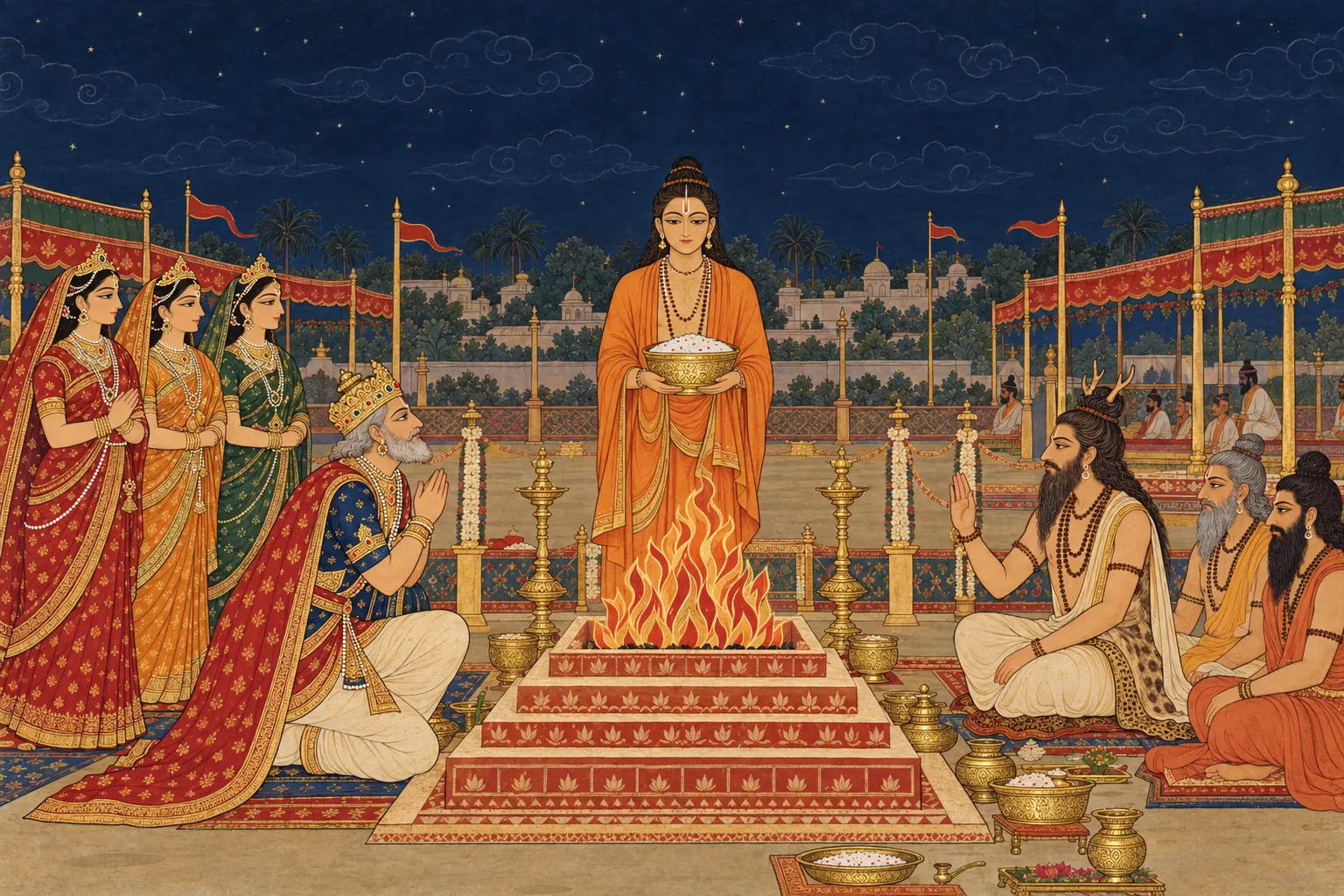
At that very time a being rose out of the fire of Dasharatha's sacrifice, holding in a golden bowl a portion of rice cooked in milk. The king received it as Indra received the nectar churned from the sea. He divided it between two queens — Kausalya and Kaikeyi — and each gave half her share to Sumitra.
All three, at the same time, had the same dreams: dwarfs holding conch, sword, mace, the Sharnga bow and discus guarding them; Garuda carrying them across the sky; Lakshmi fanning them with a lotus; the seven sages, bathed in the Ganga, reciting the Vedas.
When the time came, Kausalya bore Rama — a name his father gave him for his beauty, the most auspicious name in the world. Kaikeyi bore Bharata, and Sumitra bore Lakshmana and Shatrughna. Kalidasa says the king, with his four sons, looked like Airavata with four tusks, like statecraft with its four means, or like Vishnu with his four arms.
Note: This chapter follows cantos 9 and 10 (verses 9.1–82 and 10.1–86). The spring description of canto 9 is very long and is only hinted at here. Kalidasa describes the sage's son's varna only as "different from the twice-born"; the name Shravana Kumara belongs to later tradition.
Source: Kalidasa's Raghuvamsha (from M. R. Kale's English translation, with Mallinatha's commentary), Dasharatha: Curse and Boon