
Chapter 7
The Bow and Parashurama
The prince who broke Shiva's bow at Mithila and won his bride was stopped on the road home by the man who had cleared the earth of kshatriyas twenty-one times
The Bow and Parashurama is chapter 7 of Raghuvamsha. Source: Raghuvamsha, canto 11 (Kalidasa). It is told in 5 scenes — With Vishvamitra; The Bow of Mithila; On the Road Home; Two Bows; A Closed Road, an Open Way — followed by 10 quiz questions.
With Vishvamitra
Kaushika — Vishvamitra — came to Dasharatha and asked for Rama to guard his sacrifice. Rama was still a boy, with the lock of hair at the temple that marks a child. But Kalidasa says that courage is not measured by age.
Dasharatha let Rama and Lakshmana go, for in the Raghus' house no petitioner had ever been turned away, even one who asked for life itself. The city's streets were swept, women sprinkled water and flowers, and the two brothers bent at their father's feet. Their father's tears fell on their heads.
On the way Vishvamitra taught them two spells, Bala and Atibala, through which these princes, used to floors set with jewels, felt no fatigue as they walked. They went on as though they were near their mothers. Lakes offered them sweet water, breezes the pollen of flowers, clouds their shade.
While guarding Vishvamitra's sacrifice, Rama killed Tataka. Kalidasa sums up this episode in a few verses and keeps his eye on what comes next.
The Bow of Mithila
At Mithila the bow of Shiva was brought before Rama — the bow with which Shiva had once chased the sacrifice that fled in the shape of a deer. King Janaka had declared that whoever strung it would marry his daughter; the bride-price was valour.
The bow lay like a sleeping snake. Rama lifted it and strung it as easily as Love strings his bow of flowers. He drew it so far that, as Rama pulled, it broke with a crack like thunder. Kalidasa imagines that the sound travelled to tell Parashurama that the line of kshatriyas had come to life again.
The king of Mithila kept his promise and gave his daughter — Sita, born not of a womb, Lakshmi herself — to Rama, in the presence of the radiant Vishvamitra, as though fire stood witness. Then he sent word to Dasharatha: "May the house of Nimi be made pure by receiving your daughter-in-law as its own."
Dasharatha was himself looking for a worthy bride for his sons when the Brahmins arrived with the news. He came to Mithila and surrounded it with his army, as a lover surrounds his beloved in an embrace.
There Rama married Sita, Lakshmana married her younger sister Urmila, and Bharata and Shatrughna married the two daughters of Kushadhvaja, Janaka's brother. Kalidasa says the four sons with their four brides looked like the king's four policies, each with its own means.
On the Road Home
Dasharatha went three stages with Janaka to see him off, sent him back, and turned toward Ayodhya himself.
Then a wind rose from the wrong quarter and tore the banners from the army. A terrible ring formed around the sun. The skies darkened to the grey of hawks' wings and the red of evening clouds. Jackals howled facing the sun, as if egging on Parashurama.
Dasharatha asked Vasishtha. The guru said, "It will end well." And then a mass of light appeared ahead. Slowly it took the shape of a man — Parashurama.
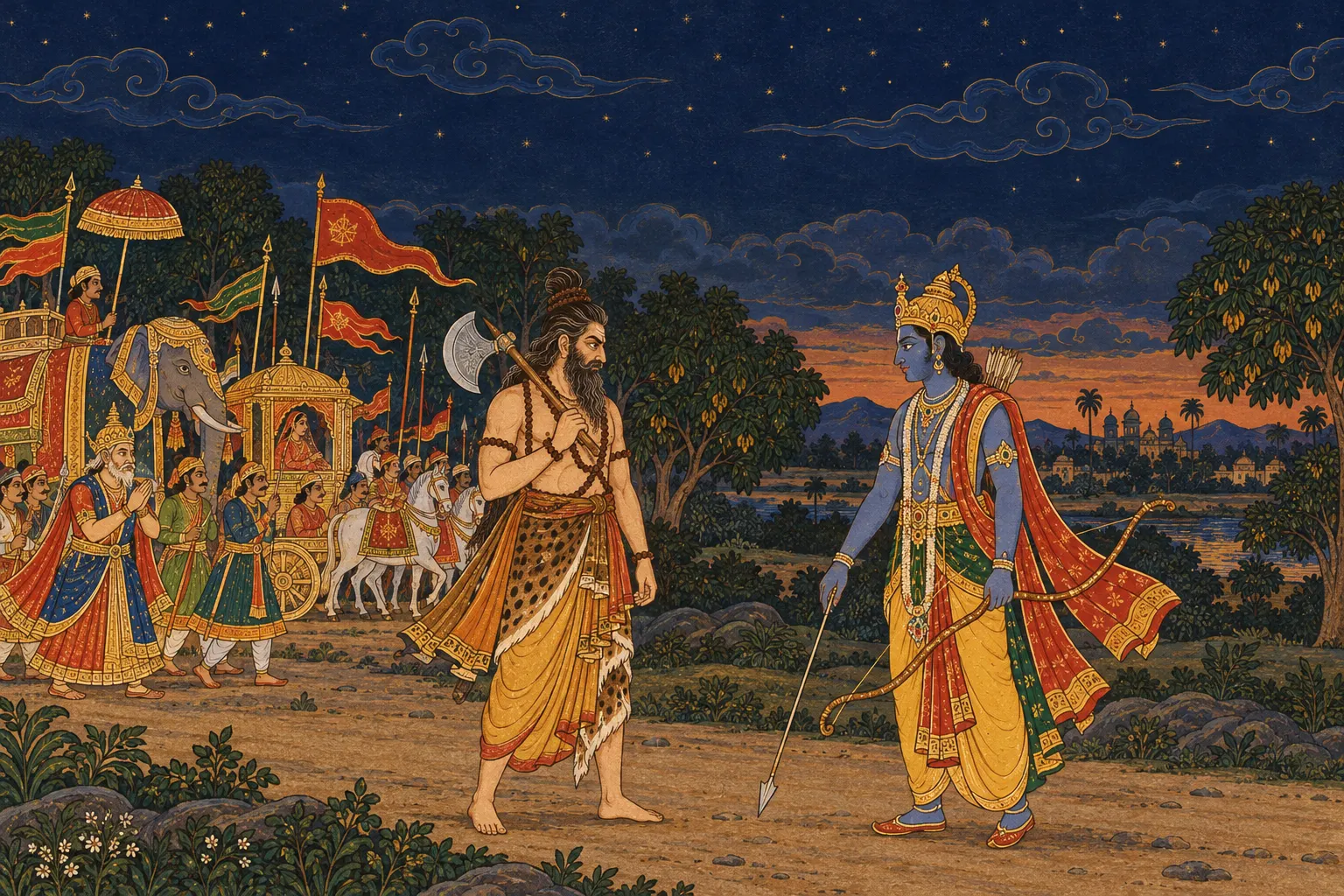
He had the sacred thread of his father and the fiery temper of his mother, like a sandalwood tree with a snake coiled round it. Kalidasa says two things that startle the reader: that at his father's command he had first cut off his mother's head — he conquered pity first — and then conquered the earth. And that, with a rosary of rudraksha at his right ear, he looked like the very count of twenty-one slaughters of kshatriyas.
Dasharatha's heart sank. His sons were still boys, and the name "Rama" was the same for his own son and for this fearful enemy. The name had become to him like a jewel that sits both in a necklace and on a serpent's hood.
Two Bows
Parashurama did not even look at Dasharatha. The king kept crying out, "An offering of welcome, an offering!" and the sage's eyes stayed fixed on Rama, burning with the fire of his anger at the kshatriyas.
He said, "The race of kshatriyas is my enemy; it has done me harm. I was calmed only by destroying it again and again. But news of what you did has woken me like a sleeping snake. You have broken the bow of the king of Mithila that no other king had bent. Hearing it, I felt that you had thrown down the pride of my valour.
"There was a time when the word 'Rama' meant only me in all the world. Now that you are rising, the word is split between us, and I feel ashamed. Know that Shiva's bow had already been weakened by Vishnu's power. The wind topples a tree on the river bank only when the current has already undermined its roots.
"This is my bow. Put an arrow to it. String it, and meet me in single combat. If the strength of your arms equals mine, I will admit defeat. And if you fear the edge of my axe, then fold your hands and ask for mercy."
Rama only smiled and took the bow. The very bow that Parashurama had held became beautiful the moment it was in his hand, like a fresh cloud with a rainbow drawn across it. As soon as it was strung, Parashurama's fire dimmed to the smoke of a quenched ember.
People saw the two standing face to face — one's radiance growing, the other's fading, like the sun and moon facing each other at evening.
A Closed Road, an Open Way
Rama set an arrow to the bow and said, out of compassion, "You are a Brahmin, and it was you who began the offence, yet I cannot strike you without mercy. Tell me: shall I send this arrow at your power to move, or at the worlds you have earned?"
Parashurama said, "I know you — you are the Primeval Being. I provoked you to see the divine fire in you. I destroyed my father's enemies and gave the earth to a Brahmin; today my defeat at your hands is itself an honour. Do not take away my power to move — I want to visit holy places. If the road to heaven is closed to me, I do not grieve; I am indifferent to pleasure."
Rama said, "So be it," and loosed the arrow to the east. That arrow closed the road to heaven for Parashurama. Rama touched the sage's feet and asked his pardon.
Parashurama said, "From my mother I had the nature of a kshatriya, and I have lost it to you in defeat, and kept my father's peace. You have turned my defeat into a kindness. Go; may no obstacle meet you on your way." And he vanished.
Dasharatha felt that his son had been born again — like rain falling on a tree surrounded by forest fire. After a few nights on the road, they reached Ayodhya, whose windows were full of the faces of women, like lotuses, looking at the princess of Mithila.
Note: This chapter follows canto 11. The OCR of my source was not clear for the verses on the killing of Tataka, so she is only hinted at. Kalidasa mentions Parashurama's cutting off his mother's head in a single verse; it is kept here to that length.
Source: Kalidasa's Raghuvamsha (from M. R. Kale's English translation, with Mallinatha's commentary), The Bow and Parashurama