
Chapter 1
Dilipa and Nandini
A king who had everything except a son — and a cow he followed, without once stopping, for twenty-one days
Dilipa and Nandini is chapter 1 of Raghuvamsha. Source: Raghuvamsha, cantos 1–2 (Kalidasa). It is told in 7 scenes — The Sun's Line and a Modest Poet; King Dilipa; At Vasishtha's Hermitage; Surabhi's Curse; Twenty-One Days; The Lion; Rise, My Son — followed by 10 quiz questions.
The Sun's Line and a Modest Poet
Kalidasa opens his great poem in an odd way: by acknowledging how small his own powers are. What is this glorious line of kings, descended from the Sun, he asks, and what is my modest talent beside it? It is like trying to cross an ocean on a raft, or like a short man stretching up for fruit meant for the tall.
And yet he writes, because the virtues of these kings have reached his ears. He tells us what the Raghus were like: pure from birth, men who carried every undertaking through to its fruit, who offered the sacrifices by the book, who gave to petitioners as each one wished, who punished in proportion to the crime. Schooling in boyhood, pleasure in youth, the forest in old age — and finally, through yoga, they relinquished their bodies.
The first king of that line was Manu. And in that line came Dilipa.
King Dilipa
Kalidasa paints Dilipa so that you see the man first and count his virtues afterwards. Broad chest, shoulders as broad as a bull's, the towering stature of a sal tree. He looked like warrior-courage itself, given a body to stand in.
His subjects were like the rim of a wheel under a good driver: wherever he steered, they ran in that track, never a hair's breadth to either side. And the taxes he took, in Kalidasa's image, were like the water the sun draws up from the earth — taken only to be given back a thousandfold.
His queen was Sudakshina, a princess of Magadha. His palace was full of wives, but he counted himself the husband of only two: Sudakshina and the goddess of royal fortune.
Yet this great king's house lacked one thing. Many years went by, and no son was born.
At Vasishtha's Hermitage
One day the king handed the burdens of the kingdom to his ministers and set out with his queen for the hermitage of their guru, Vasishtha. They rode in a single chariot, with only a handful of attendants, so as not to break the peace of the forest. Even so, their radiance made it look as if a whole army was marching with them.
All along the road the breeze brought them sweet scents. Peacocks lifted their necks at the rumble of the wheels; deer ran beside the chariot, and in the eyes of the stag and his doe, the king and queen caught a glimpse of each other's eyes. Dilipa kept pointing out one thing after another to his wife, and never noticed how far they had come.
They reached the hermitage at dusk. The sages were coming home from the forest with firewood, kusha grass and fruit, and deer lay about the courtyards of the huts as if they were the children of the sages' wives.
Dilipa touched the feet of Vasishtha and of his wife Arundhati. When the guru asked after his health, the king said that all was well in the kingdom — but there was a thorn in his heart. He feared, he said, that his forefathers drank the water he offered them warm with sighs, because they wondered who would offer it after him.
Surabhi's Curse
Vasishtha sat for a while with his eyes closed, still as a pond when the fish have gone to sleep. Then he told the king what the trouble was.
On his last journey home from Indra's court, Dilipa had passed Surabhi, the cow of plenty, resting in the shade of a wishing-tree. His mind had been on his queen, and he had failed to walk around her in respect. Surabhi had cursed him: until you serve my daughter, you will have no child. The elephants of the quarters were splashing in the Ganga just then, and the roar was so loud that neither the king nor his charioteer heard the curse.
The remedy was close at hand. Surabhi herself was far below the earth, attending Varuna's long sacrifice. But her daughter Nandini lived right there at the hermitage. Serve her, Vasishtha said, with the devotion you would give to the pursuit of knowledge.
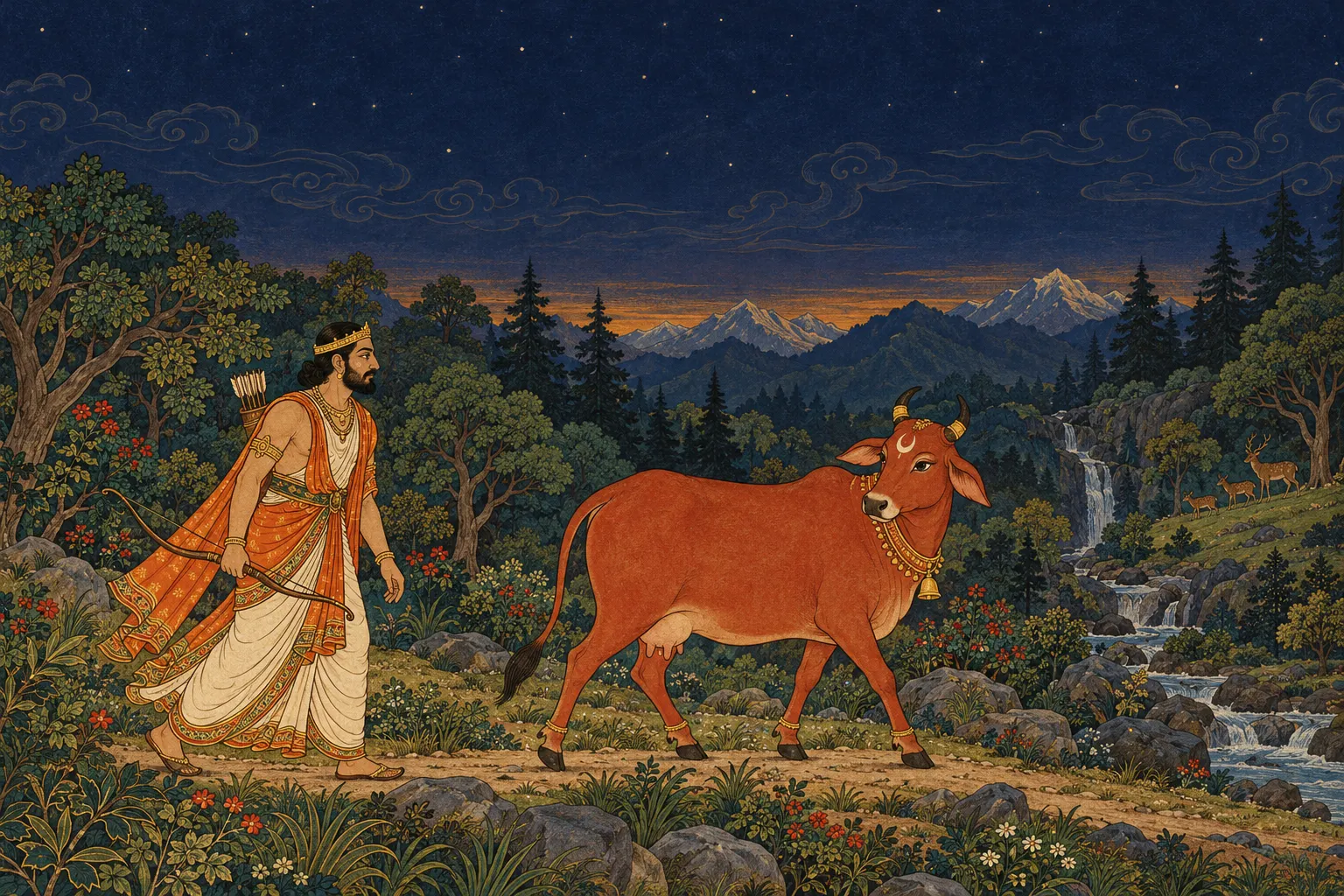
And at that very moment Nandini came back from the forest — red as a young leaf, with a white mark on her brow like a thin new moon. At the sight of her calf the milk began to run from her udder. "She came the instant she was named," said Vasishtha. "Your wish will soon be granted through her."
The rule was simple. When she walks, you walk. When she halts, you halt. When she sits, you sit. When she drinks, you drink. That night the king and queen slept on mats of kusha grass.
Twenty-One Days
At dawn Dilipa tied up the calf, anointed Nandini with sandal paste and adorned her with flowers, and let her out into the forest. The queen went a little way behind the cow; then the king sent her back. Now he was alone, bow in hand, with no attendants.
Dilipa put aside his kingship and became the cow's shadow. He fed her mouthfuls of green grass, scratched her back, brushed off the flies, and let her graze wherever she liked. When she stopped, he stopped; when she walked, he walked. Kalidasa writes that the trees seemed to call out in birdsong, "Victory to the king!" and that the wind would not let him be scorched, though he carried no umbrella against the sun.
In the evening Nandini walked ahead on her way back to the hermitage, and the king followed her. The queen waited at the edge of the grove to receive them. With the cow between the two of them, they looked like twilight between day and night.
At night the king sat beside her with a lamp and the offering-tray, and slept when she slept and woke when she woke. Three times seven days — twenty-one days — went by like this.
The Lion
On the twenty-second day Nandini wandered into a cave in the Himalaya, where tender grass grew in the spray of the Ganga. The king's eyes were caught by the beauty of the mountain. At that moment a lion sprang and seized the cow.
Her cry rebounded from the walls of the cave and pulled the king's gaze back like a rope. Dilipa saw the red cow with a lion on her back, like a lodhra tree in bloom on a mountain of red ore. He reached for an arrow — and his right hand stuck fast to the shaft and stayed there, stone-still, like a hand in a painting.
Then the lion spoke in a human voice. "Spare yourself the effort, King Dilipa. I am Kumbhodara, a servant of Shiva, friend of Nikumbha. Do you see that deodar tree? Parvati has raised it as her son. Once a wild elephant rubbed its bark raw, and Parvati grieved as if Skanda himself had been struck by a demon's arrow. Since then Shiva has set me in this cave, to live on whatever creature comes within my reach. Today is my day to eat, and this cow has come to me by divine providence."
Dilipa answered, "You serve Shiva, and I honour the maker of the world. But I cannot bear to see my guru's trust destroyed before my eyes. Eat me instead, and let the cow go."
The lion laughed. "You, an emperor, with your youth and your looks — you would throw them away for one cow? If you fear your guru's anger, give him a hundred million cows. A king's comfort is heaven itself. Your death would save only this one cow; if you live, you are a father to all your people."
Then Dilipa spoke the words for which this story is remembered. "The word kshatra means one who protects from harm. A man who does not do that — what use is a kingdom to him, and what is a life stained with shame? How could ordinary cows take this one's place? She is like Surabhi herself. Let your hunger be fed and the sage's sacrifice not fail — so I give you my body."
The lion said, "So be it." Dilipa laid down his weapons, bowed his head, and waited for the lion's spring, like a lump of flesh lying on the ground.
Rise, My Son
Just then flowers rained down on him from the sky, scattered by the Vidyadharas. A voice like nectar reached his ears: "Rise, my son."
Dilipa lifted his head. There was no lion. Nandini stood before him like a mother, milk dripping from her udder.
The cow said, "My son, I made an illusion to test you. By the sage's power, not even Yama could strike me, still less a lion. I am pleased by your devotion to your guru and your pity for me. Ask a boon. Do not think of me as only a giver of milk — when I am pleased I also fulfil wishes."
Dilipa folded his hands and asked for a son — one who would carry the line forward and whose fame would never fade. "So it shall be," said Nandini. "Milk me into a cup of leaves and drink."
Dilipa said, "Mother, I will drink only what is left after the calf has had its fill and the sacrifice its share — and only with my guru's leave, just as I take only a sixth part of what the earth yields." Hearing this, Nandini was even more pleased.
Back at the hermitage the king told his guru, and then his queen, all that had happened. Kalidasa says they hardly needed the words — the glow on the king's face had told them already. The next morning Vasishtha sent them home, after they had walked around Arundhati and the sacred fire. Nandini and her calf came to see them off.
A few days later, Queen Sudakshina conceived.
Note: The first two cantos of the Raghuvamsha (verses 1–95 and 1–75) are Kalidasa's own telling; no Purana is named as a source. Verse numbers follow M. R. Kale's English translation. According to Mallinatha's commentary, the cause of the curse is the disrespect shown to Surabhi.
Source: Kalidasa's Raghuvamsha (from M. R. Kale's English translation, with Mallinatha's commentary), Dilipa and Nandini