
Chapter 5
Indumati's Loss
A garland fell from the sky and the queen was gone — the king carried his grief for eight years, then laid down his body where the Ganga and Sarayu meet
Indumati's Loss is chapter 5 of Raghuvamsha. Source: Raghuvamsha, canto 8 (Kalidasa). It is told in 5 scenes — Raghu Renounces the World; Dasharatha and the Garland; Aja's Lament; Vasishtha's Message; Eight Years — followed by 10 quiz questions.
Raghu Renounces the World
Raghu crowned Aja king and made ready to go to the forest himself. Aja put his head at his father's feet and begged him not to leave him. Raghu loved his son dearly and gave in, and settled in a hermitage outside the city. But the royal fortune he had once laid down he never took up again — as a snake does not put back on the skin it has shed.
Father and son lived in one household but in two different ways. Aja sat on the throne and heard his subjects' cases; Raghu sat alone on a seat of kusha grass in meditation. One tried the six means of statecraft; the other mastered the three strands of nature. Raghu spent a few years there at Aja's wish, and then, through yoga, reached the Supreme Spirit and gave up his body.
Aja performed his father's last rites without fire, along with the yogis — for those who have left the body in that way do not need their sons' offerings.
Dasharatha and the Garland
Time passed. The earth gave Aja her jewels, and Indumati gave him a son — Dasharatha, he who drives his chariot in ten directions, and who would be father of Ravana's enemy.
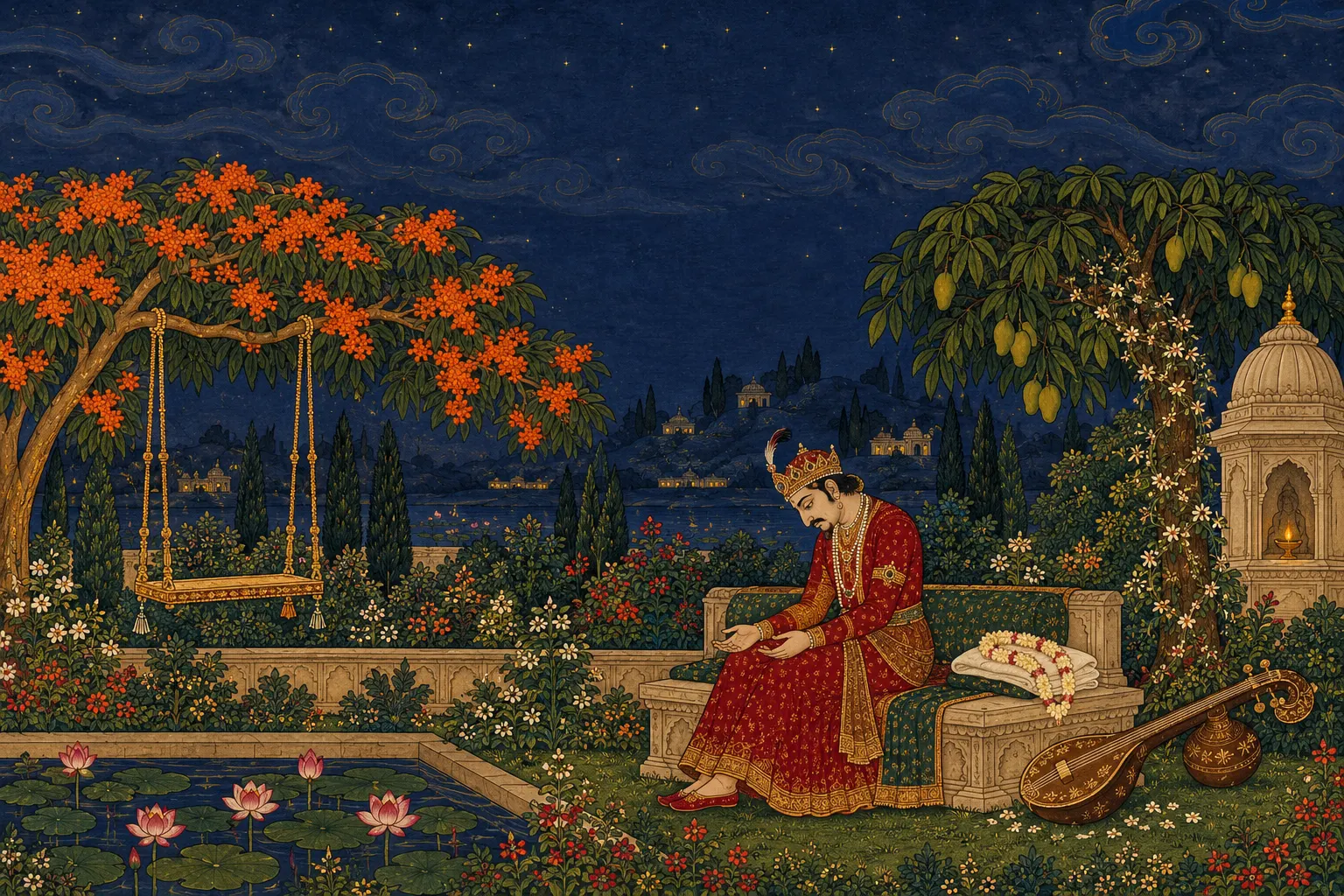
Then one day Aja was walking in a garden with his queen, as Indra walks with Shachi in the Nandana grove. At that moment the sage Narada was on his way to the southern shore, to play his veena before Shiva at Gokarna. A gust of wind snatched a garland of heavenly flowers from the end of his veena. It fell in the garden, onto Indumati's breast.
Indumati saw it, and her eyes closed. She was gone in that instant — as moonlight goes when the moon is eclipsed. And the king, too, staggered and fell with her, as the flame of a lamp falls together with a drop of its oil.
The servants' cries startled the birds. The attendants fanned Aja until he regained consciousness; Indumati did not. A remedy works only where a remnant of life is left.
Aja's Lament
Aja took her up into his lap — like a veena whose strings have not yet been strung, silent for want of sound. And he wept. Kalidasa writes that iron grows soft when it is heated; what then of one who has a body?
"Alas, if even a flower can take a life, what weapon does Fate need? Or perhaps Death takes the tender with the tender — frost kills the lotus stalk. If this garland could take life, why did it not take mine, who wear it on my chest? Or perhaps the Creator has made a thunderbolt that spares the tree and breaks the creeper twined around it.
"Beloved, even when I wronged you, you never kept silent for long. Today you left without a word to me. My life followed you first — why has it come back without you? Let it suffer for that. The sweat of love's weariness is still on your face, and you are gone. How fragile this mortal life is!
"Your friends shared your joys and your sorrows. This son of yours is like the moon of the first day. All my love was centred on you. Yet you have been cruel. Today my composure is gone, my joys are over, music has stopped, the season is dull, ornaments have no use, and my bed is empty.
"You were my wife, my counsellor, my friend, my favourite pupil in the fine arts. Tell me, what has Death not taken from me with you? You drank sweet wine from my mouth — how will you drink the water offering that reaches you wet with my tears?"
Kalidasa says the king's lament made even the trees weep, with sap running from their boughs like tears.
Afterward his kinsmen, with great difficulty, lifted her body from his lap and laid her on a pyre of aloe and sandalwood. The king did not follow her into the flames, for people would have said that the king died after his wife — not because he wished to live no longer. The rites up to the tenth day were completed in that same garden.
Vasishtha's Message
Vasishtha, who was consecrated for a sacrifice at his hermitage, knew everything through meditation. He sent a message to Aja through a pupil.
"The great sage knows the reason for your grief. Because of the sacrifice he could not come himself. He says: long ago, the sage Trinabindu was practising penance. Fearing him, Indra sent the nymph Harini to disturb him. In anger the sage cursed her: be a woman on earth. When she begged forgiveness, he said: you will live on earth until you see a flower of heaven. That Harini was born in Vidarbha and became your queen. When she saw the flower of heaven she was freed from the curse and left. So put aside your grief.
"Whoever is born must die. Protect the earth — the earth is a king's true wife. You will not get her back by weeping, nor by dying after her, for each person's road after death differs by what they have done. Your tears burn her; offer water instead. A wise man takes separation from a loved one as the drawing out of an arrow. The difference between a tree and a mountain is that when the wind blows, the tree shakes and the mountain does not."
Aja said, "So be it," and sent the pupil on his way. But Kalidasa says the message found no place in his grief-filled heart and went back, as it were, to the guru.
Eight Years
Keeping in mind that his son was still a child, Aja somehow got through eight years — looking at pictures of Indumati, at things that reminded him of her, and at her brief visits in dreams. The thorn of grief stayed in his heart as the shoot of a fig tree splits the roof of a palace.
When Dasharatha had become master of weapons and scripture, Aja gave him the charge of the kingdom. Then, wishing to be rid of his body, sick as it was, he gave up food.
At the meeting of the Ganga and the Sarayu he left his body. And Kalidasa says that he was counted among the gods, met his wife again — lovelier than in her earlier body — and the two began to play again in the groves of Nandana.
Note: This chapter follows canto 8 (verses 1–95). The lament passages are a paraphrase of Kalidasa's words, not word for word. One verse (72), in which Kalidasa has Aja stop short of dying with her for fear of public blame, is kept here in brief.
Source: Kalidasa's Raghuvamsha (from M. R. Kale's English translation, with Mallinatha's commentary), Indumati's Loss