
Chapter 11
Kusha, the Naga Princess and Atithi
The city Rama left behind came to Kusha at midnight as a widowed woman — and a naga princess was married for a lost jewel
Kusha, the Naga Princess and Atithi is chapter 11 of Raghuvamsha. Source: Raghuvamsha, cantos 16 and 17 (Kalidasa). It is told in 6 scenes — At Midnight; Ayodhya in Ruins; Towards Ayodhya; Water-Play in the Sarayu; The Naga Princess; Atithi — followed by 10 quiz questions.
At Midnight
After Rama, the eight princes of his line — Kusha and Lava among them — took their places, and Kusha as the eldest was honoured as the greatest by all, for brotherly love was the family's inheritance. Kalidasa says that family, sprung from parts of Vishnu, divided into eight branches, and none crossed its own border, as the sea does not cross its shore.
Kusha ruled at Kushavati. One midnight, when the servants slept and the lamps burned low, Kusha saw a woman standing in his bedchamber — one he had never seen before, dressed as a wife whose husband is away. The doors were shut, yet she had come in like a reflection in a mirror.
She folded her hands and said, "May all be well." Kusha half rose. "Lady, you have come in through a closed door, yet you do not seem a yogini. You look as sorrowful as a lotus-plant touched by frost. Who are you, whose wife are you? Remember that the mind of a Raghu does not turn to another man's wife."
She said, "O king, I am the presiding goddess of the city whose citizens your father took with him to heaven. I once surpassed Alaka, bright with festivals. Today my towers lie broken and my ramparts have fallen."
Ayodhya in Ruins
"On the royal roads where women once went at night to meet their lovers, jackals now walk, sparks flying from their mouths. In the pools where women's hands made drum-sounds in the water, buffaloes bellow, goring the water with their horns. The pet peacocks lie on the trees, their perches broken, their feathers scorched by wildfire.
"On the steps where women once set their henna-red feet, tigers set paws bloody from the deer they have killed. Lions' claws have scored the elephants painted on the walls. Snake-slough drapes the painted women on the pillars. The empty ghats of the Sarayu pain me.
"So leave that place and come back to your family's capital — as your father left his human form and took up the form of Vishnu."
Kusha said, "So be it." And at that moment the woman was seen no more. In the morning the king told the Brahmins what had happened. They said, "The capital itself has chosen you as her husband."
Kusha entrusted Kushavati to Brahmins learned in the Vedas and, with his queens, set out for Ayodhya on an auspicious day.
Towards Ayodhya
When Kusha's army marched it seemed like a moving capital: the rows of banners were its gardens, the great elephants its playing hills, the chariots its palaces. The weight on the earth rose as dust into the sky, like Vishnu's second step.
The elephants' musth turned the road's dust to mud, and the pounding hooves of the horses ground the mud back to dust. When the army crossed the Vindhya, the caves rang like the roaring Narmada. They crossed the Ganga on a bridge of elephants.
Reaching the bank of the Sarayu, Kusha saw hundreds of sacrificial posts set up by the Raghus. The breeze from the capital's gardens came out to welcome his tired army.
After the foundation-rite he entered the city, as a lover enters the heart of his beloved. Markets were laid out; horses in the stables, elephants in the elephant-houses. Kalidasa says the city looked like a woman with ornaments on every limb. And Sita's son, sitting in that house of his forefathers, envied neither Indra nor Kubera.
Water-Play in the Sarayu
Then came summer. Kusha wished to play in the Sarayu with his queens. Tents were pitched on the bank, and fishermen cast nets to clear it of crocodiles.
Seated in a boat, Kusha said to the Kirata woman holding a whisk beside him, "Look, the water of the Sarayu is as red as the evening glow, from my queens' washed-off ointments. The waves have carried away the kohl from their eyes, but the flush of wine has dressed their eyes again."
He himself went down into the water from the boat and played with the queens as a wild elephant plays with his mates. The queens drenched him in coloured water from golden syringes.
In this play the armlet — which Rama had received from Agastya and given to Kusha with the kingdom, the charm of victory — slipped into the water, and Kusha did not even notice.
Back in the tent he saw his arm bare, and was distressed. Not out of greed — it was his father's, the charm of victory. Divers were called. They searched and found nothing. They said, "Lord, it must be Kumuda, the naga who lives in the deep pool of the Sarayu, who took it out of greed."
The Naga Princess
Kusha's eyes went red with anger. He strung his bow, fitted the Garuda missile, and went forward to destroy the serpent. The pool boiled, lashing its arms of waves like a wild elephant trapped in a snare thrashing its trunk.
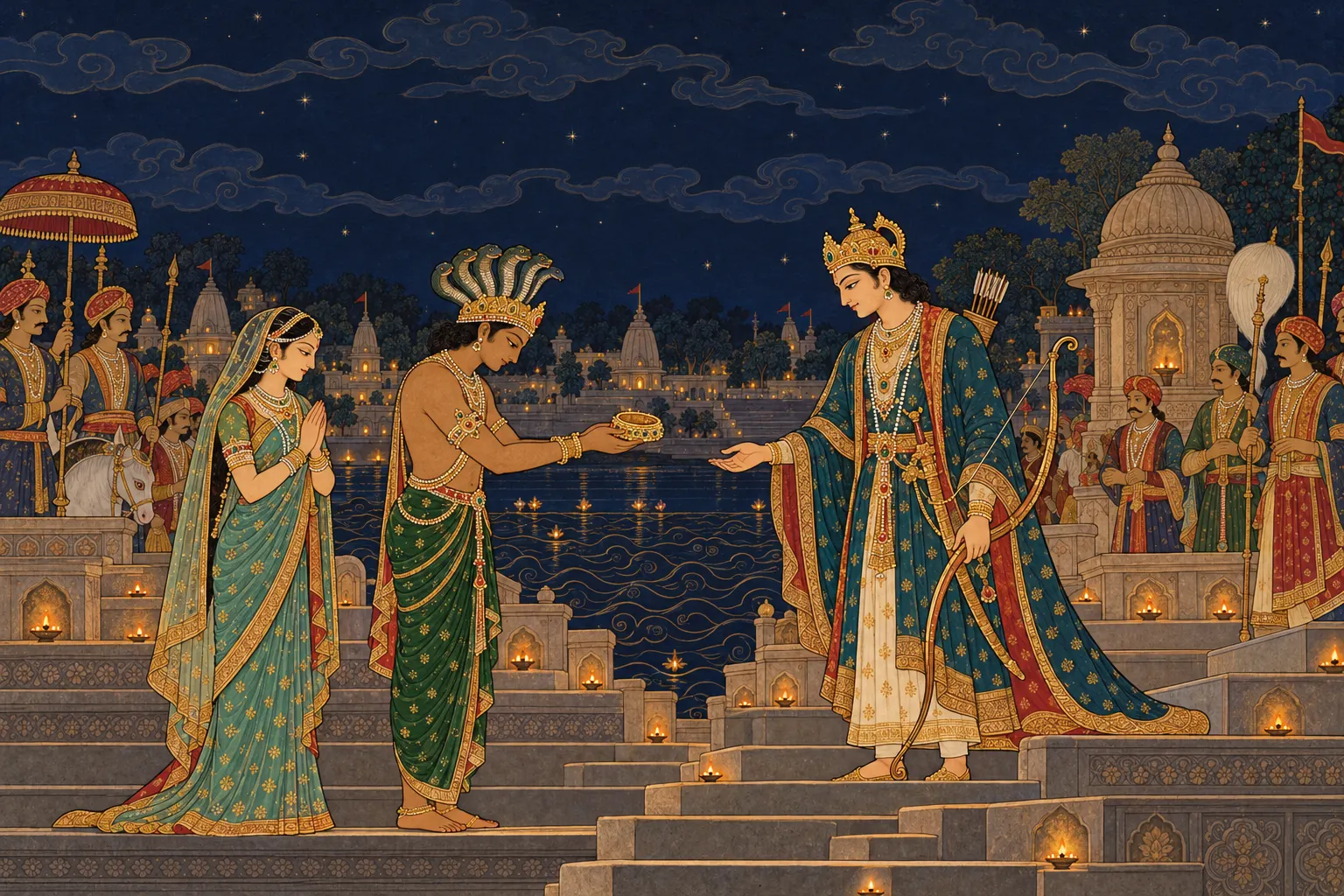
Then from that pool rose the serpent-king Kumuda, with a maiden before him — as the Parijata rose with Lakshmi from the churned ocean — and the jewel in his hand.
Kusha held back the missile of Garuda, the serpents' enemy, for the good do not nurse anger against the humble.
Kumuda bowed his head and said, "I know you to be the son of the form that is Vishnu's own. How would I dare disturb the peace of such as you? This is my little sister Kumudvati. Her ball flew up, and she saw your ornament falling from the sky and picked it up from curiosity."
"Wear it again on your arm, the bar of the earth's gate. And, O king, accept my little sister, who wants to make amends for her fault with a lifetime of service at your feet."
Kusha said, "You are a worthy kinsman," and took Kumudvati's hand before the fire. Celestial drums sounded from the sky and clouds rained flowers.
Kumuda had the joy of being kin to Sita's son, the son of the lord of the three worlds, and his fear of Garuda was gone.
Atithi
Kumudvati's son was named Atithi. Kusha taught him first the learning of the line, then gave him the hands of princesses, and felt himself doubled.
After that, going to help Indra, Kusha killed the demon Durjaya, and was himself killed by him. Kumudvati followed him, as moonlight follows the moon. Kusha sat on half of Indra's throne, and Kumudvati, a friend of Shachi, shared in the Parijata flowers.
The old ministers, remembering the king's last order, anointed Atithi. A new pavilion was built, with four pillars and a high platform. Water from holy places came in golden pitchers. The elders waved lamps over him with durva shoots and barley ears. The victory-giving mantras of the Atharva Veda were recited.
Kalidasa says the stream of the consecration fell on his head as the Ganga fell on Shiva's. Bards praised him, and he looked like a chataka bird delighted by thunder. After the anointing he gave the snatakas enough wealth to complete their sacrifices, freed prisoners, stopped executions, freed oxen from the yoke and cows from milking, and set the parrots and mynas free from their cages.
Then he rode through the city on an elephant. Kalidasa goes on to list his virtues: his word was never false, what he gave he never took back, and with youth, beauty and wealth together, no pride entered his mind.
Note: This chapter follows cantos 16 and 17 (verses 16.1–88, 17.1–81). Verses 16.35–71 (the water-play and the summer description) are only hinted at; the full description is long and ornate. A large part of canto 17 is a list of the virtues of statecraft, and only its gist is taken.
Source: Kalidasa's Raghuvamsha (from M. R. Kale's English translation, with Mallinatha's commentary), Kusha, the Naga Princess and Atithi