
Chapter 10
Lava and Kusha, and Rama's Departure
Two sons who sang their father's own story before his face — and the king who then walked into the Sarayu, with his whole city behind him
Lava and Kusha, and Rama's Departure is chapter 10 of Raghuvamsha. Source: Raghuvamsha, canto 15 (Kalidasa). It is told in 5 scenes — Rama Alone; The Brahmin's Son; The Horse Sacrifice and Lava and Kusha; The Mantle of the Earth; The Departure — followed by 10 quiz questions.
Rama Alone
After sending Sita away, Rama ruled the ocean-bound earth without her. The sages of the Yamuna, whose sacrifices were being ruined by the demon Lavana, came to Rama as their refuge. Lavana had been given Shiva's trident and was unconquerable as long as it was in his hand.
Rama gave them his promise of safety and sent Shatrughna. Shatrughna went on without hindrance. On the way he stopped at Valmiki's hermitage, and that very night Sita gave birth to two sons. Valmiki performed the rites and named them Kusha and Lava, because the moisture of their birth had been wiped away with kusha grass and with a tuft of a cow's tail-hair, lava.
Hearing of the boys' birth, Shatrughna took leave of the sage the next morning with folded hands and went on to Madhupuri.
Lavana was coming back from the forest with his prey, black, smelling of fat, like a moving funeral fire. He had left the trident at home. Shatrughna attacked him at once. Struck by Vishnu's arrow, Lavana fell to the ground; the sages cried victory, and flowers fell from the sky. On that spot, on the bank of the Yamuna, Shatrughna founded the city of Mathura.
The Brahmin's Son
On his way back to Ayodhya, Shatrughna stopped again at Valmiki's hermitage. At night, from a distance, he heard the boys singing. In the morning he had to meet Rama.
In Ayodhya a Brahmin came to Rama's door with his dead son in his arms and cried, "O Earth, what a state you are in! Slipping from Dasharatha's hands and falling into Rama's, you have passed from pain to greater pain."
Rama was ashamed. Never before in the kingdom of the Ikshvakus had a child died untimely. He said, "Wait a moment," and thought of Kubera's Pushpaka.
Taking his weapons he set out in the Pushpaka, and a voice from the sky said: "O king, somewhere in your kingdom something against dharma is being done. Find it and stop it, and your purpose will be served." Rama searched in all directions. In one place he saw an ascetic hanging by his feet from the branch of a tree, head down, eyes red, absorbed in penance.
Rama asked, "Who are you?" The man gave his name — Shambuka — and said he was a Shudra, practising penance to reach the rank of a god.
Kalidasa goes on to say plainly that Rama judged him deserving of punishment — because he was practising a penance he was not entitled to, and so bringing calamity on the people — and took up his weapon and cut off his head. On the severed head, like a lotus, the beard was singed by sparks of fire. Shambuka, the poet says, reached the world that the righteous reach — not by his hard penance but because he was punished by the king's own hand. And the Brahmin's son came back to life.
Rama then returned, meeting Agastya on the way. Agastya gave him an ornament, worthy of a heavenly being, which the sea had given Agastya as ransom when he was drinking it up.
The Horse Sacrifice and Lava and Kusha
Then Rama released the horse of the Ashvamedha. Demons, monkeys and men all came, as clouds come to ripe fields. Sages came to Ayodhya in such numbers that the city with its four gates looked like the four faces of Brahma. At the sacrifice Rama set a golden Sita in his wife's place — for he had not married again.
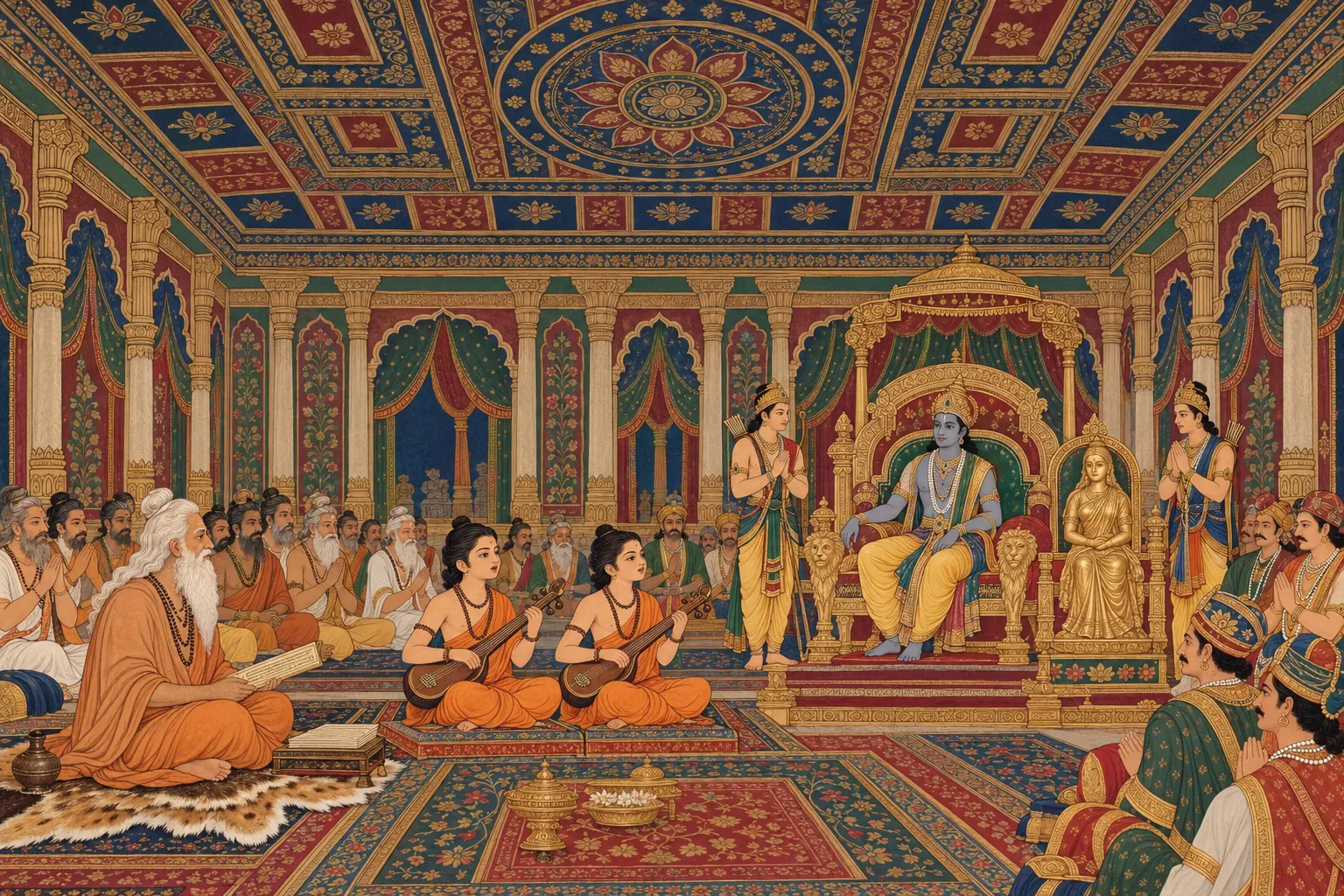
At that time Lava and Kusha, as their teacher had instructed, wandered here and there singing Valmiki's composition — the Ramayana. It was Rama's story, composed by the poet Valmiki, in a voice like that of the kinnaras — how could listeners not be charmed? Rama heard of their beauty and sweet voices. When he saw them, their faces were like his own.
The boys sang Rama's story before Rama himself, and he listened. Valmiki said to Rama, "These are your sons, born of Sita." Then he sent for Sita to come to the assembly.
The Mantle of the Earth
Sita came in a saffron robe, her eyes on her feet, her body still. The whole assembly stood with eyes lowered, like ears of rice heavy with grain. Valmiki said to her, "Daughter, remove the doubts of the people before your husband."
Sita rinsed her mouth with water and said, "If, in mind, word or deed, I have never transgressed against my husband, then, O Earth who bears all things, give me room within you."
At that instant the earth split open, a light like lightning shone out, and the goddess Earth, with the ocean for her girdle, appeared seated on a throne held up by the hoods of serpents. She took Sita into her lap and descended into the nether world. Rama kept crying, "No, no." In anger at the Earth Rama took up his bow. Then his guru Valmiki, explaining the power of fate, calmed him.
The sacrifice was completed. Rama honoured and dismissed the sages and his friends, and poured all his love for Sita onto their two sons.
The Departure
Bharata went to conquer the land of Sindhu, sent by Rama, and so thoroughly defeated the gandharvas that they had to lay down their arms and keep only their lutes. His two sons received Takshashila and Pushkalavati.
Then one day Kala himself, in a sage's guise, came to speak with Rama in private, and a condition was set: whoever came in between would be abandoned. Lakshmana was at the door. When the sage Durvasa's curse threatened, Lakshmana broke his brother's condition. Rama abandoned Lakshmana, as he had promised — and Lakshmana, by the bank of the Sarayu, laid down his body in yoga and went to heaven.
Kalidasa says Rama, with one quarter of himself gone ahead, was like Dharma left with three legs. He made Kusha king at Kushavati and Lava at Shravasti and, with his brothers, set out to the north with the sacred fire carried before him, followed by the people of Ayodhya in their love. The monkeys and demons, knowing his intention, came behind. Tears as large as kadamba buds fell on their path.
As Rama went down into the Sarayu, a heavenly chariot was waiting for him. Out of kindness to his devotees he made the Sarayu a ladder to heaven. People crowded down into it as a herd of cattle crosses a river, and so that place was called Gopratara, the cow-crossing — a holy place.
Beings like Sugriva, who were parts of gods, returned to their original forms, and Rama created a separate heaven for the citizens who had become gods.
And then, having done the gods' work — having cut off Ravana's heads, set up Lanka for Vibhishana and the northern mountain for Hanuman — Rama took back his own form as Vishnu.
Note: This chapter follows canto 15. The Shambuka episode (15.49–53) is in the Raghuvamsha and also in Valmiki's Uttara-kanda; it is told as the poet tells it, but not held up as an ideal or a verdict. In my source some verses of canto 15 were unclear in the OCR; there only the event is kept.
Source: Kalidasa's Raghuvamsha (from M. R. Kale's English translation, with Mallinatha's commentary), Lava and Kusha, and Rama's Departure