
Chapter 3
Raghu and Kautsa
The king who conquered the quarters and then gave away everything — and when a young scholar came asking, begged gold from Kubera out of a clay pot
Raghu and Kautsa is chapter 3 of Raghuvamsha. Source: Raghuvamsha, canto 4 and canto 5 (verses 1–35) (Kalidasa). It is told in 4 scenes — The King Who Set Out in Autumn; Towards the Four Quarters; The Clay Pot; Gold from Kubera — followed by 10 quiz questions.
The King Who Set Out in Autumn
When Raghu took the throne, a fire flared up in the hearts of the enemies who had cowered before Dilipa. But Raghu, the moment he took up his father's throne, brought his enemies under his hand as well.
His people looked to him with hope, as to the flag raised in honour of Indra. The wise in statecraft pointed out two roads — the straight and the crooked. Raghu chose only the first. As the moon is called "the delighter" for pleasing, and the sun "the heater" for heating, so Raghu was called "raja" because he pleased his subjects.
Then autumn came. The roads dried, the rivers shrank, and in Kalidasa's words autumn itself invited him to conquest — before his own spirit could urge him on. The horses were worshipped, the sacrificial fire gave its blessing of victory by leaning to the right, and Raghu marched out with his army.
Towards the Four Quarters
He went first to the east. The kings of Suhma bent like reeds and so were spared; the kings of Vanga who met him with ships were uprooted. Then the river Kapisha was crossed on a bridge of elephants, and he fought the king of Kalinga, lord of Mount Mahendra. Raghu won — but Kalidasa says he took the king's wealth, not his kingdom.
Then south: the Kaveri, the cardamom and pepper hills of the Malaya, and the Pandya king, who gave him pearls from the mouth of the Tamraparni. In the west the dust of his army settled on the hair of the women of Kerala, and Kalidasa says that to Raghu the sea paid tribute through the western kings — just as it had once made a way for Rama. Then he marched overland against the Persians.
In the north his horses rested on the bank of the Indus. The Huna women's cheeks flushed red — the sign that their husbands had been beaten. The king of Kamboja bowed along with the walnut trees his elephants were tied to. Then the Himalaya, the Kiratas and Kinnaras — and, across the Brahmaputra, the king of Pragjyotisha.
On his return Raghu performed the Vishvajit sacrifice, in which a man gives away everything he owns as the priests' fee. Kalidasa says good men are like clouds: they gather only to give. He honoured the defeated kings and sent them home.
The Clay Pot
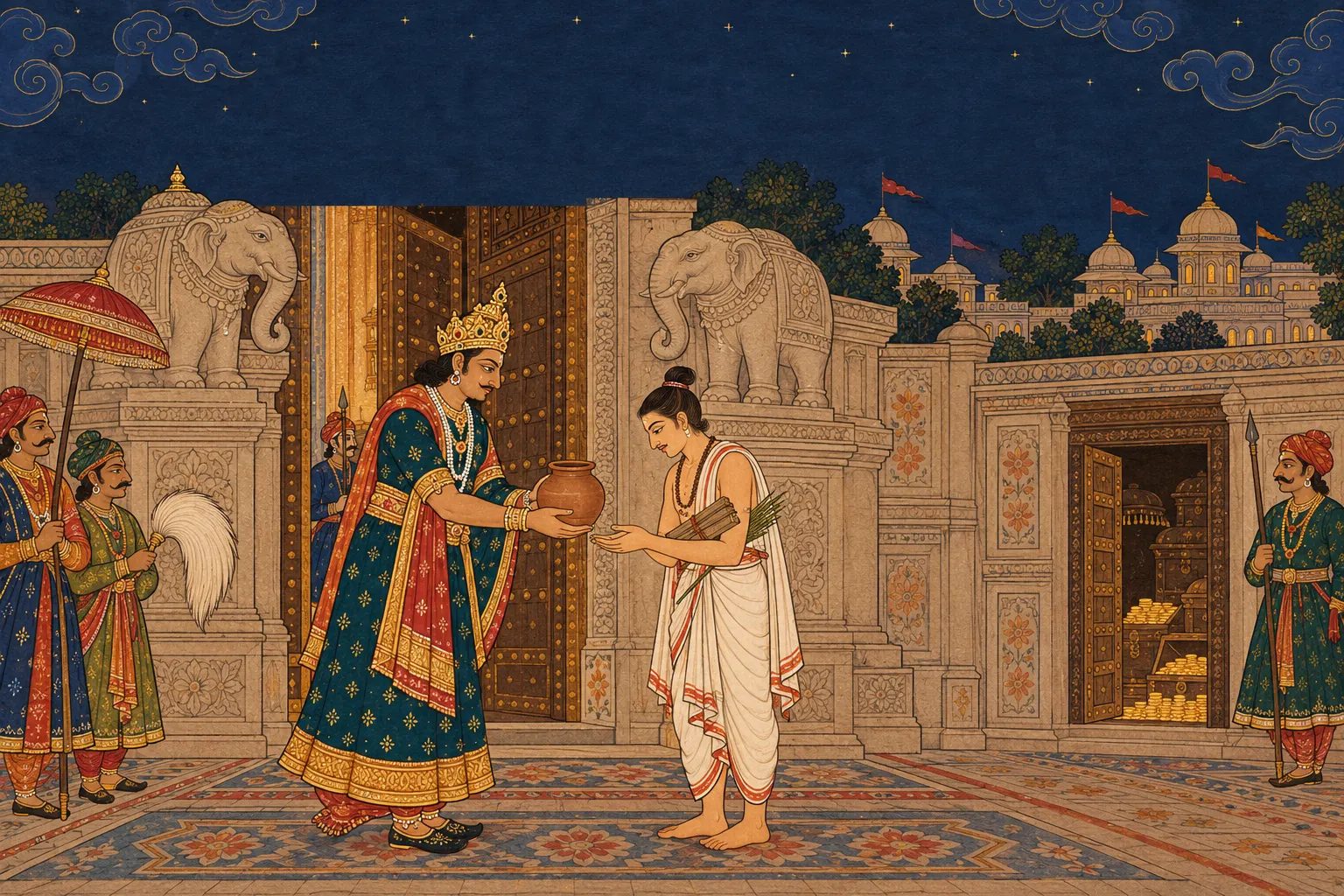
After the sacrifice, Raghu had nothing left. That was the day Kautsa, a student of the sage Varatantu, came to him. He had finished his studies and had to pay his teacher.
All the gold vessels were gone. Raghu came out to receive his guest with the offering-water in a clay pot. Kautsa saw it, and understood that the king now had nothing but the name of king. The king asked, "Is your guru well? His penance shakes Indra's seat. Are the trees of your hermitage, the water and the deer all well? And what brings you here?"
Kautsa said, "All is well, my lord. With a king like you, what sorrow could touch the people? But I have come too late. You have given everything to those who asked — like a rice plant stripped by foresters until only the stalk remains." He rose to go.
Raghu stopped him. "What do you want, and how much?" Kautsa said, "My guru never asked me for a fee. I was the one who kept insisting. At last he lost patience and said: bring me as many crores of gold coins as there are branches of learning you have studied — fourteen crores." Raghu said, "Let it not be said for the first time that a petitioner came to a Raghu's door for his guru's fee and went away to another. Please stay in my fire-hall for two or three days, like a fourth sacred fire. I shall arrange it."
Gold from Kubera
With the earth's treasures exhausted, Raghu decided to turn to Kubera, lord of wealth. By the power of Vasishtha's consecration, his chariot could not be stopped on sea, in the sky or on mountains. That night he slept in his weapon-filled chariot, ready to march against Kubera as against a mere feudal chief.
At dawn the treasury officers came running, breathless. A shower of gold had fallen from the sky into the treasury. Kubera had paid before the fight began.
Raghu wanted to give all the gold to Kautsa. Kautsa would take fourteen crores, and not one coin more. Raghu kept saying, "It is all yours." Kautsa kept saying, "I want only what my guru asked." The people of Ayodhya watched in wonder — one who would not take more than he needed, and one who gave more than he was asked.
The treasure was loaded on hundreds of camels and mules. As he left, Kautsa laid his hand on Raghu's head and said, "A king from whom even the sky is milked — what wonder that the earth gives to him? What blessing can I give you? Only one: may you have a son like yourself, as your father had you."
After that blessing a son was born to Raghu. He was born at Brahma's hour, and so he was named for Brahma — Aja.
Note: This chapter covers canto 4 (the conquests) and canto 5, verses 1–35 (Kautsa's story). The places Kalidasa names (Suhma, Vanga, Kalinga, Pandya, Kamboja, Pragjyotisha) cannot always be matched exactly to modern locations, so only directions and well-known names are kept here.
Source: Kalidasa's Raghuvamsha (from M. R. Kale's English translation, with Mallinatha's commentary), Raghu and Kautsa