
Chapter 2
The Birth of Raghu
The son whose name means "the one who goes" — and who fought Indra himself, and asked for his father's sacrifice instead of the horse
The Birth of Raghu is chapter 2 of Raghuvamsha. Source: Raghuvamsha, canto 3 (Kalidasa). It is told in 5 scenes — The Birth; The Name; The Hundredth Horse; War with Indra; The Family Way — followed by 10 quiz questions.
The Birth
Sudakshina began to show the signs of her pregnancy. Kalidasa says she grew pale, wore fewer ornaments, and thinned until she was like a dawn sky with a few stars left and a faded moon. The king kept asking whether she had any wish at all — and whatever it was, nothing was beyond his reach.
As the months went by, the king saw her as the earth itself, carrying a hidden treasure. Nine months passed. At the moment the son was born, five planets stood in their exalted positions, the quarters brightened, and the flame of the sacred fire leaned to the right. The newborn's glow made the lamps in the lying-in room look as if they had been painted on the wall.
To the servant who brought news of the boy, the king gave everything except three things: the moon-white umbrella and the two fly-whisks, the marks of a king. He gazed at his son's first face with eyes as unblinking as a lotus in still air.
The Name
When it was time to name the child, Dilipa thought of the destiny awaiting him. His son would master every branch of learning and pursue his enemies to the ends of the earth. It was this idea of reaching the farthest limits that gave the boy his name — Raghu.
Raghu grew as the young moon grows by the sun's rays. He learned his letters, was given the sacred thread, mastered the four branches of learning, and learned the weapons from his father himself — for Dilipa was not only the one king on earth but the one archer. He married, and the king made him crown prince. Kalidasa says the goddess of royal fortune, who loves virtue, moved half-way from the old king to the newly named crown prince, as beauty moves from one open lotus to another.
The Hundredth Horse
Dilipa had completed ninety-nine sacrifices without obstruction. Now the horse for the hundredth was set loose, and Raghu was given charge of it, along with other princes and archers.
But before the guards' very eyes, Indra, invisible, carried the horse away.
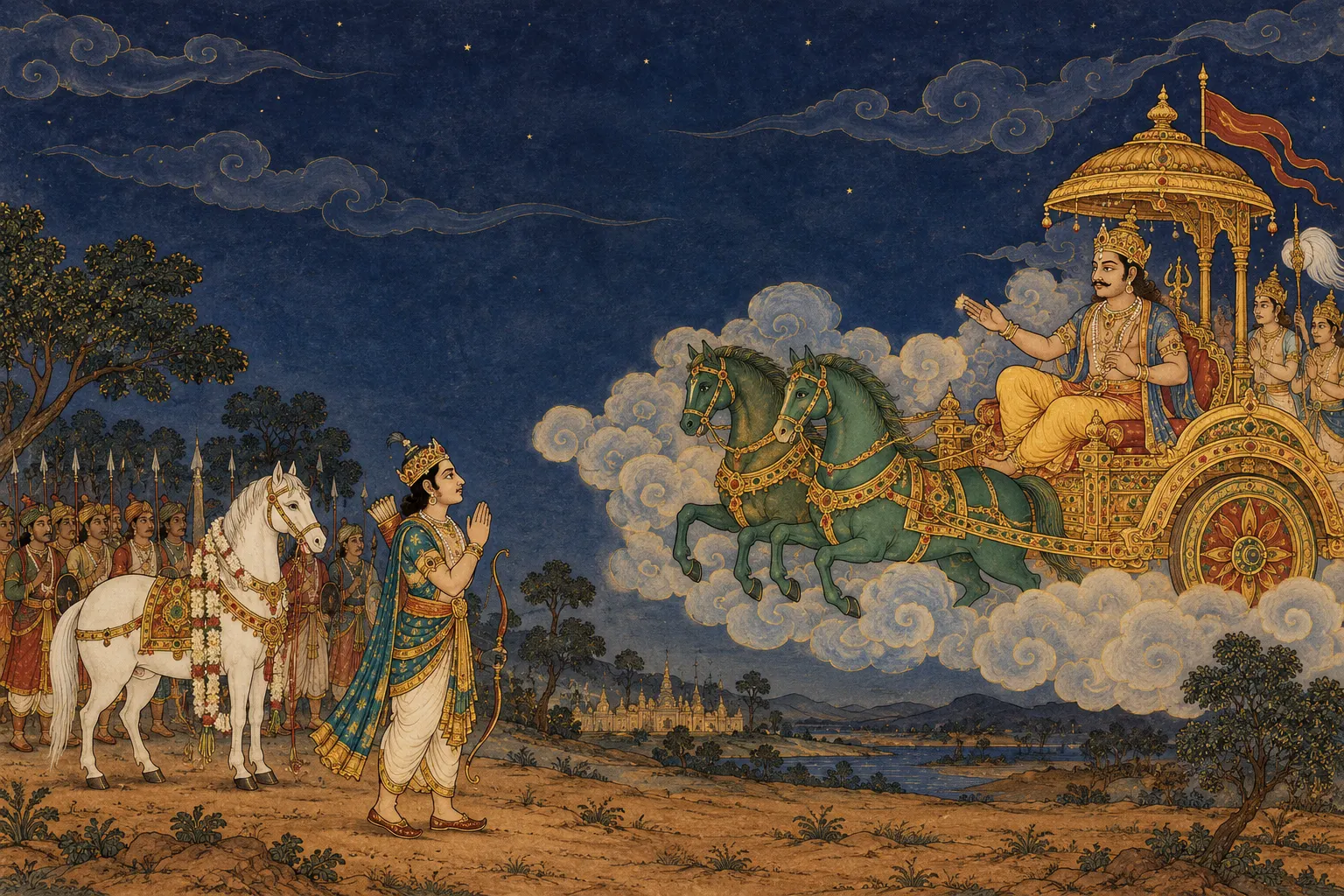
The army stood stunned. Then they saw Vasishtha's cow Nandini coming along. Raghu touched his eyes with the holy water that flowed from Nandini's body, and he could see what ordinary eyes cannot. In the east he saw Indra: a chariot with green horses, the stolen horse tied by a rope, and the charioteer holding him back again and again.
Raghu's voice reached the sky. "Lord of the gods, in a sacrifice the first share is yours. How can you obstruct my father's? You are the one who is meant to stop the enemies of sacrifice; if you stop it yourself, how will dharma go on?"
Indra answered, "Son of a kshatriya, what you say is true. But those whose wealth is their fame must guard it. Your father, with a hundred sacrifices, wants a name equal to mine. As Hari alone is Purushottama and Shiva alone Maheshvara, I alone am Shatakratu. Do not bring ruin upon yourself, as Sagara's sons once did — I have taken this horse in the form of Kapila."
War with Indra
Raghu laughed. "Then take up your weapon, lord of gods. You will not get the horse without defeating Raghu." And with his face turned upward he set an arrow to his bow and stood like Shiva in the archer's stance.
Indra's anger rose. He let fly an unfailing arrow that sank into Raghu's broad chest, and Raghu, with the power of Skanda, drove an arrow marked with his own name into Indra's arm, whose fingers were rough from stroking Airavata. With another arrow he brought down Indra's banner of the thunderbolt. The gods watched in fury; the Siddhas from above and the soldiers from below stood silent.
Then with a crescent-headed arrow Raghu cut the string of Indra's bow. Indra threw the bow aside and took up the thunderbolt. It struck Raghu full on the chest and he fell — and the soldiers' tears fell with him. But in an instant he shook off the pain and rose, and the soldiers' cheers rose with him.
Indra was pleased by his courage. "My thunderbolt does not stop even for mountains, and you took it. I am pleased — ask what you will, except the horse."
Raghu replied with the same humility. "Lord of gods, if the horse cannot come back, then see to it that my father receives the full fruit of the hundred sacrifices, as if the last had been completed in due form. And send your own messenger to tell him so, as he sits in the sacrificial hall."
Indra said, "So be it," and went away. Raghu, a little unsatisfied at heart, returned to his father's assembly. His father had already heard everything from Indra's messenger. He touched his son's body where the thunderbolt had wounded it — and his hand was numb with joy.
The Family Way
Thus, in Kalidasa's words, Dilipa completed his ninety-nine sacrifices as if he had built a stair to heaven.
Then he did what the kings of the Ikshvaku line had always done in old age. He withdrew his mind from the senses, set the white umbrella on his son's head, and went with his queen to live in the forest among ascetics, in the shade of a tree.
Note: This chapter follows canto 3 (verses 1–70). Some word-meanings are taken from Mallinatha's commentary, but the events follow the original.
Source: Kalidasa's Raghuvamsha (from M. R. Kale's English translation, with Mallinatha's commentary), The Birth of Raghu