
Chapter 9
Sita Is Sent Away
The king who had found Sita pure in fire sent her to the forest after a spy's report of what the city said — and in the message she sent back there was not a word of complaint
Sita Is Sent Away is chapter 9 of Raghuvamsha. Source: Raghuvamsha, canto 14 (Kalidasa). It is told in 5 scenes — The Coronation; Pregnancy and Rumour; Rama's Decision; On the Bank of the Ganga; Sita's Message — followed by 10 quiz questions.
The Coronation
The Pushpaka came to rest near Ayodhya. In a garden by the Sarayu, Rama saw his mothers. Aged without their husband, both queens looked at their sons through tears and could not even recognise them — they knew them only by their touch. Sita came forward and said, "I am Sita, the unlucky one, who brought her husband to grief," and touched the feet of both mothers-in-law.
The mothers said, "Rise, daughter. It was through your virtues that your husband and his brother crossed the great calamity."
The old ministers brought water from holy places in golden pitchers and anointed Rama. But it was as though the anointing had already begun, with the tears of joy from the mothers' eyes. With them came the chiefs of the demons and the monkeys, bringing water from rivers, seas and lakes, as rain-water falls on the Vindhya mountain.
Rama rode into the capital in a chariot. Lakshmana waved a whisk over him and Bharata held the umbrella. Kalidasa says he looked like all four oceans rising together. A column of aloe-wood smoke rose from the palace and the wind spread it, as if Rama, come back from the forest, had himself loosened the hair of the city.
Then Rama went to Kaikeyi and said with folded hands, "Mother, our father did not fall from truth and lose the fruit of heaven — it was the fruit of your own good act." In this way he took away her shame.
Pregnancy and Rumour
Some time later Sita's face grew pale — like autumn kasa grass — her eyes more luminous than before, and without a word it was clear she was with child. Rama took her on his lap and asked in private what she wished for.
Sita said, "I want to go once more to the penance-groves on the Ganga, where kusha grows, the deer eat nivara grain, and the hermits' daughters became my friends." Rama gave his word.
Rama climbed to the highest terrace of his palace to look at Ayodhya. The market-streets were full, boats moved on the Sarayu, citizens strolled in the gardens. He asked his spy, Bhadra, what people were saying in the city about him.
Bhadra said hesitantly, "My lord, your people praise every act of yours — except one: that you took back the queen who lived in a demon's house."
Kalidasa says that as Rama heard this his heart broke like hot iron under a hammer.
Rama's Decision
Rama had two roads before him: to ignore the talk, or to give up an innocent wife. His mind swung back and forth like a swing. He decided that the slander could be wiped out by no other means. For those whose treasure is fame, fame weighs more than the body — how much more than a wife.
He called his three brothers. Their faces had lost colour. He said, "See what a stain has come upon the solar line because of me, like breath on a mirror. I cannot bear this first and only blot on my family, as a young elephant cannot bear the tying-post. To remove it I will give up Janaka's daughter, though she is with child, as I once gave up the earth at my father's command.
"I know she is innocent. But public scandal weighs more — even the shadow of the earth, people say, is a stain on the moon. And killing Ravana was done to avenge that very insult. Would a snake that is stepped on not bite?
"Do not stop me out of your compassion." None of the brothers dared answer.
Then Rama called his obedient Lakshmana and said, "Your sister-in-law has asked to visit the penance-groves. Take her in a chariot on that pretext and leave her near Valmiki's hermitage."
On the Bank of the Ganga
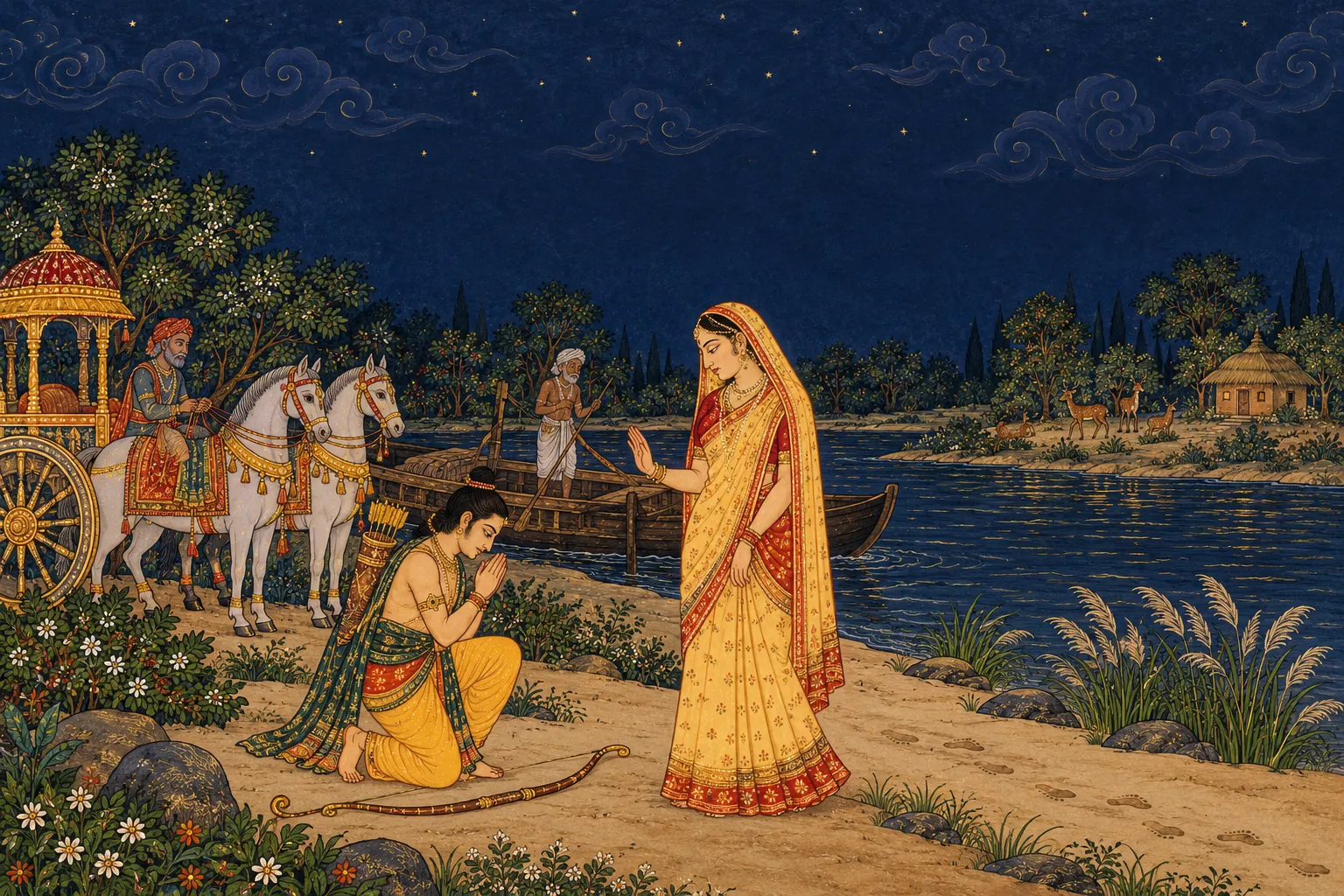
Lakshmana had heard how Parashurama killed his mother at his father's order, so he did not question his elder brother's command. The charioteer Sumantra yoked fast horses, and Lakshmana set out with Sita in the chariot.
Sita was happy — her husband had kept her wish. On the way her right eye twitched, and she had a sense of some coming misfortune. In her mind she prayed that the king and her brother-in-law would be well.
They reached the Ganga. Lakshmana ferried her across by boat. There, on the sand, with folded hands and a shaking voice, he gave her Rama's order.
Sita fell to the ground like a creeper. Her ornaments scattered. The earth itself at first did not give her room, as if to ask how that husband of the Ikshvaku line could cast her off without cause.
When she came to, the full weight of her sorrow overwhelmed her, but she did not curse her husband. Again and again she blamed herself — that she was the unlucky one, made for endless sorrow.
Sita's Message
Lakshmana helped her up, showed her the way to Valmiki's hermitage, and fell at her feet to beg forgiveness: "Lady, I had no choice. I was bound to obey, however cruel the command."
Sita raised him. "Son of Sumitra, I am pleased with you. May you live long. You are bound to your elder brother as Vishnu is to Indra." And then she gave her message:
"Bow to all my mothers-in-law, and ask them to pray for the seed of their son that is in my womb. And say to the king from me: my trial by fire was done before you, and yet you gave me up because of what people said. Is that worthy of your learning or your line?
"But perhaps it is wrong to blame you — this is the fruit of my own past deeds, falling like a thunderbolt. Once you rejected Lakshmi and went to the forest with me; now that she has come to you, she could not bear to stay in a house with me.
"After the child is born I will do penance, looking at the sun, so that in my next life you will be my husband again and there will be no separation. And a king's duty is to protect the orders and stages of life, as Manu said. So even though you have cast me off, I deserve protection like the other ascetic women."
Lakshmana said, "I will say so," and went out of sight, and Sita burst into tears like a frightened osprey. Peacocks stopped dancing, trees dropped their flowers, and the deer let the grass fall from their mouths. The forest wept with her.
At that moment Valmiki went out into the forest to gather kusha. He was the same sage from whose mouth, in grief at a bird's killing, the first verse had once burst forth. He saw Sita. "Daughter, I know through meditation that your husband has left you because of false slander. Do not grieve. Come to my hermitage, where the women ascetics will care for you. Your father was my friend. Bear your child without fear."
Sita touched his feet. At Valmiki's hermitage she was given a hut where a lamp of ingudi oil burned and a bed of deerskin lay. There, dressed in bark, bathing in holy water and welcoming guests, she nurtured the seed of her husband's line.
Lakshmana returned and told Rama everything. Rama wept as the winter moon sheds its dew. Kalidasa tells us that he had driven Sita from his home, but never from his heart.
Note: This chapter follows canto 14 (verses 1–86). The gist of Sita's message (verses 60–67) is Kalidasa's, but the words here are a paraphrase. This episode is also in Valmiki's Uttara-kanda, where Sita's reaction and message take a different form.
Source: Kalidasa's Raghuvamsha (from M. R. Kale's English translation, with Mallinatha's commentary), Sita Is Sent Away