
Chapter 8
Exile, Lanka and the Pushpaka
The Rama whose whole story Kalidasa compresses into one hundred and four verses — and then, flying home in the Pushpaka, shows Sita every place she had walked on foot
Exile, Lanka and the Pushpaka is chapter 8 of Raghuvamsha. Source: Raghuvamsha, cantos 12 and 13 (Kalidasa). It is told in 5 scenes — The White Hairs of Old Age; Chitrakuta to Panchavati; From Shurpanakha to Ravana; The End of Ravana; In the Pushpaka — followed by 10 quiz questions.
The White Hairs of Old Age
Dasharatha had enjoyed every pleasure, and he was now like a lamp that has burned its oil to the wick and is about to go out at dawn. Kalidasa says grey hairs came to his ear as if afraid of Kaikeyi and whispered, "Make Rama king."
The news of Rama's coronation made everyone happy, as a canal makes a garden happy. Kaikeyi brought the preparations to a halt, unmoved by the king's tears. She asked for the two boons the king had once given her. By one, Rama went to the forest for fourteen years; by the other, Bharata got the kingdom — which brought only her own widowhood.
Rama had at first accepted, with tears, the earth his father gave him; now he accepted his father's command to go into the forest with joy. People saw that Rama's face was the same in a pair of silk garments and in a pair of bark garments. With Sita and Lakshmana he left for the forest.
Dasharatha remembered his old curse. He took giving up his body as the only atonement.
Chitrakuta to Panchavati
Bharata was called from his mother's family. On hearing of his father's death he turned away not only from his mother but from the kingdom. He set out with an army to find Rama, weeping at the trees under which Rama had sat, which the hermitage-dwellers pointed out.
At Chitrakuta he told Rama of their father's death and begged him to take the kingdom. Rama could not break his father's word. So Bharata asked for his sandals and kept them as the deities of the kingdom. He did not enter the city but lived at Nandigrama, ruling as though it were a trust.
Rama, Sita and Lakshmana stayed at Chitrakuta. One day, while Rama slept with his head in Sita's lap, Indra's son, in the form of a crow, pecked at Sita's breast. Rama let fly a blade of grass as a missile, and the crow fled, losing one eye.
Then they went south. Agastya gave Sita an ointment, and its scent made the bees forget the forest and leave the flowers to follow her.
From Shurpanakha to Ravana
At Panchavati, Ravana's sister Shurpanakha fell in love with Rama. Rama said, "I have a wife; go to my younger brother." Lakshmana refused her too. She went back to Rama, and Sita laughed. In anger Shurpanakha took her true demon shape, and Lakshmana cut off her nose and ears. She went to Khara and Dushana.
Rama alone destroyed that whole army of demons with his arrows. It was Shurpanakha who carried the news to Ravana. Ravana sent Maricha as a golden deer, drew Rama and Lakshmana away, and carried off Sita. Jatayu fought him briefly and, with his wings cut off, told Rama where she had gone before he died. Rama and Lakshmana performed his rites as for a father.
After Kabandha was freed from his curse by death, they learned of Sugriva. Rama killed Vali and gave Sugriva the kingdom. The monkeys went out in all four directions to search for Sita. Hanuman crossed the ocean and found Sita in Lanka, ringed by demonesses like a healing herb ringed with poisonous creepers. He gave her Rama's ring.
Then came the war. Meghanada's serpent-noose bound Rama and Lakshmana, and they were freed when Garuda came. Lakshmana fell wounded by Ravana's spear, and Hanuman brought the herb that revived him. Kumbhakarna fell like a mountain.
The End of Ravana
Then Ravana himself came, and Indra sent his own chariot with Matali. Rama was on foot, Ravana in a chariot. Rama climbed into that chariot, whose banner fluttered in the wind from the waves of the heavenly Ganga.
Ravana had ten heads and twenty arms. Rama looked at him with the respect due to a worthy foe — who had conquered the guardians of the world, who had offered his own heads to Shiva, who had lifted Kailasa. Ravana shot an arrow into Rama's right arm, which had already throbbed to foretell the union with Sita.
After many exchanges, Rama loosed the Brahma missile. It entered Ravana's chest and went into the earth, as if to tell the serpents the glad news. Then it multiplied tenfold and cut off all ten heads. The gods rained flowers, though they feared the severed heads might join again.
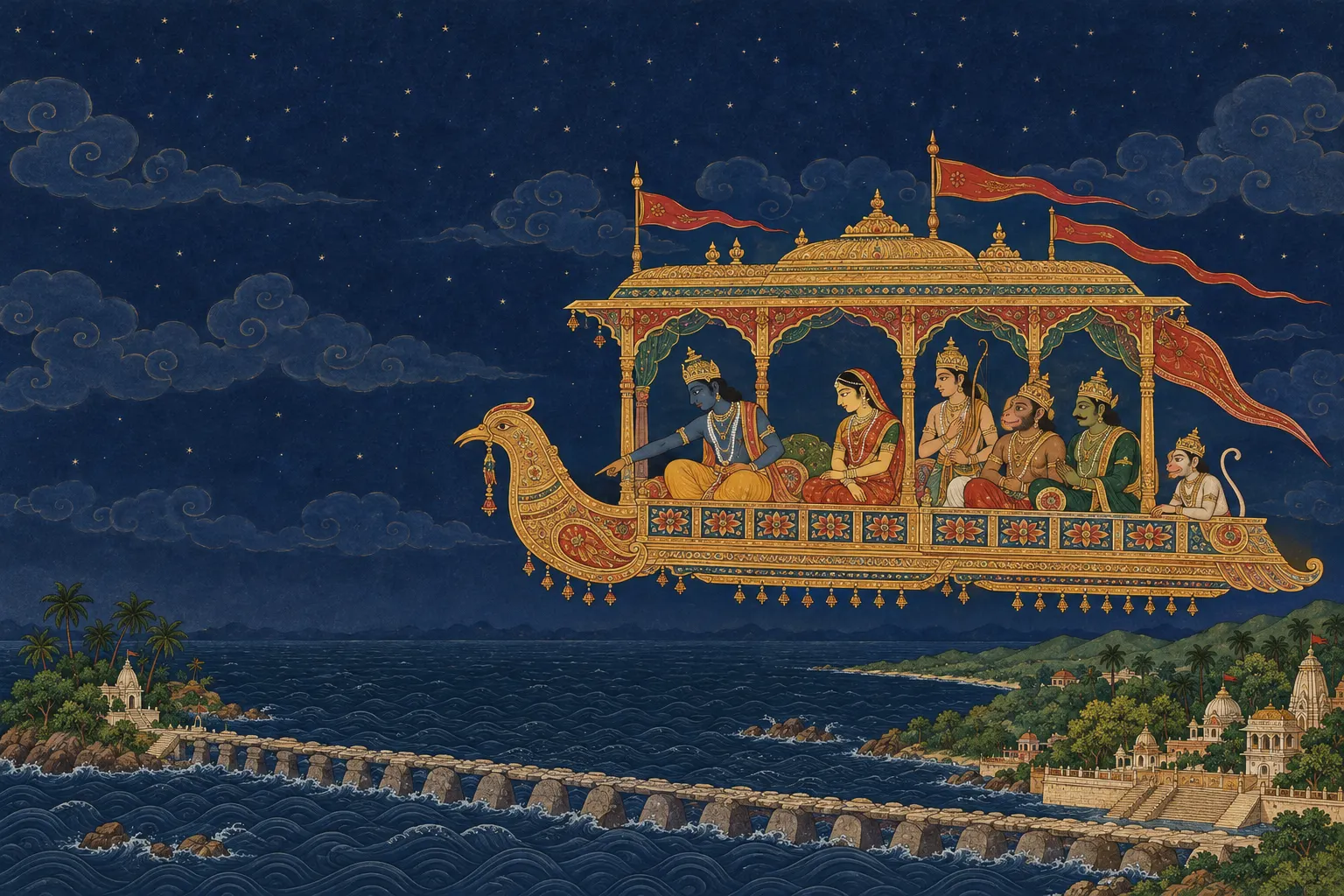
Matali went back. Rama found Sita pure in the fire, gave Vibhishana the kingdom of the demons, and set out for Ayodhya in the Pushpaka with Sugriva, Lakshmana and Vibhishana.
In the Pushpaka
Flying through the sky, Rama said to Sita, "Look, daughter of Videha, this ocean that I divided with a bridge up to the Malaya mountain, as clear as an autumn sky with its stars and the Milky Way. Our forefathers dug it, searching for Sagara's horse." And then he began to show her everything.
"Those oyster-shells, the hissing snakes, the lines of areca palms along the shore. The pollen of the ketaki has dusted your cheeks. Down there is Janasthana, where ascetics are rebuilding their hermitages. And this is where I found your anklet, gone silent in its grief. These creepers showed me the way you were carried off, bending their branches toward it. The does looked toward the south and told me what I could not learn myself.
"That is Mount Malyavan, where I spent the rains without you. And that is Pampa, where I longed to hold you and caught at an ashoka branch, and Lakshmana stopped me. That is Panchavati, where I slept with my head in your lap. That is the hermitage of the great sage Agastya, who threw Nahusha down from heaven. That is the penance-grove of Atri. That is Chitrakuta, where I put a tamala flower in your ear."
Then the meeting of the Ganga and the Yamuna, and the Sarayu — like a mother, coming to embrace him with the cool breeze of her waves. And in front, Bharata — in bark clothes, on foot, with the materials of worship in his hands, with Vasishtha ahead and the old ministers behind.
"Look, Bharata is coming to meet me."
Note: This chapter follows cantos 12 and 13. The OCR of cantos 11 and 12 in my source is noisy, so some details of this chapter (Kaikeyi's boons, the crow, Shurpanakha) are told more briefly. Kalidasa's Rama story differs from Valmiki's in places (for example the plain verse on Sita's trial by fire, 12.104), and where it differs, Kalidasa's text is what is given.
Source: Kalidasa's Raghuvamsha (from M. R. Kale's English translation, with Mallinatha's commentary), Exile, Lanka and the Pushpaka