
Kanda 3
Aranya Kanda
Everything was going well in the forest. Then a deer appeared
The Dandaka forest
Rama, Sita and Lakshmana travelled on through the Dandaka forest.
Dandaka was not a single place. It was an enormous forest stretching far to the south, with hermitages scattered through it. Wherever they came upon one, the three would stay a few days and then move on.
On the way they met a demon named Viradha. Rama and Lakshmana overcame him.
But at almost every hermitage they heard the same complaint.
The demons would not let the sages live in peace. Sacrifices were destroyed as soon as they began. Ascetics were attacked, and those who did not take up weapons themselves had no means of defending themselves.
Rama gave them his word that he would protect them.
Much of what happened later in the Dandaka forest had that promise behind it.
After some time they reached the hermitage of the sage Agastya.
Agastya gave Rama several weapons — Vishnu's bow, Indra's quiver, and a sword.
He advised them to live further on at Panchavati, on the bank of the Godavari. There was water there, and land fit to live on.
The three reached Panchavati and built their hut there.
Most of the fourteen years had passed, and they were now in the final stretch of the exile.
Shurpanakha
One day a demoness came to Panchavati.
Her name was Shurpanakha.
She was no ordinary forest demoness. She was the sister of Ravana, the king of Lanka.
Rama and Ravana had never encountered each other. Their worlds were separate. Rama was in the Dandaka forest in exile, and Ravana was the king of Lanka across the sea.
Shurpanakha became the link that joined those two worlds for the first time.
She saw Rama and was drawn to him.
She introduced herself and asked Rama to marry her.
Rama told her Sita was his wife. Then he said, in jest, that his younger brother Lakshmana was on his own, and she could speak to him.
Shurpanakha went to Lakshmana.
Lakshmana also treated it as a joke and sent her back to Rama.
For a while this went on like banter.
Then Shurpanakha noticed Sita.
It seemed to her that Sita was the obstacle between herself and Rama.
Her manner changed all at once.
She lunged to attack Sita.
Lakshmana drew his sword at once and cut off her nose and ears.
Shurpanakha fled, screaming.
She went to her brothers Khara and Dushana, who lived in that same region.
Seeing the state their sister was in, they flew into a rage.
Not long after, Khara, Dushana and Trishira came to fight Rama with an army of fourteen thousand demons.
Rama sent Sita and Lakshmana to safety in a cave and stood up to the fight alone.
When it ended, Khara, Dushana, Trishira and their entire army had been killed.
Now the matter was no longer confined to Shurpanakha's humiliation.
Three leading demons connected to Ravana's family, and fourteen thousand soldiers, had been killed by one man.
The news reached Lanka.
And for the first time Ravana's attention turned to Rama.
The golden deer
Shurpanakha reached Lanka.
She told Ravana what had happened to her, and how her brothers Khara and Dushana had been killed.
But she did not speak only of revenge.
She also described Sita's beauty to him.
From here Ravana's plan changed.
Instead of sending an army to kill Rama, he decided to carry Sita away.
But there was a problem.
As long as Rama and Lakshmana were near the hut, it was all but impossible to find Sita alone.
To draw them away from there, Ravana needed a trick.
And for that he remembered a demon who already knew Rama.
Maricha.
Maricha was Ravana's uncle.
He had faced Rama years before, when Rama went with Vishvamitra to protect his sacrifice.
Rama had killed Subahu then, and had used a weapon on Maricha that did not kill him but flung him far away.
Maricha had survived.
But that one encounter had put such a fear of Rama into him that he never wanted to tangle with him again.
Now Ravana came to him.
His plan was that Maricha should take the form of an extraordinary deer and go near Rama's hut.
Sita would see the deer.
Rama would go after it.
And when the hut was empty, Ravana would carry Sita away.
The moment he heard the plan, Maricha tried to stop him.
He said plainly that he had seen Rama's strength. To make an enemy of him was to invite your own destruction.
He advised Ravana to give up the idea of Sita.
Ravana would not listen.
Maricha explained it again and again.
Ravana's decision did not change.
In the end he threatened Maricha that if he did not come along, he would kill him where he stood.
Maricha now had only two choices.
To die at Ravana's hands.
Or to walk into a plan with Rama at the other end of it.
At last he said, "Better to die at Rama's hands than at yours."
And he went with Ravana.
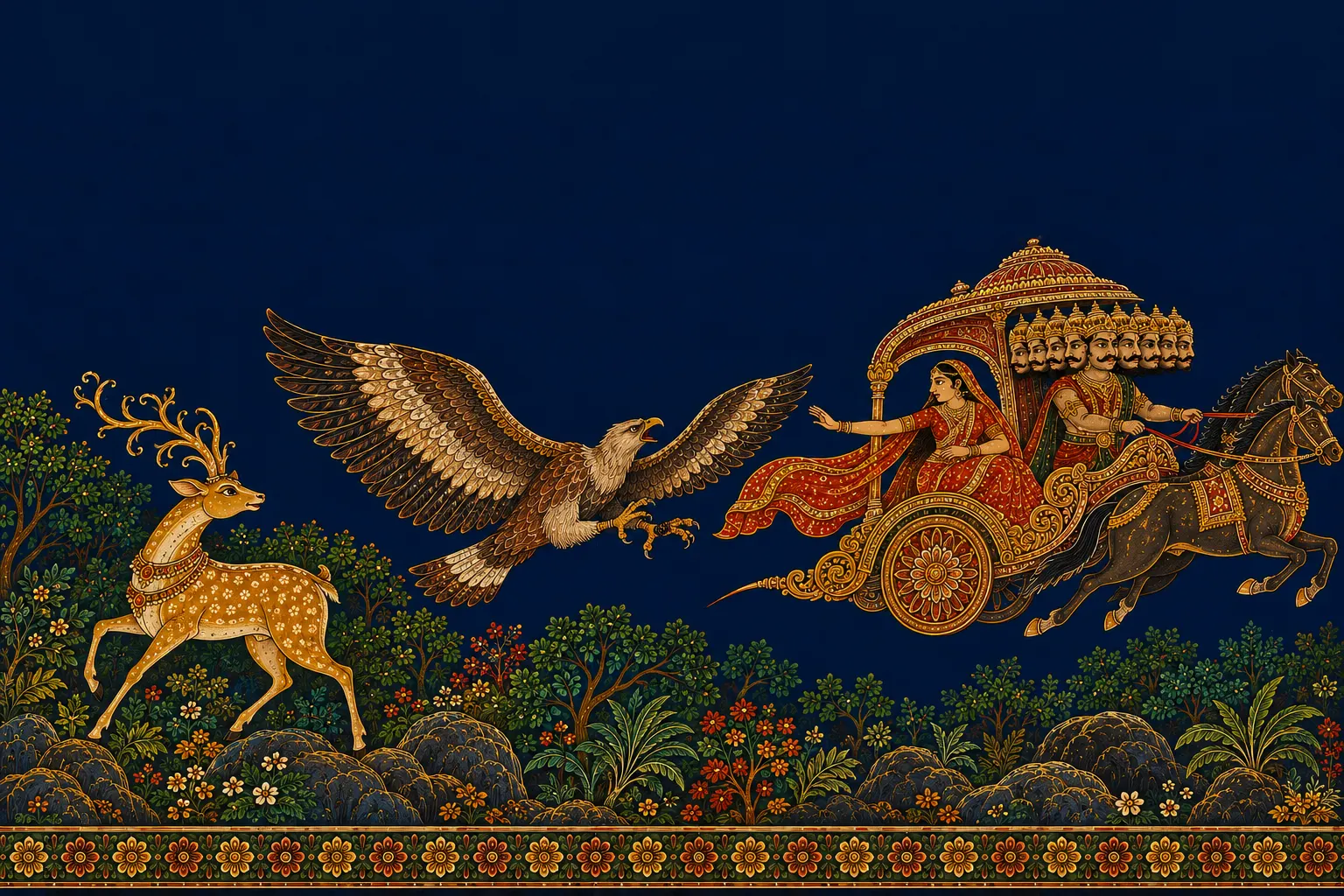
Maricha took the form of a strange deer.
Its body shone like gold. There were spots on it like silver. It was so unusual and so beautiful that it did not look like a real animal of the forest at all.
It began moving about near Rama's hut.
Sita noticed it.
She asked Rama to catch it for her if he could.
Rama took his bow and went after it.
Maricha was doing exactly what he had been sent to do.
He would come close, then bound away.
Chasing him, Rama went far from the hut.
At last Rama loosed an arrow at him.
The moment it struck, Maricha's disguise fell away.
But before dying he completed the last part of the plan.
He called out in Rama's voice — "Ah Sita! Ah Lakshmana!"
The voice carried all the way to the hut at Panchavati.
Sita panicked.
She told Lakshmana to go to Rama at once.
Lakshmana was certain nothing could harm Rama.
He explained to her that the voice might be a demon's trick, and that Rama had told him to stay there and protect her.
But Sita's fear kept growing.
She began to believe Rama really was in danger.
She asked Lakshmana in harsh words why he was still standing there.
In the end Lakshmana had to go.
The Lakshmana rekha
In the popular Ramayana, Lakshmana does one more thing before he goes.
He draws a line around the hut.
He tells Sita never, under any circumstances, to step outside this line. As long as she stays within it, nobody can touch her.
This is the line people call the Lakshmana rekha.
In that version Ravana then works out how to call Sita outside it — he refuses the alms she offers and says that if she wants to give them she must come out to him. Sita steps out, and only then is Ravana's way open.
This line is not in Valmiki's Ramayana.
What Valmiki describes instead comes next.
The taking of Sita
Now Sita was alone in the hut.
This was the opening Ravana had wanted.
He came there in the guise of a wandering ascetic. A staff in his hand, a begging bowl. He stood outside and asked for alms.
Sita took him for an ascetic and welcomed him.
She offered him a seat, gave him alms, and when he asked, told him who she was, whose wife she was, and why she was in the forest.
Ravana listened.
Then he told her who he really was.
He said he was Ravana, the king of Lanka, and told Sita to come away with him.
Sita turned on him and refused.
And then Ravana showed his true form.
He carried her off.
His chariot rose into the sky and set off towards the south.
Jatayu
On the way, someone stopped him.
Jatayu.
He was the old king of the vultures, and an old friend of Dasharatha's.
Jatayu blocked Ravana's way and fought him.
He broke Ravana's bow, wrecked his chariot, and killed his charioteer.
But Jatayu was old.
In the end Ravana cut off his wings, and he fell to the ground.
When Rama and Lakshmana returned, the hut was empty.
They went on, searching for Sita.
On the way they found Jatayu — badly wounded, but with just enough breath left to speak.
He told Rama that Ravana had taken Sita, and had carried her away towards the south.
Having said that, Jatayu died.
Rama performed his last rites with his own hands. Jatayu had been Dasharatha's friend, and Rama gave him the farewell one gives to an elder of one's own family.
Kabandha
Going on, the two brothers came upon a demon named Kabandha.
He was strange to look at — an enormous trunk with no head, one eye in his chest, and very long arms. Anything that came within reach of those arms was dragged towards him.
He caught Rama and Lakshmana too.
The two of them cut off his arms.
As he fell, Kabandha asked who they were, and when he learned, he told them his own story. A curse had given him this shape, and there was only one way out of it.
He asked Rama to cremate him.
Rama did so.
And out of the fire Kabandha came in his old form.
Before leaving, he gave Rama the advice he needed most.
He said that finding Sita alone was impossible. For that he needed allies, and those allies were on Mount Rishyamuka, where Sugriva lived. Sugriva had the strength of the vanaras behind him, and he was the one who could help.
And he said that on the way, near Lake Pampa, they would come to Shabari's hermitage. Be sure to go there.
Shabari
Rama and Lakshmana reached Shabari's hermitage.
Shabari was very old.
She had been waiting for Rama a long time. Her gurus had told her that one day Rama would come to her hermitage, and she had spent her life waiting for that day.
When Rama and Lakshmana arrived, Shabari welcomed them and served them with every honour.
She told Rama the road ahead — go towards Lake Pampa and Mount Rishyamuka, Sugriva is there.
But in the popular Ramayana, Shabari is best known for something else.
It is said that when Rama came to her hermitage, Shabari gave him berries to eat.
She tasted every berry first.
The sweet ones she gave to Rama.
The sour ones she set aside.
Her only purpose was that Rama should get nothing but the best berries.
In the popular story Rama ate those berries with love.
In it, Shabari's devotion is expressed not through a grand ritual but through something very simple — she wanted to give Rama the best of whatever she had.
After this Rama and Lakshmana moved on again.
Two people.
No army.
No knowledge of where Sita was.
Only one name — Sugriva.
Note: Shurpanakha, the fourteen-thousand-strong army of Khara, Dushana and Trishira (sarga 22, which Rama destroys alone), the golden deer, the taking of Sita, Jatayu, Kabandha and Shabari are all in Valmiki's Aranya Kanda. But the "Lakshmana rekha" is not in Valmiki's Ramayana. There, Lakshmana draws no line before he leaves, and Ravana sets no condition to bring Sita outside — he comes as an ascetic, converses with her, tells her who he is, and then carries her off. The version with the line comes from later folk traditions and regional Ramayanas, and today it is one of the most repeated episodes of all. Shabari's tasted berries are not in Valmiki either — there she honours Rama and tells him the road ahead. The berries belong to later tradition. Valmiki also does not say how many years passed at Panchavati — which is why no duration is given here. Ravana gave Sita twelve months' grace (3.56.24), and that count returns in the Sundara Kanda.
Source: Valmiki Ramayana, Aranya Kanda