
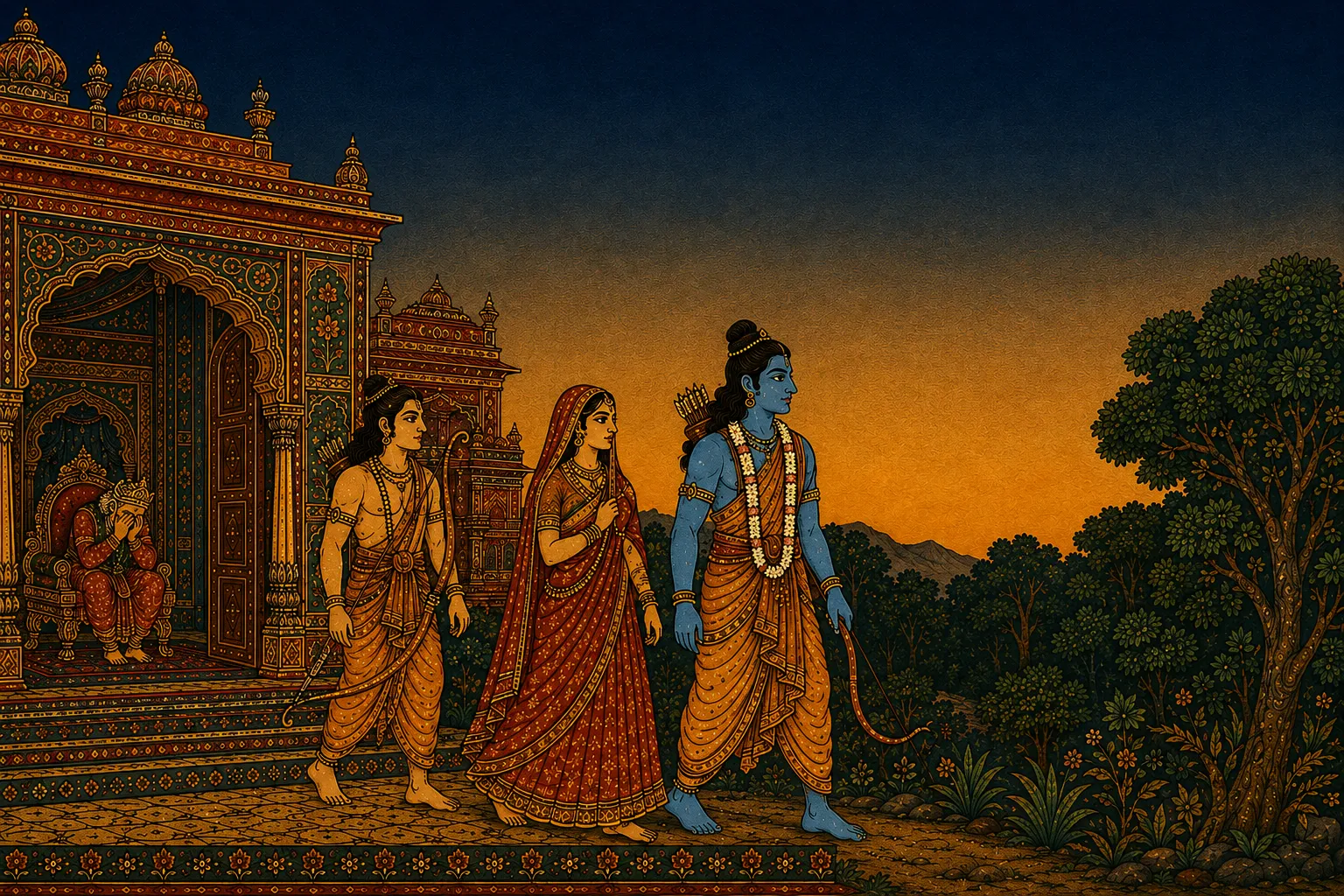
Kanda 2
Ayodhya Kanda
One promise, and a whole royal house fell apart
Preparing for the coronation
Dasharatha had now reached the age at which a king begins to think about what comes after him.
One day he called the assembly and proposed that Rama be made crown prince.
Nobody in the assembly objected. The decision was accepted at once.
The coronation was to be the very next day.
Ayodhya began to be decorated overnight. Arches were tied over the gateways, flags went up on the roofs, lamps were set out in the lanes.
Rama was called and told of the decision. That night he and Sita kept the fast that was kept before a coronation.
The whole city was waiting for the next morning.
But one man knew nothing about any of it.
Bharata was not in Ayodhya at that time. He had gone to his mother's family, to the country of Kekaya.
Manthara and the two boons
That same night Manthara came up to the roof of the palace.
She was Kaikeyi's old servant, who had come with her from her father's house.
From above she saw Ayodhya decorated. Lamps were burning on the houses, there was movement of people in the streets, and the whole city was preparing for some great celebration.
She came straight down and went to Kaikeyi.
She reminded her of something old.
Many years ago, in a war between the gods and the asuras, Dasharatha had been wounded. Kaikeyi had brought him safely off the battlefield. Pleased with her, Dasharatha had given her two boons — whenever she wished, whatever she wished, she could ask.
Kaikeyi had asked for nothing at the time.
Both boons remained unused.
Manthara said to Kaikeyi, "Tomorrow Rama becomes king. Bharata is not even here. After that, what place will be left in this palace for you and your son?"
Slowly Kaikeyi's mind changed.
She withdrew to the kopabhavan, the chamber in the palace where a queen went when she was angry or distressed.
When Dasharatha heard, he came to win her round.
He asked what was wrong, he tried to reason with her, but Kaikeyi stayed silent.
At last Dasharatha gave his word that whatever she asked for, she would have.
Then Kaikeyi asked for her two old boons.
The first — that Bharata receive the kingdom.
The second — that Rama go to the forest for fourteen years.
The ground seemed to disappear beneath Dasharatha's feet.
He tried to reason with Kaikeyi. He pleaded. He wept. He even fainted.
But the word had been given.
A king's given word was not treated as a private matter in those days. His standing, and the trust his kingdom rested on, were built on it.
Dasharatha was trapped inside his own promise.
Towards the forest
Rama was called and told everything.
He neither objected nor raised a single question.
For him his father's word was enough.
Sita was told that life in the forest would be hard. There would be no palace, no comforts, no regular meals.
She was told to stay in Ayodhya.
Sita refused outright.
Where Rama lived, she would live.
Trying to stop Lakshmana was useless too.
The three of them took off their royal clothes and put on valkala — the garments made of tree bark that forest-dwellers and ascetics wore.
Everything Rama was to have worn the next day for his coronation was left behind.
The minister Sumantra took a chariot and went to see them out beyond Ayodhya.
The people of the city set out behind the chariot as well.
For some distance the crowd walked with them. Then, little by little, people stopped and turned back.
Kevat
At Shringaverapura, on the bank of the Ganga, they met Guha, the chief of the Nishadas. He was the headman of that region and an old friend of Rama's.
Guha arranged a boat, and the three of them crossed the Ganga.
This same moment of crossing is told another way in the popular Ramayana — and it is that version that is told most often, in house after house.
In it the man who rows the boat is named Kevat.
Rama asked him to take them across the river.
Kevat was willing, but he had one condition.
He wanted Rama to let him wash his feet before he stepped into the boat.
He had heard a story about Rama.
According to the popular version, Ahalya had turned to stone under her curse, and had returned to her true form the moment Rama's feet touched her.
Kevat said, laughing, that his boat was only wood. If it too turned into a woman the moment Rama's feet touched it, he had no second boat to earn his living with.
So let him wash the feet first.
Rama smiled.
Kevat washed his feet. Then he seated Rama, Sita and Lakshmana in his boat and took them across the Ganga.
On the far bank Rama wanted to pay him the fare.
Kevat refused to take it.
His argument was that the two of them do the same work.
He carries people from one bank of a river to the other.
And Rama carries people across the ocean of worldly existence.
How can one boatman take a fare from another?
He asked for only one thing: that as he had carried Rama across the Ganga today, so one day, when the time came, Rama should carry him across the ocean of existence.
The death of Dasharatha
Sumantra had to turn back from there.
He brought the empty chariot back to Ayodhya.
The same chariot Rama had ridden out in was now going through the city towards the palace without him.
Behind them in Ayodhya, Dasharatha's condition kept worsening.
On the sixth night he died.
In his last hours he was remembering something from his youth.
Long ago, while hunting, he had heard the sound of a pot filling in the dark. He thought it was an elephant drinking, and he loosed an arrow towards the sound.
There was no elephant there.
There was a boy, who had come to fetch water for his blind parents.
After his death the boy's father had cursed Dasharatha that one day he too would die grieving for his son.
That day had come.
The sandals and Nandigrama
By the time Bharata returned from his mother's family, everything had changed.
His father was dead.
Rama had gone to the forest.
And the throne was set in front of him.
Bharata went straight to his mother Kaikeyi.
He told her plainly that he had consented to none of this, and that he would not accept a kingdom that came to him this way.
After that he set out for Chitrakuta to bring Rama back.
He did not go alone. With him went all three mothers, the ministers, and a great number of the people of Ayodhya.
The two brothers met at Chitrakuta.
Bharata begged Rama to return.
He said their father was gone, Ayodhya was without a king, and Dasharatha, whose promise had sent Rama into exile, was no longer alive.
But Rama would not agree.
For him a promise his father had given did not end with his father's death.
What had been said had to be carried out.
Bharata reasoned with him at length, but Rama would not return.
Then Bharata asked him for something else — give me your sandals.
Rama took off his sandals and gave them to Bharata.
Bharata took them back to Ayodhya.
He placed those sandals on the throne and refused to live in the palace as a king himself.
He went to live at Nandigrama, outside Ayodhya, and ran the kingdom from there.
For fourteen years the government was in Bharata's hands, but not as king.
Rama's sandals stayed on the throne.
And the kingdom was run in Rama's name.
Note: Manthara, the two boons, the exile, Guha the Nishada chief, Chitrakuta, Dasharatha's death on the sixth night (sarga 64) and Bharata taking the sandals and settling at Nandigrama are all in Valmiki's Ayodhya Kanda. But the Kevat episode is not in Valmiki. Valmiki has the crossing of the Ganga and Guha arranging the boat; the washing of the feet, the fear of the boat turning into a woman, and the refusal of the fare come from Tulsidas's *Ramcharitmanas* and from folk tradition. Ahalya does not turn to stone in Valmiki either — the curse made her invisible. The stone version is also later tradition. Valmiki does not give the name of the boy Dasharatha killed by accident — the text calls him only "the sage's son", "the ascetic", "the forest-dweller" (sarga 63). The name "Shravan Kumar" belongs to later tradition, and the Agni Purana (6.37–38) calls the same boy Yagnyadatta.
Source: Valmiki Ramayana, Ayodhya Kanda