
Kanda 1
Bala Kanda
Ayodhya needed an heir
The Putrakameshti sacrifice
Ayodhya, on the banks of the Sarayu, was flourishing.
The kingdom of Kosala stretched far in every direction. The streets of the city were broad, and water was sprinkled on them every day. The treasury was full, there was no shortage of grain, and there was no enemy at the border.
King Dasharatha had everything a king wants — an army, a treasury, and three queens: Kausalya, Kaikeyi and Sumitra.
Only one thing was missing.
He had no children.
This was not only a private sorrow. Dasharatha was growing old, and there was no one to take the throne after him. Without an heir, a fight over power could break out inside the royal house. That was what worried him most.
One day he summoned his teacher Vashishtha. Vashishtha was the oldest adviser the royal family had — the man whose word Dasharatha accepted without asking why.
Vashishtha first advised an Ashvamedha sacrifice.
This was not a remedy for childlessness. It was the ritual by which a king declared that his authority stood above all others.
A horse was set free for a whole year, and the army walked behind it. Every kingdom it passed through unchallenged was taken to have accepted that authority. Whoever stopped the horse was issuing a challenge — and then there was war. When the year was complete the horse returned, and only then was the sacrifice performed.
Dasharatha's Ashvamedha was completed without a single obstruction.
But it did not give him what he wanted.
After this Vashishtha sent for the sage Rishyashringa. Under his direction the Putrakameshti sacrifice was performed — the particular rite performed in the desire for a child.
One offering after another fell into the fire, and the flames rose higher.
And then a shining figure stepped out from the middle of the fire.
In his hands was a golden vessel filled with payasam — rice cooked in milk, but this had not been made in any kitchen.
"Divide this among your queens," he said.
Then he left the way he had come.
Dasharatha divided the payasam among the three queens.
The time came, and in a single season four sons were born in Ayodhya — Rama to Kausalya, Bharata to Kaikeyi, and two to Sumitra, Lakshmana and Shatrughna.
The four grew up together.
But before long, a pattern emerged that no one had taught them.
Wherever Lakshmana was, his eyes went looking for Rama. If Rama got up and walked, Lakshmana walked behind him. In the same way Shatrughna stayed with Bharata.
There were four brothers, but they had settled into two pairs.
Those bonds lasted for the rest of their lives.
Vishvamitra's demand
Rama was very young then. He had not yet seen a real war.
Then one day the sage Vishvamitra came to the court at Ayodhya.
Vishvamitra was no ordinary sage. He had been born a king and had become a sage by the force of his austerities. His anger was as famous as his penance.
Dasharatha stood up, gave him a seat and asked what had brought him. As kings often did when receiving an honoured guest, he added that Vishvamitra could ask for anything he wished.
Vishvamitra answered directly.
"I am performing a sacrifice. Demons come again and again and destroy it. To protect it, I need your eldest son — Rama."
The court fell silent.
Dasharatha's breath caught. The son for whom he had waited so many years was still very young.
He said he would go himself with his entire army. He would give gold, he would give grain, he would give whatever was wanted — anything but Rama.
Vishvamitra said nothing.
His face slowly hardened, and everyone in the court understood what might happen next.
Then Vashishtha came to Dasharatha and said quietly that this sage did not ask for anything without knowing why. Give him what he is asking for.
Dasharatha agreed.
Rama set out.
And Lakshmana — whom nobody had said anything to — went with him.
On the way Vishvamitra gave the two brothers two disciplines, Bala and Atibala. With these disciplines, neither hunger nor exhaustion would trouble them. For travellers moving through the forest, there could be no greater gift.
Then, as they walked, one by one, he taught them both the use of the divine weapons.
Tataka and the sacrifice
The first encounter came in a dry, ruined forest.
Tataka lived there — a yakshi who had once been beautiful and had become a demoness after a curse. She had laid the whole forest waste. People had stopped using that road.
Rama hesitated.
There was a woman in front of him, and raising a hand against a woman was holding him back.
Vishvamitra explained to him that killing such a person to protect the people is a prince's duty — whoever that person may be.
Rama raised his bow, and Tataka fell where she stood.
After this the sacrifice began.
The sages said it would run for six days and six nights, and for that long it would have to be guarded.
The two brothers kept watch around the fire altar.
On the sixth day the demons came down on them.
Two of them were in front — Maricha and Subahu.
Rama loosed the Manavastra at Maricha. The arrow struck his chest and flung him a hundred yojanas away into the sea.
A yojana is an old measure of distance. Its exact value was never settled — the old texts themselves put it anywhere between three and a half and fifteen kilometres — but a yojana is usually reckoned at about thirteen kilometres. So a hundred yojanas is roughly thirteen hundred kilometres.
Then he loosed the Agneyastra at Subahu, and he was killed on the spot.
He drove away the remaining demons with the Vayavya weapon.
Maricha survived.
And years later that same Maricha will return — to play a part that changes the whole direction of Rama's life.
Ahalya's hermitage
The sacrifice was over, but Vishvamitra did not turn back. He took the two brothers and went on.
On the way they came to a hermitage.
The door stood open. There was nobody inside. No person, no sound, no smoke from a hearth — only dust and a silence that had settled over years. Outside, the creepers had climbed the wall and reached the roof.
Rama asked why the place lay like this.
Vishvamitra told him it was the hermitage of the sage Gautama, and that his wife Ahalya had lived here.
One day Gautama was away from the hermitage. At that time Indra, king of the gods, took Gautama's form and came inside.
Ahalya understood that the man standing before her was not her husband but Indra.
Knowing who he really was, she still accepted his advances.
Gautama returned and came to know everything.
He cursed Ahalya — she would be visible to nobody, she would live on air, she would lie here on the ashes of this hermitage.
But at the end of the curse he set a condition too, as though something ahead were visible to him.
The day Rama sets foot in this hermitage, that day this curse will end.
Then Gautama also left, and the hermitage stayed as it was.
Now that day had come.
Rama went inside.
And Ahalya, invisible for years, slowly became visible again — as though a shape were rising out from under the dust.
Not long after, Gautama returned too, and took Ahalya back.
The abandoned hermitage came to life again.
The bow at Mithila
After this Vishvamitra took Rama and Lakshmana with him to Mithila, where King Janaka was performing a great sacrifice.
Janaka welcomed the two princes.
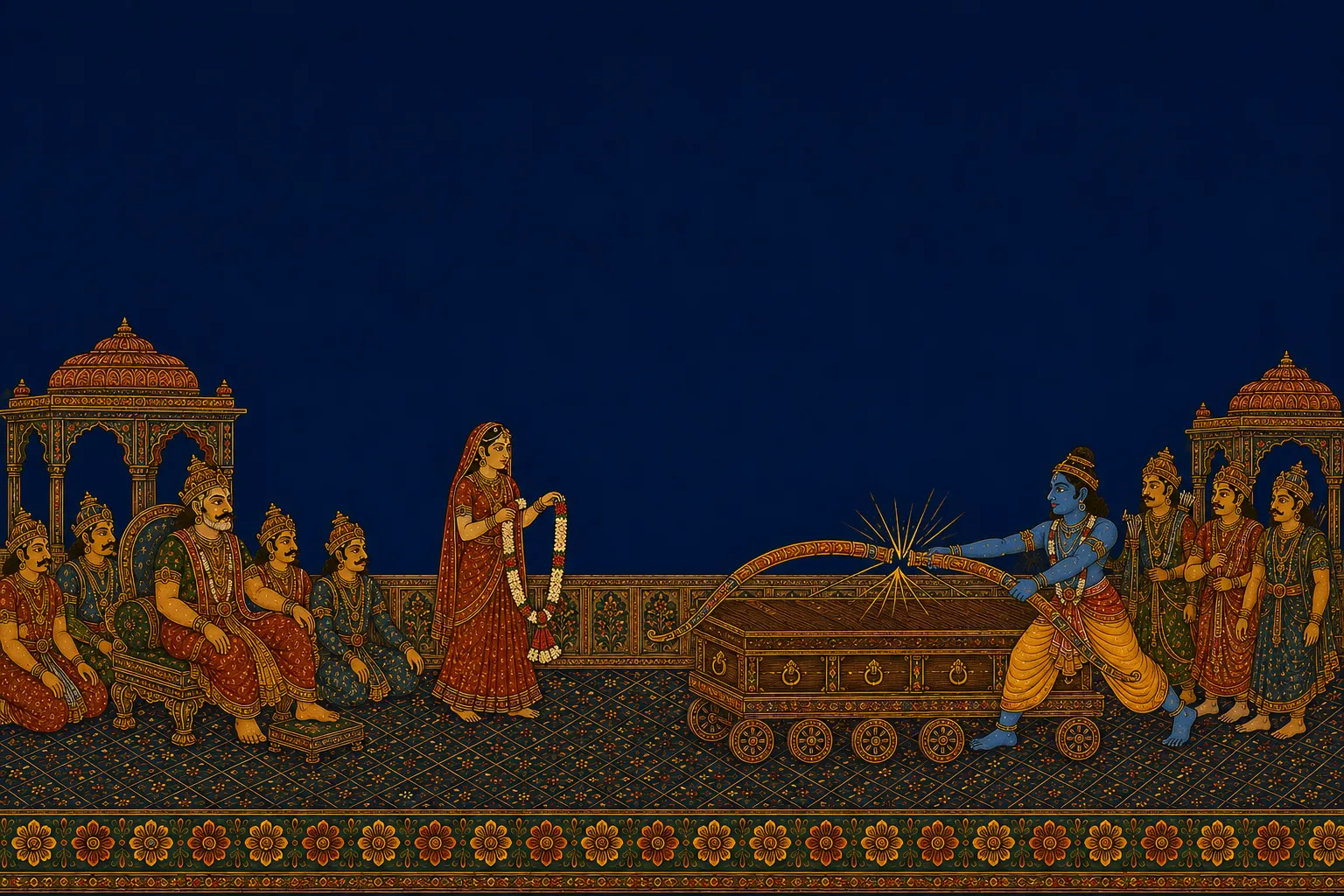
In the course of conversation Janaka mentioned the famous bow that belonged to his royal house, the bow of Shiva. Tradition calls this bow the Pinaka. Janaka's family had been keeping it for generations.
The condition for his daughter Sita's marriage was tied to this bow.
Janaka had vowed that whoever could lift that bow and string it would marry Sita.
Many kings and warriors had tried before. Not one had succeeded.
Vishvamitra asked Janaka to show the bow to Rama.
The king gave the order for it to be brought.
It was kept in an enormous chest. The chest had eight wheels, and it took many strong men to drag it to the assembly.
The chest was opened.
Rama stepped forward.
He asked permission to take the bow in his hands. Janaka and Vishvamitra gave it.
Rama lifted the bow and strung it.
Then he drew the string back to his ear.
In that instant the bow snapped in the middle.
The sound was so loud it was as though a mountain had split.
The assembly sat stunned.
Janaka's condition had been met.
And what began as one marriage became four. Sita to Rama. Sita's sister Urmila to Lakshmana. Mandavi to Bharata and Shrutakirti to Shatrughna — the two daughters of Janaka's brother.
Parashurama
After the weddings the whole royal party set out for Ayodhya. The road ran through the forest.
A figure stood blocking their way.
Parashurama — a sage, and a warrior. An axe on his shoulder. He was a devotee of Shiva, and his anger was so famous that kings grew wary at the sound of his name.
News of the breaking of Shiva's bow had reached him. He was an extraordinary warrior himself, and he had come to test the strength of the youth who had broken it.
He held out a second bow he had brought with him. This one was Vishnu's.
"If you have that much strength," he said, "then string this one and show me."
Rama took the bow.
And strung it without any difficulty.
Parashurama stood silent for a while.
He had his answer. This was no ordinary prince standing before him.
His anger subsided. He moved out of the road and went away to his austerities.
The royal party moved on, and the gates of Ayodhya came into view.
In the celebration held in Ayodhya that day, nobody had any idea that for one of these four brothers a fourteen-year exile had already been written.
Note: Dasharatha's sacrifices, the journey with Vishvamitra, the killing of Tataka, Maricha and Subahu, Ahalya, and the breaking of the bow are all in the Bala Kanda of Valmiki's Ramayana. The sacrifice was guarded for six days and nights and the demons came on the sixth day (sarga 30); the Manavastra striking Maricha and flinging him a hundred yojanas into the sea is there too, and so is the Agneyastra on Subahu. The chest holding the bow had eight wheels and five thousand men dragged it (sarga 67). Valmiki calls this bow "Shiva's bow" — the name "Pinaka" does not appear in these sargas. The name Pinaka is very old; the Yajurveda calls Rudra "Pinakahasta". But for this bow the name is tradition's, not the text's. Note also that many modern scholars consider both the Bala Kanda and the Uttara Kanda to be later layers. That argument is still going on.
Source: Valmiki Ramayana, Bala Kanda