
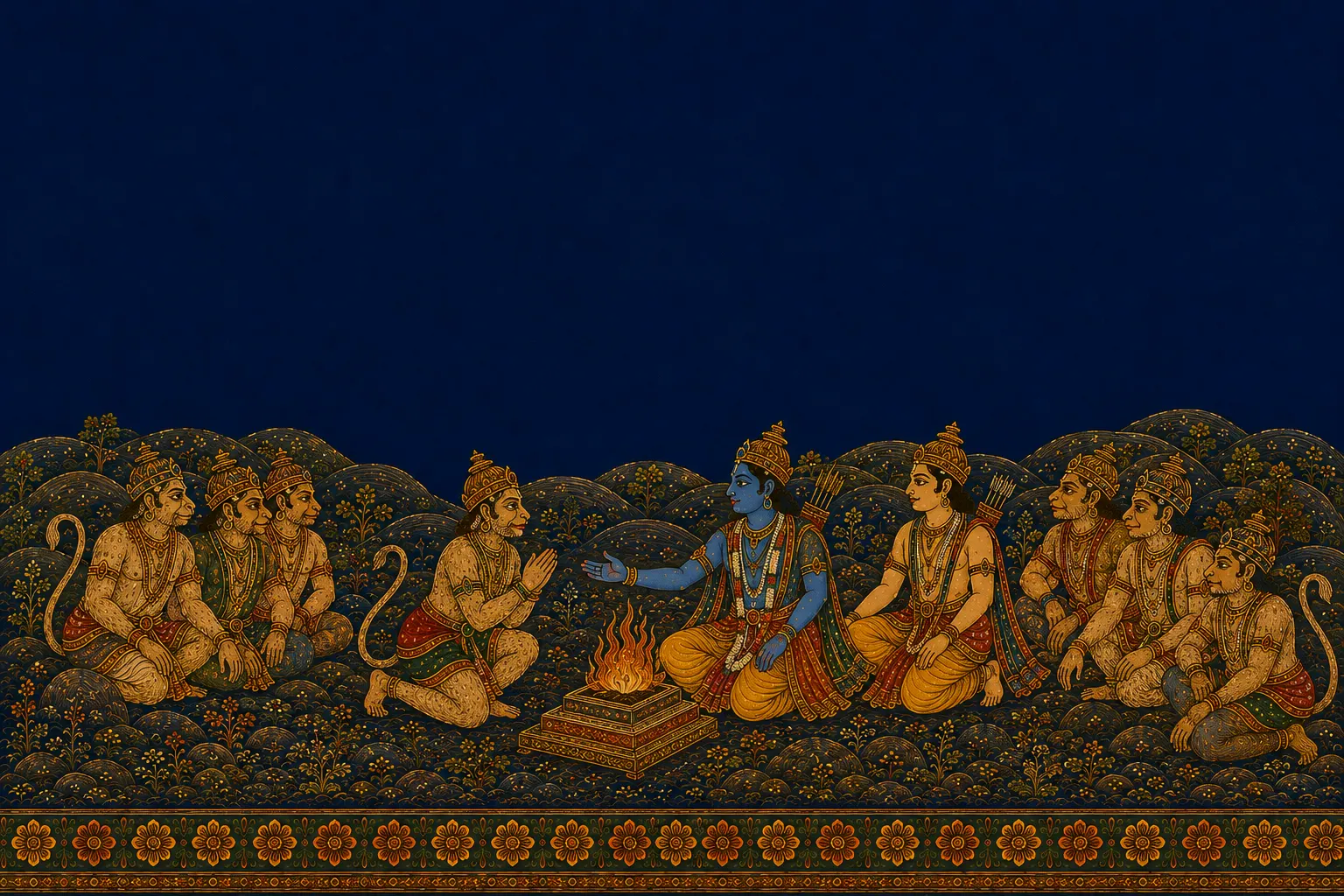
Kanda 4
Kishkindha Kanda
Before the search could begin, a friend was needed
Meeting Hanuman
Following the road Shabari had described, Rama and Lakshmana reached Mount Rishyamuka.
The vanaras living on the mountain saw them from a distance.
Seeing two armed strangers coming towards him, Sugriva was alarmed. He thought Vali might have sent them.
Sugriva was the younger brother of Vali, the king of Kishkindha. There had once been a deep bond between the two brothers, but one incident changed everything.
Fighting a demon, Vali had gone inside a cave, and Sugriva had waited outside for him.
A long time passed.
Blood was seen flowing out from inside, and no answer came.
Sugriva concluded that Vali had been killed. He blocked the mouth of the cave and returned to Kishkindha.
But Vali was not dead.
When he came back, he took it that Sugriva had shut him in deliberately and had tried to seize his kingdom.
Sugriva explained at length, but Vali did not believe him.
He drove Sugriva out of Kishkindha.
He also kept Sugriva's wife Ruma for himself.
And Sugriva was afraid that if Vali caught him, he would kill him.
That was why he lived hidden on Mount Rishyamuka.
The place was safe for him. Because of an old curse, Vali could not come onto Mount Rishyamuka.
So it was his old fear that came back when he saw the strangers.
He told Hanuman to go and find out who they were.
Hanuman took the guise of a brahmin and went to Rama and Lakshmana.
He spoke with them both with great courtesy and care.
Rama was struck by his language and his manner of speaking.
He said to Lakshmana that anyone who could speak in such clear and measured words could be no ordinary person.
After the conversation, Hanuman understood that these two had not been sent by Vali.
He took Rama and Lakshmana to Sugriva.
There, with fire as their witness, Rama and Sugriva became friends.
Each needed the other.
Rama was searching for his wife.
Sugriva wanted his kingdom and his wife back.
The two of them gave their word to help each other.
The bundle of ornaments
Sugriva told Rama one more important thing.
Some time earlier he and his companions had seen a woman being carried through the sky by a demon.
The woman had been calling for help.
From above she had tied some of her ornaments in a cloth and dropped them.
The vanaras had picked them up and kept them safe.
Sugriva brought that bundle and opened it in front of Rama.
Rama looked at the ornaments.
In his grief he could not identify them properly.
Then Lakshmana looked at them.
He said he did not recognise Sita's armlets or her earrings.
But he recognised the anklets from her feet.
The reason was very simple.
He bowed at Sita's feet every day. So it was those ornaments his eyes fell on most.
Now Rama was certain that Sita really had been taken to the south.
And Sugriva now had proof that he could be of use in Rama's search.
The agreement was clear.
Rama would free Sugriva from Vali.
And Sugriva would put his whole strength into the search for Sita.
Seven great sal trees
But one difficulty was still left.
Sugriva knew how strong Vali was.
He could not believe that Rama could really defeat him.
He told Rama about Vali's strength.
Then he pointed to the old skeleton of Dundubhi lying nearby. Dundubhi had been a demon in the form of a buffalo, and Vali had killed him in a fight and flung his heavy body a long way off.
Rama pushed the huge skeleton with his toe.
It fell far away.
Even then Sugriva was not fully satisfied.
He pointed to seven enormous sal trees standing there.
Vali's strength was measured by the fact that he could shake all of them at once.
Rama raised his bow.
He loosed a single arrow.
The arrow went through all seven trees, one after another.
Then it split a mountain, went down into the earth, and finally returned to Rama's quiver.
Now Sugriva had no doubts left.
The killing of Vali
Sugriva took Rama and went to Kishkindha.
Standing outside the city, he challenged Vali to fight.
Vali came out.
The two brothers grappled.
Rama stood some distance away with his bow, ready.
But he did not shoot.
The reason was that Vali and Sugriva looked very much alike.
In the fight both their bodies were covered in dust. They were locked together and constantly changing places.
Rama was afraid the arrow might strike Sugriva instead.
Vali wounded Sugriva badly.
Sugriva somehow got away.
He came back to Rama and asked angrily why he had not helped.
Rama gave his reason.
So that there would be no mistake of identity a second time, a garland was put around Sugriva's neck.
Sugriva went to Kishkindha again and challenged Vali a second time.
This time Vali's wife Tara tried to stop him.
She had word from Angada that Sugriva had made an alliance with Rama. She told Vali that Sugriva could not have come back alone so quickly — there was somebody behind him.
But Vali did not listen to her.
He went out to fight again.
The two brothers grappled again.
This time Rama recognised the garland on Sugriva's neck.
He shot from behind a tree.
The arrow struck Vali's body.
He fell to the ground.
Vali's question
The wounded Vali asked Rama a direct question.
He had not been fighting Rama.
He had no personal quarrel with Rama.
So why, instead of fighting him face to face, had Rama killed him from cover?
Valmiki's Ramayana records this question.
And Rama answers it.
His answer has three parts.
First — while his younger brother Sugriva was alive, Vali had kept his wife Ruma for himself. Under the old code, a younger brother's wife was regarded as a daughter. Rama calls this a grave wrong.
Second — Rama says he is a prince of the Ikshvaku line, and that punishing those who act against dharma is part of a king's duty. Ayodhya at that time was governed in Bharata's name, but Rama considers himself a representative of that same royal authority.
The third argument is the most disputed. Rama says that in hunting, an animal may be killed face to face or from cover. Vali was a vanara, and so Rama makes this comparison part of his answer as well.
Vali listened to what Rama said.
After that he did not argue at length.
Before he died he set the matter of his son Angada before Rama and Sugriva.
He asked that Angada be protected and treated properly.
Then Vali died.
This is one of the most argued-over episodes in the whole Ramayana.
Rama gives his answer.
Vali asks his question.
The story preserves both.
Four search parties
After Vali's death Sugriva became king of Kishkindha.
Vali's son Angada was made crown prince.
Now it was Sugriva's turn to keep his word.
But just then the rains began.
Heavy rain and bad roads made it hard to send search parties any distance.
So it was decided to wait until the rains ended.
Rama and Lakshmana went to live on a nearby mountain.
Time passed.
The rains ended.
But no word came from Kishkindha.
Sugriva had his kingdom back. He had returned to the life of the palace.
Rama was still waiting.
When enough time had gone by, Lakshmana lost his patience.
He went to Kishkindha in anger.
Sugriva understood that he had left it too long.
He immediately ordered the vanara army gathered and the search begun.
Great search parties were formed and sent out in all four directions — north, east, west and south.
The southern party had leading warriors in it — Angada, Hanuman and Jambavan.
Sugriva had given them all one month. Come back within the month, news or no news.
The parties searched forests, mountains and distant regions for Sita.
No news came.
The month began to run out.
The members of the search party grew anxious. They knew there could be serious consequences if they returned empty-handed.
At last they reached the shore of the sea.
Ahead there was only water.
There was no trace of Sita.
The party had all but given up.
Sampati
Just then they met a very old vulture.
His name was Sampati.
He was Jatayu's elder brother.
In conversation Sampati learned that Jatayu had been killed by Ravana while trying to save Sita.
He grieved at the news of his brother's death.
But he could help the vanaras.
Sampati could see across enormous distances.
He looked across the sea.
At last they had the answer they had been searching for.
Sita was in Lanka.
Ravana had taken her across the sea to his kingdom.
Now, for the first time, the search party knew where Sita was.
But a new difficulty stood in front of them.
To reach Lanka, the sea had to be crossed.
The distance was about a hundred yojanas.
Who will leap a hundred yojanas?
The vanaras began to estimate their own strength.
One said he could leap a few yojanas. Another, more than that.
Angada said he could probably cross the sea, but he was not confident he could get back.
Everyone was naming his limit.
But one vanara was silent.
Hanuman.
He was sitting to one side.
As though he himself could not remember what he was capable of.
Then Jambavan went to him.
Jambavan was very old and knew Hanuman's strength.
He reminded Hanuman of his childhood.
As a child Hanuman had been so lively and so strong that he had once seen the rising sun, taken it for a fruit, and leapt towards it.
Some sages, worn out by his mischief, had laid a curse on him — he would forget his own powers. Only when somebody reminded him would he remember them again.
Now was that time.
Jambavan reminded him that he was the son of the wind. There was a strength in him that he himself had no idea of.
There was nobody else who could cross that sea.
As he listened to Jambavan, Hanuman began to remember what he was.
He stood up.
His body began to grow.
Before him lay a hundred yojanas of sea.
Beyond it, Lanka.
And in Lanka, Sita.
The next part of the search was now in the hands of one vanara.
Note: The friendship with Sugriva, the piercing of the seven sal trees with a single arrow (sarga 12 — the arrow also pierces a mountain and the earth and returns to the quiver), the killing of Vali, the search parties and Sampati are all in Valmiki's Kishkindha Kanda. Jambavan tells the story of Hanuman's childhood and the curse in sarga 66. Lakshmana recognising only the anklets is a famous verse, but a disputed one: "nūpure tv abhijānāmi nityaṁ pādābhivandanāt" (sarga 6) is missing from old manuscripts and from the Baroda critical edition. The verse says only that he bowed at her feet daily and so knew the anklets — "he never raised his eyes" is a later expansion of it. Rama answers Vali's question with three arguments (sarga 18). The other reasons often listed — that Vali would have gone over to Ravana or called up an army if approached openly — are not in the text itself but in the Dharmaakuutam commentary.
Source: Valmiki Ramayana, Kishkindha Kanda