
Kanda 5
Sundara Kanda
One vanara, one sea, and a city that burned
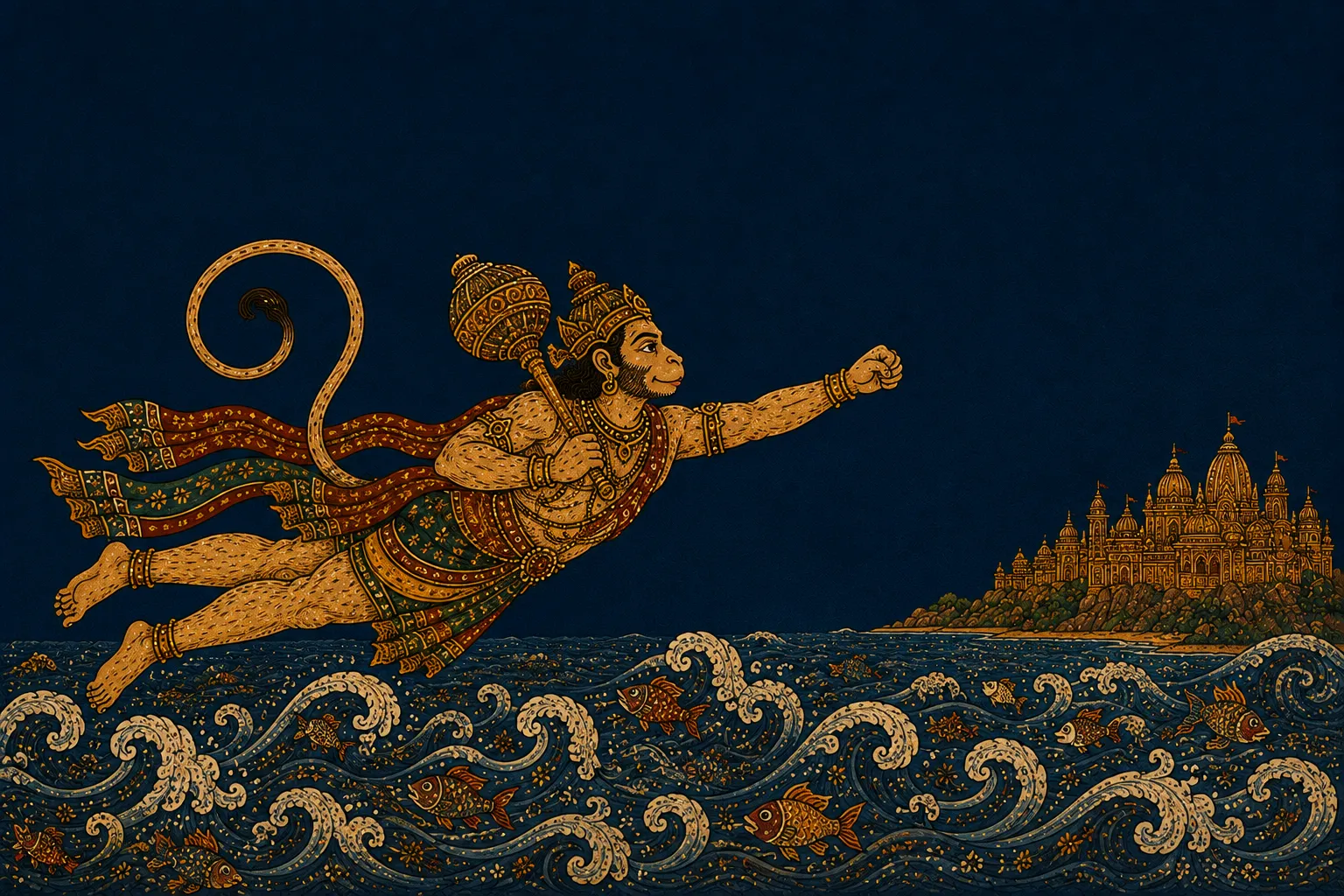
Over the sea
Hanuman climbed Mount Mahendra.
Behind him the whole party stood watching him.
He made his body grow, pressed the mountain down under his feet, and leapt.
Below him was the sea. Ahead, nothing was visible — no shore, no mark. Only water, and the wind above it.
On the way the sea sent up Mount Mainaka from below.
Mainaka rose out of the water and stood in front of him, so that Hanuman could sit on it and rest a while.
Mainaka had come to help, not to stop him.
Hanuman touched it with his hand in thanks and went on. He said there was no stopping anywhere before the work was done.
Then Surasa blocked his way.
This was a test the gods had sent. They wanted to see whether Hanuman had intelligence as well as strength.
Surasa said that nobody could pass from here without entering her mouth.
Hanuman began to make himself larger.
Surasa made her mouth larger.
Hanuman grew again. The mouth grew again.
Then all at once Hanuman shrank to the size of a thumb, went inside that enormous mouth, and came out the other side.
The condition had been met, and there had been no fight at all.
Further on, Simhika caught his shadow from below. She would seize the shadow of creatures flying overhead and drag them down.
Hanuman felt as though something were pulling him backwards.
He used the same trick that had just worked. He went into her mouth, and tore his way out of her from the inside.
Ahead lay Lanka.
Lanka at night
Reaching Lanka, Hanuman made himself very small and slipped into the city in the dark.
At the gate Lankini stopped him.
A single blow from Hanuman brought her down.
As she fell she said she had been told long ago — the day a vanara defeated her, from that day Lanka's days would be numbered.
That day had come, and the city was asleep.
Hanuman searched every corner all night.
He climbed onto the roofs of palaces, looked into rooms, paced the lanes.
He reached Ravana's palace and saw him sleeping.
In one room he saw Mandodari and was deceived for a moment — could this be her?
Then he steadied himself. A woman sleeping here so peacefully could not be the one he had come to find.
Sita was nowhere.
The whole night had gone. Tired, Hanuman sat down.
The thought of turning back came to him — and with it the thought of what he would say when he got there.
Then he remembered that one place was still left.
The Ashoka grove.
The Ashoka grove
In the Ashoka grove, under a shinshapa tree, surrounded by demonesses, Sita was sitting.
Thin. In dirty clothes. Sitting on the ground.
But not broken.
Hanuman settled on a branch of the tree, hidden among the leaves, and watched.
Just then Ravana came there.
He tried once more to persuade her. Then he moved to threats.
When he carried her off he had given her twelve months' grace. Ten had gone.
Two months more, he said. After that, think it over.
The moment Ravana left, the demonesses surrounded Sita and began to frighten her.
Then one of them stopped the rest.
Trijata.
She told them her dream of that night — in it Lanka was burning, and Rama was winning.
After that the demonesses fell quiet.
The ring and the chudamani
Hanuman now had a hard task in front of him.
He had to speak to Sita, and in such a way that she did not cry out in shock. One scream would have woken all of Lanka.
So, sitting in the tree, he began quietly to tell Rama's story.
Starting from Ayodhya, up to the exile, and on from there.
The woman sitting below began to listen.
Then Hanuman dropped Rama's ring down from above.
Sita picked it up and knew it.
She took off her chudamani and gave it to him.
And she told him something old that only Rama knew, so that Rama would have no doubt that Hanuman had truly met her.
Hanuman said he could carry her away with him right now.
Sita refused.
She wanted Rama to come himself and take her away.
The burning of Lanka
The work was done.
But Hanuman did not simply leave.
He wrecked the whole grove — tore up trees, broke the garden, and made a great noise.
He killed the demons who came to seize him. He killed Ravana's son Akshaya.
And then he let himself be bound, deliberately, by Indrajit's Brahmastra.
He wanted to be bound, because he wanted to speak to Ravana face to face — and being captured was the easiest way to be taken straight into Ravana's court.
In the court Hanuman told Ravana plainly to give Sita back, or nobody would be able to stop what came next.
Ravana flew into a rage and ordered Hanuman killed.
Then Vibhishana stopped him.
He said Hanuman was an enemy's envoy, and killing an envoy is not considered right. A punishment may be given, but he should not be killed.
Ravana accepted this.
Then another punishment was decided — set his tail on fire.
Hanuman began to make his tail longer.
Cloth was brought and wound around the tail. Hanuman kept lengthening it, and the demons kept piling on more cloth and more oil.
Then it was lit.
And in that same instant Hanuman made himself small.
The bonds went slack, and he was out.
Carrying his burning tail, he went leaping from roof to roof across Lanka.
The city burned.
Hanuman crossed the sea and returned to his companions.
Then he came before Rama and put Sita's chudamani into his hands.
Sita had been found. She was alive, and she was in Lanka, waiting for Rama.
Note: Mainaka, Surasa, Simhika, Lankini, the meeting with Sita in the Ashoka grove, Trijata's dream, the chudamani and the burning of Lanka are all in Valmiki's Sundara Kanda. Ravana first orders Hanuman killed, and Vibhishana stops him by saying an envoy is not to be killed; Ravana agrees, and only then is the burning of the tail decided on (sargas 52–53). Surasa was sent by the gods, and the text gives the reason too: to see whether Hanuman had intelligence as well as strength (sarga 1). Ravana's threat of "two months" (5.22.8–9) is what remained of the twelve months' grace he gave her when he carried her off — ten months had passed by the time Hanuman arrived. Sita's refusal to return with Hanuman is in the text as well. Why this book is called the "Sundara Kanda" is something the traditions do not agree on — which is why no single reason is given here.
Source: Valmiki Ramayana, Sundara Kanda