
Kanda 7
Uttara Kanda
The story was over, and still one book remained
Ravana's story
Rama was crowned on returning to Ayodhya, and the time began that is called Ramarajya.
But before it goes forward, the Uttara Kanda turns back.
The sage Agastya sits Rama down and tells him the whole story of Ravana — the story nobody had asked for during the war.
Ravana's ancestry was not entirely rakshasa.
On his father's side, he descended from the sage Pulastya, a son of Brahma.
And Lanka had not been his to begin with. It belonged to his half-brother Kubera.
Ravana performed severe austerities and won a boon from Brahma — that no god, gandharva, yaksha or demon should be able to kill him.
Every kind of being he thought might be a danger to him, he listed one by one.
One kind he did not list at all.
Human beings.
They seemed to him so insignificant that he did not think them worth counting.
After receiving the boon he defeated Kubera in war and took Lanka from him.
The Pushpaka Vimana came into his hands in that same defeat — the very vimana that years later carried Rama back to Ayodhya.
And that one omission, made while asking for the boon, became in the end the road to his death.
The story of Hanuman's childhood comes in this part as well.
As a child Hanuman once saw the sun in the sky, took it for a fruit, and leapt to catch it.
And that was not his only piece of mischief. He would get into the hermitages of sages and scatter their belongings, overturn the things of worship, throw the materials of the sacrifice about.
The sages were troubled.
But they also knew that with the boons of Brahma and Indra this child was invincible, and that there was neither need nor way to punish him heavily.
So they laid a small curse on him — Hanuman would not remember his own strength. Only when someone reminded him would he remember.
On the seashore, Jambavan did exactly that.
What a washerman said
Years passed.
The king's informers lived in every town. Their work was just this — to go from lane to lane listening to what people were saying about the king, and to come back and report it.
One day what they reported was not good.
There was talk in the city that the queen had lived so long in Lanka and the king had taken her back.
And in that talk there was also this: that a washerman, quarrelling with his wife, had said he was no Rama, to take back into his house a woman who had lived in another man's.
Rama asked whether this was only one man's opinion.
The answer was no.
In Lanka he had said that he wanted the answer to be given in front of everyone.
Now that same "everyone" was speaking again.
And this time there was no fire in the middle of it.
Rama decided to send the pregnant Sita away to the forest.
As a king, Rama placed the voice of his people above his own household.
But as a husband, he was not the one who paid the price. Sita did.
The task was given to Lakshmana.
He seated her in a chariot and took her away. He said nothing the whole way.
Sita believed she was going to visit some hermitage.
Only after setting her down across the Ganga did Lakshmana tell her the truth.
And then he took the chariot and went back.
Sita was left standing there.
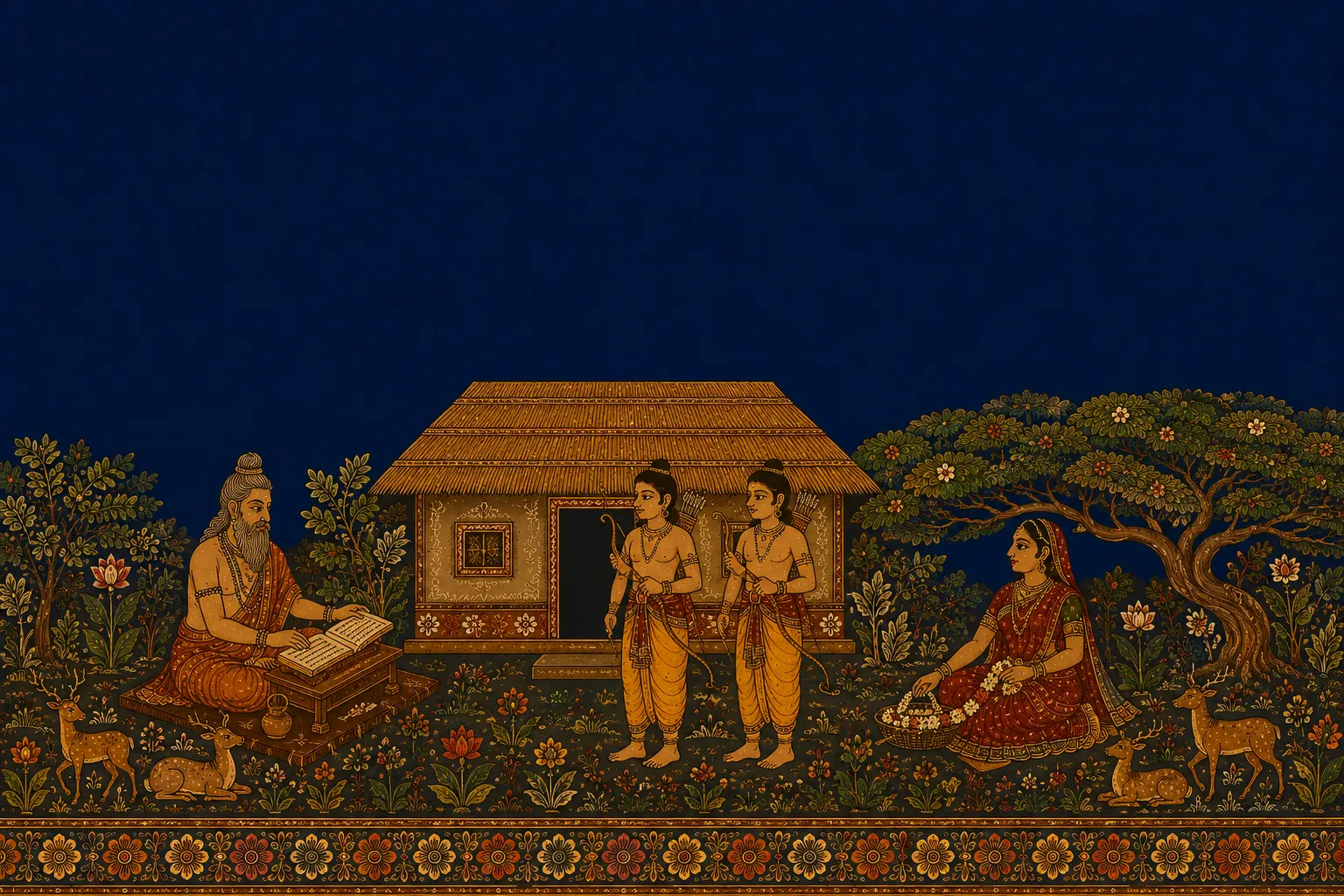
At Valmiki's hermitage
Sita found shelter at the hermitage of the sage Valmiki.
Lava and Kusha were born there, and grew up there.
Valmiki was the sage who composed the poem we know as the Ramayana.
He made the two boys learn that whole poem by heart, and both learned to sing it — without knowing whose story they were singing.
Meanwhile another thing happened in Ayodhya, which is counted among the hardest episodes in this book.
A brahmin came to the court carrying the body of his son. His claim was that something was going wrong in the kingdom, and that this was why it had happened.
Rama was told that a man named Shambuka was performing austerities, and that by the rules of his varna he had no right to do so.
Rama sought Shambuka out and killed him.
This episode has been sharply criticised for centuries, and still is.
Many scholars consider it part of the later layer of the Uttara Kanda.
But it is present in the text that has come down to us — which is why it has not been hidden here.
Lava and Kusha
Years later an Ashvamedha sacrifice was held in Ayodhya.
Rama had not married again.
He had a golden image of Sita made for the sacrifice, and kept that beside him.
At that sacrifice two boys came and began to sing that poem before the whole assembly.
They went on singing. One canto after another, and then a third.
The assembly listened, and as it listened it grew quieter and quieter.
What was being sung was their own story.
Ayodhya, the exile, the abduction, the sea, Lanka — everything the people sitting in that assembly had lived through was being sung back to them, bound into verse.
And the singers were two boys nobody knew.
Rama was listening to his own life in somebody else's voice.
And then he saw their faces.
Their ages matched.
Their faces did too.
Rama understood. They were his sons.
Into the earth
Sita was called.
Rama said she should take an oath of her purity once, in front of everyone, and after that everything would be well.
Sita came.
She took the oath.
And then she refused to return.
She called on the earth — if I have never thought of anyone but Rama, then let mother earth take me into herself.
The earth opened.
A throne rose up, and on it sat the earth herself.
She took Sita into her lap.
And the two of them went down.
The earth closed again.
Rama was left standing there.
This was the man who had had a bridge built across the sea, who had killed Ravana, and who had served out a fourteen-year exile without a word of complaint.
This time he had no weapon in his hands, and there was no enemy in front of him.
The story ends here — not with a victory, but with an emptiness.
Note: Ravana's earlier history, the curse on Hanuman (sarga 36 — the title of the sarga is itself "The sages curse Hanuman"), Sita's banishment, the killing of Shambuka, Lava and Kusha, the golden image (sarga 91, in Rama's own words) and Sita entering the earth are all in Valmiki's Uttara Kanda. But the Uttara Kanda is precisely the book that many modern scholars, along with the Bala Kanda, consider a later layer, and that argument is still going on. Which means the right thing to say about everything in this book is: it is in the received Valmiki text, in the book whose antiquity is disputed. The informer Bhadra reports the talk that had spread through the whole city (sargas 42–43); the washerman's remark is one example within that, not the sole cause. And the sages made the curse a small one deliberately, because against the boons of Brahma and Indra a greater punishment was neither necessary nor possible.
Source: Valmiki Ramayana, Uttara Kanda