
Kanda 6
Yuddha Kanda
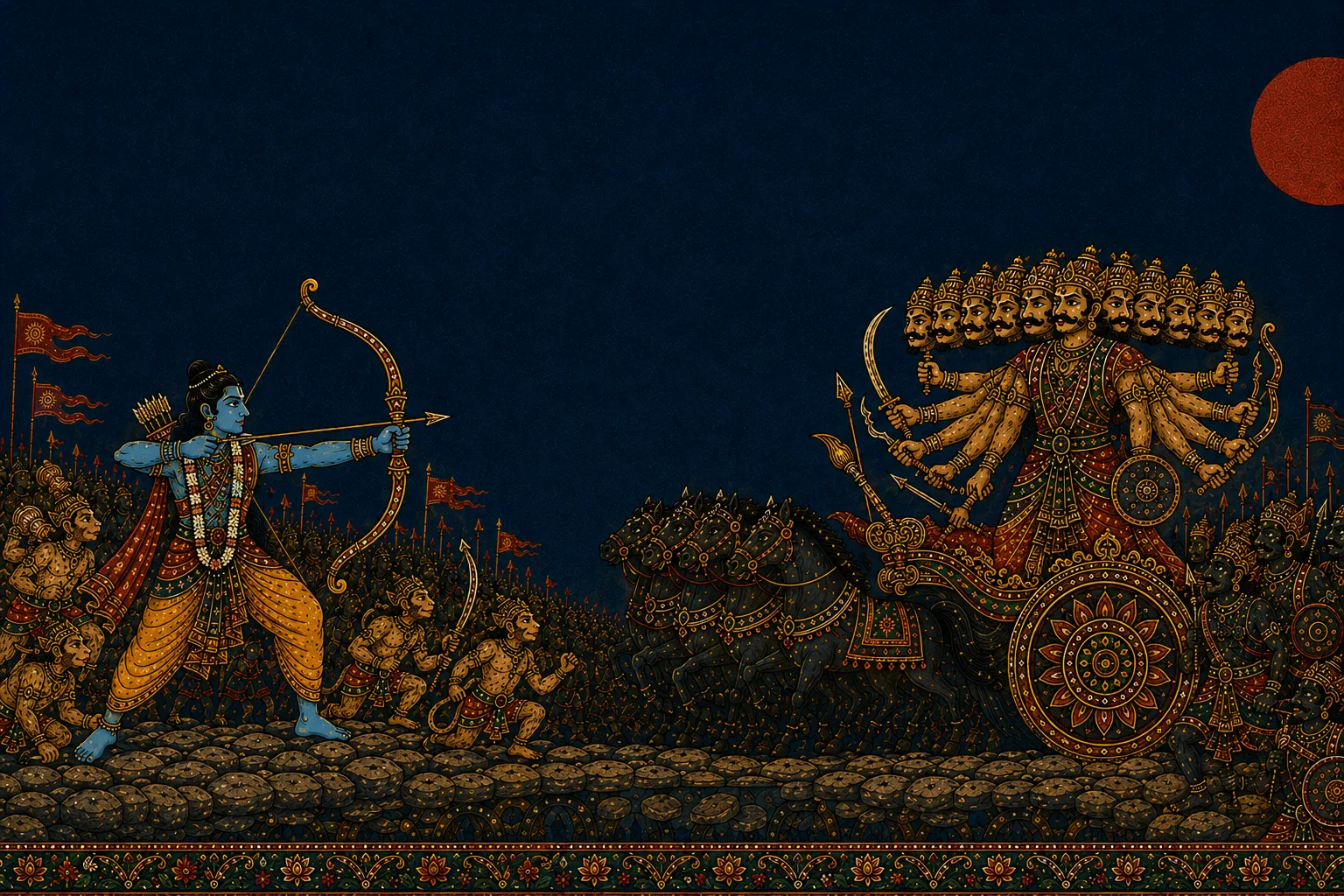
Ten heads, and it took a whole army to bring them down
Vibhishana
Lanka had burned.
A vanara had come, walked about inside the city, killed a prince, and left a large part of the city on fire.
In the debate held in Ravana's court that day, most people were talking about revenge.
But one voice was different. Vibhishana's.
Vibhishana was Ravana's younger brother.
In front of the entire court he said the thing nobody else was saying — give Sita back. What has been done is wrong, and returning her is best for everyone.
Ravana kicked him out of the assembly.
Vibhishana took his four companions, crossed the sea, and came to Rama.
The vanaras were suspicious. This is Ravana's brother. He could be a spy. Letting him come close is foolish.
Hanuman spoke for him.
And Rama said that he does not turn away anyone who comes to him for refuge.
At that moment, right there on the shore, Vibhishana was declared king of Lanka — of a Lanka that had not yet been won.
The sea and the bridge
Now the sea lay in front of them.
Rama sat on the shore for three days, asking for a way across.
No answer came.
On the fourth day he picked up his bow.
Then the sea gave him the answer — in your own army there is Nala, the son of Vishvakarma. He can build a bridge, and whatever he sets down, I will let stand.
Nala took charge of the work, and the vanaras began carrying stones.
The bridge was built in five days. It stretched for a hundred yojanas.
The whole army walked across it and crossed the sea.
Two stories are attached to this bridge that are told in every household.
The first is that the vanaras wrote Rama's name on the stones, and that this was what made the stones float.
The second is about a squirrel.
It is said that while the great vanaras were carrying enormous rocks, a small squirrel also set to work. She would go into the water and get wet, then roll in the sand, then run to the bridge and shake the sand off her body — so that the gaps between the stones would be filled.
Some vanaras laughed at her.
Rama stopped them.
He said work is not large or small. Everyone does as much as they can, and the squirrel was putting her whole strength into it.
Then he picked her up and stroked her back.
It is said that the stripes on a squirrel's back are the marks of Rama's fingers.
Angada's message
Angada went to Ravana's court as an envoy.
This was the last chance, and both sides knew it.
The message carried both the terms and the consequence — give Sita back with honour, or you will be killed and Lanka will be Vibhishana's.
Ravana heard it all.
Then he told his servants to seize this vanara and kill him.
Four demons came forward to take hold of him.
Angada let them take hold.
Then, with them hanging off him, he climbed to the roof of the palace. They fell away one after another.
And Angada came back to his army, breaking Ravana's palace roof as he went.
After that there was nothing left to talk about.
The serpent-noose
In the very first days Indrajit used the nagapasha — serpents that his sorcery had turned into arrows.
Rama and Lakshmana both fell bound in the field.
The two brothers lay there on a bed of arrows, covered in blood.
Panic broke out in the army. The two men on whom the entire campaign depended were lying on the ground.
Then Garuda came.
At the sight of him those serpents fled, and at his touch the wounds of both brothers closed.
Kumbhakarna
Then Ravana gave the order to wake Kumbhakarna.
Kumbhakarna slept for months at a stretch. Waking him was a campaign in itself — thousands of demons were put to it, drums were beaten, elephants were driven over him, water was poured on him.
He woke.
He heard the whole story, and having heard it, he told his brother the plain truth.
He did not say give Sita back. That was Vibhishana's argument.
He said something else.
He said that what stood in front of them today had been warned about already. The ministers had said it, the well-wishers had said it, the advisers had said it — all of them. Ravana had listened to none of them, and what was happening now was exactly what had been foretold then.
Then he went out to fight.
He gave his reason plainly. He did not pretend Ravana was right.
Ravana was his brother, and his brother was in danger.
He could reproach his brother for being wrong. He could not abandon him.
He was killed that same day.
Indrajit
Ravana's son Indrajit turned out to be the most dangerous of them.
He did not fight face to face.
He had the art of fighting while invisible. He would go into the clouds and shoot from there. The arrows could be seen coming; the one shooting them could not.
Every blow the army below struck went nowhere, because there was no target.
The vanaras were dying and could not fight back. That is enough to break any army.
Even his name came from one of his victories: he had defeated Indra in battle.
There was only one way to deal with him, and Lakshmana took it.
Indrajit was performing a sacrifice at Nikumbhila. If that sacrifice were completed he would become invincible, and then nobody could kill him.
Lakshmana broke the sacrifice, and in the fight that followed he killed Indrajit.
That was the real turning point.
After this Ravana had nobody left — no brother, no son, no commander.
The spear and the sanjivani
Now Ravana came into the field himself.
And in that fight he hurled the Shakti at Lakshmana.
Lakshmana fell and did not get up. The blood kept flowing, the breath kept going, but he lay unconscious.
Rama lifted him and sat with him.
The brother who fourteen years ago had decided, without being asked, to walk out behind him, was now lying in his lap.
The vanara physician Sushena was called.
He looked at him and said Lakshmana was still alive.
Then he told Hanuman to go to the mountain of herbs. Four herbs are found there — vishalyakarani, savarnyakarani, sanjivakarani and sandhanakarani.
Hanuman flew.
But when he reached the mountain, the herbs had disappeared from sight, as though they knew someone had come looking for them.
Hanuman did not argue with them.
He tore off the whole peak, and brought it back with him.
Lakshmana sat up.
Ahiravana
The popular Ramayana tells another story from this period, one that is very well known in northern India.
In it Ravana has a brother or ally, Ahiravana, who is the king of the underworld.
Using sorcery he gets into the war camp and carries off both Rama and Lakshmana in their sleep, to sacrifice them there.
Hanuman goes searching and reaches the underworld.
There he meets Makardhwaja, who according to that story is his own son and guards the gate of the underworld.
In the end Hanuman defeats Ahiravana and brings the two brothers back on his shoulders.
This entire episode is not in Valmiki's Ramayana. It comes from later traditions and folk Ramayanas.
Rama and Ravana
Now the final battle was between two men.
Those who had fought until now were Ravana's brothers, his son, his commanders.
All of them were gone.
In Lanka there was nobody in front of him now, and nobody behind him.
Then the sage Agastya came to Rama and gave him the Aditya Hridaya — the hymn to the sun that he told him to recite three times.
Then the two came face to face.
The fight went on a long time. So long that the armies on both sides stopped fighting and stood watching.
Every head Rama cut off, another exactly like it grew in its place. He would cut that one too, and a third would grow.
This did not happen once. A hundred heads were cut, and there was no sign of Ravana dying.
Rama stopped.
He was puzzled. The arrows that had worked on every enemy until now — why were they not working on this one?
Then he took up the weapon Brahma had given him.
This time, the weapon was not aimed at Ravana's head.
It struck him in the chest.
And Ravana fell.
Vibhishana was crowned — the same declaration that had been made long before on the other side of the sea was now completed in Lanka.
The ordeal of fire
The war had been won.
The question was still there.
Sita was called.
What happened next, nobody had expected.
Rama said, before the whole assembly, that he had fought this war to avenge the insult to his house. He said he could not simply take back a woman who had lived so long in another man's house.
And he told Sita that she could go wherever she wished.
The assembly fell silent.
Sita answered.
She said that in what had happened to her she had had no choice. Ravana had carried her off; she had not gone.
And if Rama had meant to say this, he could have sent word on the day Hanuman came. She would have given up her life then, and this whole war would never have happened.
Then she told Lakshmana to prepare a pyre.
Lakshmana looked at Rama.
Rama did not stop her.
The pyre was lit, and Sita walked into it.
And the fire gave her back — unhurt, in front of everyone.
Then Rama said he had never doubted her. But he knew people would ask, and he wanted the answer to be given in front of everyone.
This same argument will return years later.
And the next time, there will be no fire in the middle of it.
Then they all returned to Ayodhya in the Pushpaka Vimana.
The fourteen years were ending on exactly that day.
At Nandigrama Bharata was counting the days, and he had said that if Rama had not returned by that day, he would not stay alive after it.
The vimana arrived on time.
Note: Vibhishana's arrival, Nala's bridge (five days, a hundred yojanas — sarga 22), Angada's embassy (sarga 41), the serpent-noose and Garuda (sarga 50), Kumbhakarna, the killing of Indrajit at Nikumbhila, Lakshmana's fall and the mountain of herbs (sarga 101), the Aditya Hridaya (sarga 105), the heads growing back again and again (sarga 107) and the ordeal of fire (sargas 115–116) are all in Valmiki's Yuddha Kanda. But the stones floating because Rama's name was written on them, and the squirrel who helped build the bridge, are neither of them in Valmiki. They come from later traditions and folk stories. The whole story of Ahiravana and the underworld is not in Valmiki either. And the deadline of "before sunrise" for bringing the sanjivani is not in the text either — it is a very famous detail, but there is no such condition in sarga 101. Hanuman could not identify the herbs because they vanished when they saw someone coming. Kumbhakarna does not say "give Sita back" — that is Vibhishana's argument. Kumbhakarna reproaches Ravana for not heeding his advisers' warnings (sarga 63), and fights because his brother is in trouble. The spear that struck Lakshmana was thrown by Ravana, not Indrajit — Indrajit had already been killed before that.
Source: Valmiki Ramayana, Yuddha Kanda