Chapter 2

Eighteen Years of Offerings

A king who offered ten thousand oblations every day for eighteen years was told by the goddess Savitri — not a son, but a radiant daughter will be yours

Eighteen years of vows

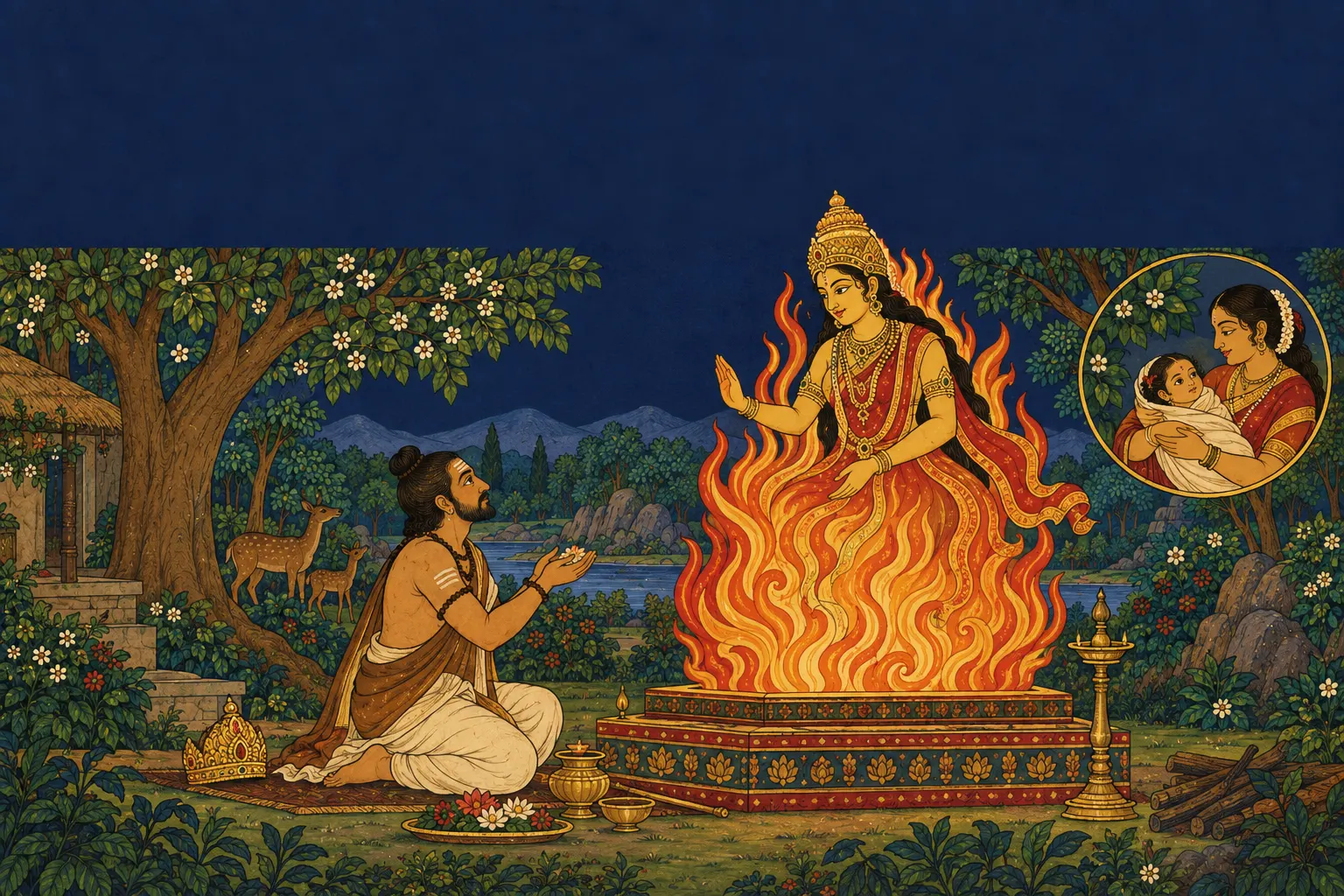
Wishing for offspring, Ashvapati took up rigid vows — celibacy, frugal fare, mastery over his senses. Every day he offered ten thousand oblations to the fire and recited mantras in honour of the goddess Savitri, eating temperately just once, around the sixth hour of the day. He kept this vow for eighteen full years.

When the eighteen years were complete, the goddess Savitri was pleased. She appeared to the king in embodied form, straight out of the sacrificial fire, and said — "I am gratified by your celibacy, your purity, your self-restraint, and your devotion. Ask for the boon you desire, Ashvapati — but never show disregard for virtue."

Ashvapati said — "It is for the sake of virtue that I undertook this vow. O goddess, may many sons worthy of my line be born to me — the twice-born have told me that great merit lies in having offspring."

A daughter, not a son

The goddess Savitri answered — "King, I had already spoken to the Grandsire about this very wish of yours. By Brahma's own favour, a daughter of great energy will soon be born to you on earth. Do not question this — I tell it to you, pleased, and at the Grandsire's own command."

Ashvapati said "So be it," and thanked the goddess once more, saying "May this happen soon." The goddess vanished, and the king returned to his own city, and ruled his subjects righteously.

Some time later his queen Malavi conceived, and in time bore a daughter with eyes like lotus petals. That best of kings joyfully performed the customary rites for her. Since this gift had come through the oblations offered to the goddess Savitri, both her father and the Brahmins named the girl Savitri.

The one none dared approach

Princess Savitri grew up as radiant as the goddess Sri herself. When she reached the age of youth, her beauty was such that people said — "We have beheld a goddess."

But overwhelmed by her radiance and splendour, not a single prince found the courage to ask for her hand.

On the day of a festival, after fasting and bathing, she presented herself before the family deity and had the Brahmins offer oblations at the sacred fire with due rites. Taking the flowers offered to the god, that lady, beautiful as Sri herself, went to her exalted father. Reverencing his feet and offering him those flowers, she stood beside the king with joined hands. Seeing his own daughter, who resembled a celestial maiden, arrived at youth and still unsought, the king grew sad.

Note: This episode is clear in Ganguli's translation — ten thousand oblations every day, an eighteen-year vow, and a daughter granted in place of a son, all appear exactly as written in the original. The king's not questioning the goddess — she says plainly that this comes by Brahma's own command, and that he should not question it — is also directly from the text. The English dialogue lines are flowing paraphrases of the Sanskrit verses, not word-for-word translations.

Source: Mahabharata, Vana Parva — Pativrata-mahatmya Parva, Eighteen Years of Offerings

Now — how much stayed with you?

What happened?

What did Ashvapati do to obtain children?

  • He had a hundred sacrifices performed
  • He sought a sage's blessing
  • He kept a vow to the goddess Savitri, offering ten thousand oblations every day for eighteen years
  • He gave up his kingdom
Read the whole story — Eighteen years of vows

Ashvapati took up rigid vows of celibacy and self-restraint.

Every day he offered ten thousand oblations while reciting the mantra of the goddess Savitri.

He kept this vow for eighteen full years.

Who said it?

"I am gratified by your celibacy, your purity, your self-restraint, and your devotion. Ask for a boon." — Who said this?

  • The goddess Savitri, to Ashvapati
  • Agni, to Ashvapati
  • Brahma, to Ashvapati
  • Narada, to Ashvapati
Read the whole story — Pleased after eighteen years

When the eighteen years were complete, the goddess Savitri appeared from the fire.

Pleased by the king's vow, she told him to ask for a boon.

But she also warned him never to disregard virtue.

What happened?

What did Ashvapati ask the goddess for?

  • Eternal life
  • A vast kingdom
  • Victory over his enemies
  • Many sons worthy of his line
Read the whole story — A father's wish

Ashvapati asked the goddess Savitri for sons worthy of his line.

He said the twice-born had told him that great merit lies in offspring.

The goddess's answer came next.

Who said it?

"By Brahma's own favour, a daughter of great energy will soon be born to you. Do not question this." — Who said this?

  • Ashvapati, to the goddess Savitri
  • The goddess Savitri, to Ashvapati
  • Narada, to Ashvapati
  • Brahma, to the goddess Savitri
Read the whole story — A daughter, not a son

The goddess Savitri said she had already told this wish to Brahma.

By Brahma's own favour, a radiant daughter would be born instead.

Ashvapati said "So be it" and accepted this.

Why is that?

Why was the princess named Savitri?

  • Because this gift came through the oblations offered to the goddess Savitri
  • Because she resembled the goddess Savitri in looks
  • Because she was born in the month of Shravan
  • Because her mother's name was Savitri
Read the whole story — A name, a grace

The princess was born through the grace of the goddess Savitri's oblations.

For this reason the king and the Brahmins named her Savitri.

She had eyes like lotus petals.

What happened?

What happened to Savitri on reaching the age of youth?

  • Her marriage was quickly arranged
  • She left the kingdom
  • She went to an ashram to practise austerities
  • Overwhelmed by her radiance and beauty, no prince found the courage to seek her hand
Read the whole story — The one none dared ask for

Savitri grew up as radiant as the goddess Sri herself.

People who saw her said they had beheld a goddess.

But her radiance left every prince too fearful to seek her hand.

What happened?

What did Savitri do on the day of a festival?

  • She had a swayamvara announced
  • After fasting and bathing, she had oblations offered at the family deity's sacred fire, then went to her father with flowers
  • She went to the forest to begin austerities
  • She told her father she did not wish to marry
Read the whole story — A festival day

Savitri had oblations offered at the family deity's fire after fasting and bathing.

Taking the offered flowers, she went to her father.

Reverencing his feet, she offered him those flowers.

Why is that?

Why did Ashvapati grow sad on seeing his daughter?

  • She looked unwell
  • She had asked her father for something
  • She had reached the age of youth, and still no one had come to ask for her
  • She was refusing marriage
Read the whole story — A father's concern

Savitri had reached the age of youth.

Yet overwhelmed by her radiance, no one came to seek her hand.

Seeing this, Ashvapati grew sad.

Fact

What was Savitri's mother's name?

  • Shaivya
  • Damayanti
  • Gandhari
  • Malavi
Read the whole story — Mother and daughter

Ashvapati's queen was named Malavi.

Savitri was born to her.

Later in the story, Malavi too is granted a hundred sons.

Riddle

I am the goddess whose oblations a king offered for eighteen years, and by whose grace he received a daughter — that same daughter was named after me. Who am I?

  • The goddess Savitri
  • The goddess Lakshmi
  • The goddess Saraswati
  • The goddess Durga
Read the whole story — Oblation and name

Ashvapati offered oblations to the goddess Savitri for eighteen years.

Pleased, the goddess granted him a daughter.

The princess was named Savitri, after that very goddess.