
Chapter 7
The Fourth Boon
Yama granted Savitri a hundred sons without thinking that the boon was incomplete without her husband — and she used his own words to ask for Satyavan's life
The third and fourth boons
Savitri said — "My father has no sons. Let him have a hundred radiant sons, so that his line may carry forward — this is my third boon." Yama said — "Your father shall have a hundred excellent sons, who will increase his line. Now this wish of yours too is fulfilled, princess. Go back — you have come very far."
Savitri did not stop. "In my husband's company I have no sense of the length of the way. My mind wishes to go further still. Listen, I say again — you are the mighty son of Vivasvat, and for this the wise call you Vaivasvata. You deal out equal justice to all beings, and for this you are called the lord of dharma. A man trusts the righteous even more than he trusts himself — that is why everyone longs for closeness with the righteous. It is goodness of heart alone that wins every creature's trust." Yama said — "What you have said, I have heard from no one but you. I am deeply pleased with this speech of yours. Except Satyavan's life, ask for a fourth boon, and then go your way."
Savitri said — "Let me and Satyavan, from both of us, have a hundred sons, strong and valiant, to carry our line forward. This is my fourth boon." Yama said — "You shall have a hundred sons, strong and valiant, who will bring you great delight. Take no more weariness upon yourself now — go back."
A noose comes undone
Savitri did not stop. "The righteous always follow the eternal law. The company of the good with the good is never fruitless, and the good have nothing to fear from the good. It is by the truth of the righteous that the sun moves in the sky, and by their austerity that the earth stands firm — both the past and the future depend upon the righteous. It is for this that the righteous are never cheerless in the company of the righteous." Yama said — "The more deeply you speak, the greater my regard for you grows. Ask me for some matchless boon."
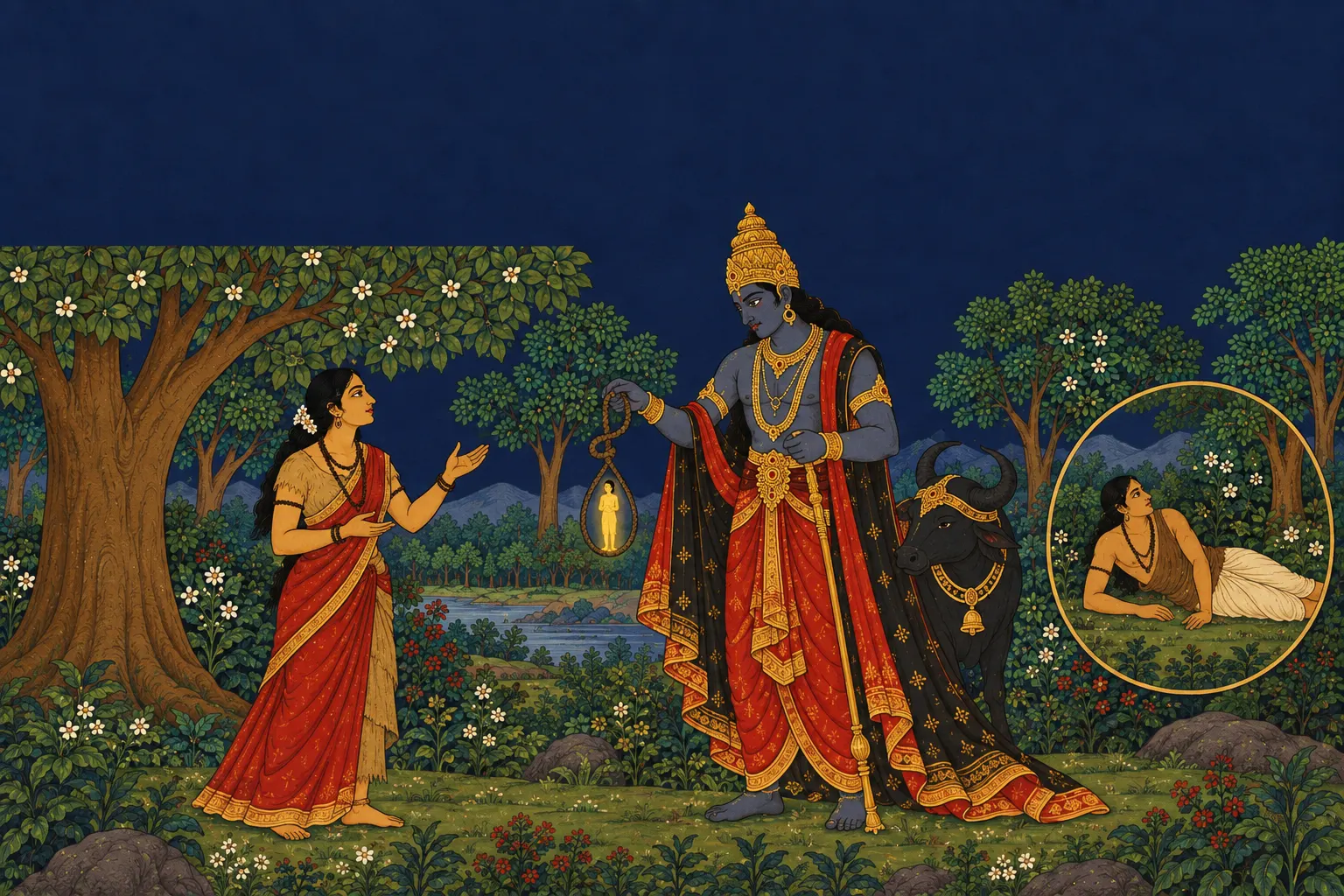
Then Savitri said — "The boons you have given me cannot be fulfilled without my husband's company. So, along with my other boons, I ask this too — let my husband Satyavan have life! Without my husband, I am as one dead. Without my husband, I wish for no happiness. Without my husband, I wish for no heaven. Without my husband, I wish for no prosperity. Without my husband, I cannot bring myself to live at all. You granted me a hundred sons, and yet you take my husband away! So I ask for this boon — 'let Satyavan live' — so that your own word may come true."
Hearing this, Vivasvat's son, the god of justice, said "So be it," and untied his noose, and spoke to Savitri with a joyful heart — "Chaste and pure woman, I have freed your husband. You may take him back, healthy. He will attain success, and will live with you for four hundred years. Performing sacrifices with due rites, he will win great fame in this world. From your womb he will have a hundred sons, all of whom will be kings, always renowned in your name. Your father too shall have a hundred sons by Malavi, who will be known as the Malavas." Having granted these boons, Yama returned to his own realm.
Satyavan awakens
After Yama left, Savitri returned to the place where her husband's ash-hued body lay. Going to him, she laid his head upon her lap, and sat down upon the ground. Then Satyavan regained his senses. Gazing at Savitri again and again with love, as if returning from a distant land, he said — "How long I have slept! Why did you not wake me? And where is that dark figure who was dragging me away?"
Savitri said — "You have slept long upon my lap. That worshipful Yama has returned to his own realm. You are well now, and sleep has left you — if you can, rise. See, the night has deepened."
Note: This episode is clear in Ganguli's translation — Savitri receives five boons in total, which she herself lists later, to the sages: her father-in-law's sight and strength, his kingdom, a hundred sons for her father, a hundred sons for herself, and Satyavan's life, with a four-hundred-year span attached. Satyavan's life is counted as the fifth boon — this is explicit in the original text. The English dialogue lines are flowing paraphrases of the Sanskrit verses, not word-for-word translations.
Source: Mahabharata, Vana Parva — Pativrata-mahatmya Parva, The Fourth Boon