Chapter 4

Bark Garments

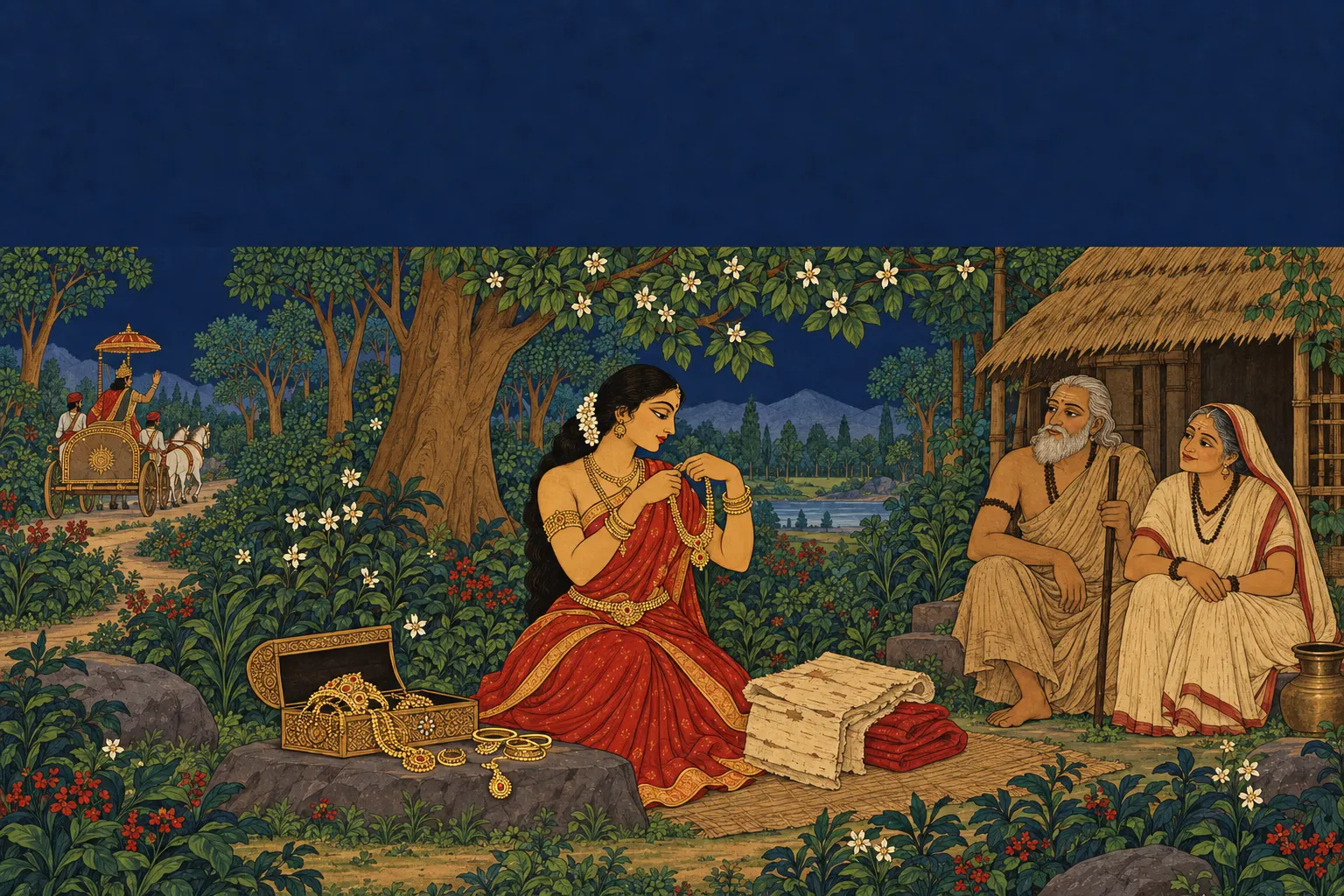
A princess removed all her ornaments and put on garments of bark, and began serving among the ascetics of the forest — knowing already when her husband would die

A wedding in the forest

Ashvapati summoned elderly Brahmins and priests, and on an auspicious day set out with his daughter for Dyumatsena's hermitage. There he found the blind king seated on a cushion of kusha grass beneath a sala tree. After duly offering him water, a seat, and a cow, Dyumatsena asked — "What is the purpose of your visit?"

Ashvapati explained his wish — "This is my daughter, Savitri. O knower of morality, accept her, according to the custom of our order, as your daughter-in-law." Dyumatsena said — "Deprived of our kingdom, living in these woods, we lead the life of ascetics. How will your daughter, raised in a palace, bear the hardship of this forest?" Ashvapati answered — "My daughter knows, as well as I do, that happiness and sorrow come and go. Such words are not fitting from one such as me. I have come here having made up my mind, bowing to you in friendship — do not destroy my hope. You are my equal in every way, as I am yours." Dyumatsena said — "I too had wished for this alliance before, but hesitated after losing my kingdom. Let that old wish be fulfilled today. You are a welcome guest to me."

Summoning all the twice-born dwelling in that forest, the two kings had the marriage performed with due rites. Having given his daughter fine robes and ornaments, Ashvapati returned to his own kingdom with a joyful heart. The moment her father departed, Savitri removed all her ornaments, and put on garments of bark and cloth dyed red.

Service, and a hidden memory

Savitri pleased everyone with her service, her virtues, her tenderness, and her self-denial. She served her mother-in-law with robes and ornaments, worshipped her father-in-law as a god, and kept a careful check on her speech. She pleased her husband with sweet words, her skill in every task, her evenness of temper, and the private signs of her love. In this way, living in the hermitage of those forest-dwellers, they continued their life of ascetic austerity. But Narada's words stayed present, day and night, in sorrowful Savitri's mind.

The three-night vow

After a long time had passed, the appointed hour for Satyavan's death drew near. Narada's words had never left Savitri's mind, and she had been counting the days as they passed. Having reckoned that her husband would die on the fourth day following, she began the Triratra vow — a fast kept continuously through three nights.

Hearing of her vow, Dyumatsena grew deeply sorrowful. He rose and comforted Savitri, saying — "This vow you have taken, daughter, is exceedingly hard — to fast through three nights together is very difficult." Savitri answered — "Do not be sorrowful, father. I shall be able to keep this vow. I have undertaken this task with firm resolve, and it is perseverance that carries a vow to its completion." Hearing this, Dyumatsena said — "I cannot tell you to break your vow. One like me should instead say — complete your vow." And having said this, he fell silent.

Fasting on, Savitri grew as lean as a wooden doll. Knowing that her husband would die on the morrow, she spent that sorrowful night in anguish.

Note: This episode is clear in Ganguli's translation — the exchange between Dyumatsena and Ashvapati, the wedding, Savitri setting aside her ornaments, and the three-night Triratra vow all appear exactly as written. Savitri worked out on her own, by counting the days, that her husband would die on the fourth day — this too is directly from the text. The English dialogue lines are flowing paraphrases of the Sanskrit verses, not word-for-word translations.

Source: Mahabharata, Vana Parva — Pativrata-mahatmya Parva, Bark Garments

Now — how much stayed with you?

What happened?

Where did Ashvapati find the blind king, on reaching Dyumatsena's hermitage?

  • In a palace
  • By a river
  • Seated on a cushion of kusha grass beneath a sala tree
  • In a cave
Read the whole story — A meeting in the forest

Ashvapati travelled with Brahmins and priests to Dyumatsena's hermitage.

There he found the blind king seated on a cushion of kusha grass beneath a sala tree.

After a due welcome he stated his wish.

Who said it?

"Deprived of our kingdom, living in these woods, we lead the life of ascetics. How will your daughter bear this hardship?" — Who said this?

  • Dyumatsena, to Ashvapati
  • Ashvapati, to Dyumatsena
  • Satyavan, to Savitri
  • Shaivya, to Ashvapati
Read the whole story — A hesitation

Dyumatsena hesitated, pointing to the hardships of forest life.

Ashvapati answered that happiness and sorrow both come and go, and such words did not become him.

Dyumatsena, remembering his own old wish, accepted the marriage.

What happened?

What did Savitri do the moment her father left, after the wedding?

  • She planned to win back Dyumatsena's kingdom
  • She returned with her father
  • She immediately began her fast
  • She removed all her ornaments, and put on garments of bark and red cloth
Read the whole story — Setting aside royal dress

The marriage was performed with due rites, and Ashvapati returned home with joy.

The moment her father left, Savitri removed all her ornaments.

She put on garments of bark and red cloth, suited to forest life.

Why is that?

Why did Savitri remain sorrowful day and night, even while serving and pleasing everyone around her?

  • Because forest life was very hard
  • Because Narada's words
  • Because her in-laws were displeased with her
  • Because she missed her father
Read the whole story — A hidden sorrow

Savitri pleased everyone through her service and her virtues.

But within, Narada's words never stopped troubling her.

This very sorrow later drives her to count the days.

What happened?

What did Savitri do once she knew the time of Satyavan's death?

  • Knowing he would die on the fourth day, she began the Triratra vow
  • She told Dyumatsena everything at once
  • She stopped Satyavan from going into the forest
  • She had a special sacrifice performed
Read the whole story — A three-night vow

Remembering Narada's words, Savitri had been counting the days.

On learning her husband would die on the fourth day, she began the Triratra vow.

This vow meant fasting through three nights without a break.

Who said it?

"This vow you have taken, daughter, is exceedingly hard — to fast through three nights together is very difficult." — Who said this?

  • Satyavan, to Savitri
  • Narada, to Savitri
  • Ashvapati, to Savitri
  • Dyumatsena, to Savitri
Read the whole story — A father's concern

Dyumatsena grew deeply sorrowful on hearing of the vow.

Savitri said her firm resolve would let her complete it.

Dyumatsena, in the end, blessed her to complete the vow.

What happened?

What happened to Savitri during her vow?

  • She grew more radiant
  • She grew as lean as a wooden doll
  • She fell ill with fever
  • She fainted
Read the whole story — The toll of the fast

Savitri fasted through three nights together.

This left her as lean as a wooden doll.

Knowing the very next day was the day, she spent that night in anguish.

Why is that?

Why had Dyumatsena earlier hesitated to accept the marriage with Savitri?

  • Savitri's looks did not please him
  • Narada had spoken against the marriage
  • After losing his kingdom, he felt he was no longer worthy of the alliance
  • Satyavan was not yet ready
Read the whole story — A hesitation born of loss

Dyumatsena had earlier wished for this same alliance with Ashvapati.

But after losing his kingdom, hesitation held him back.

When Ashvapati himself came to him, he gladly accepted the marriage.

Fact

How did Savitri serve her mother- and father-in-law — recall it?

  • She had a new hermitage built for them
  • She promised to win back their kingdom
  • She persuaded them to return to the city
  • She pleased her mother-in-law with robes and ornaments, worshipped her father-in-law as a god, and kept careful check on her speech
Read the whole story — Winning hearts through service

Savitri pleased everyone with her service, her virtues, and her self-denial.

She served her mother-in-law with robes and ornaments, and worshipped her father-in-law as a god.

She pleased her husband with sweet words and skill in every task.

Riddle

I am the vow a queen kept, fasting through three nights together, knowing her husband would die on the fourth day. What am I?

  • The Triratra vow
  • The Ekadashi vow
  • Karva Chauth
  • The Navaratri vow
Read the whole story — Before the fourth day

Counting Narada's words, Savitri had worked out the fourth day.

She kept the Triratra vow — a fast through three nights together.

The next morning was the very day she had been waiting for.