Chapter 3

The One She Chose

A princess travelled the land to choose her own husband, and returned to say she had chosen the son of a blind, kingless king — whose life had only a year left to run

On a golden chariot

Ashvapati said to Savitri — "Daughter, the time has come for your marriage, yet no one comes to ask for you. So go and seek out a husband worthy of you yourself. Whomever you choose, tell me, and I will arrange your marriage with due care. Listen — I have heard from the learned that a father who does not give his daughter in marriage earns disgrace, as does a husband who neglects his wife, and a son who fails to protect his widowed mother. So go and seek a husband, and act so that the gods have no cause to blame us."

Obeying her father's word, Savitri mounted a golden chariot and set out with his aged counsellors, to roam among sacred places and hermitages.

The one she chose

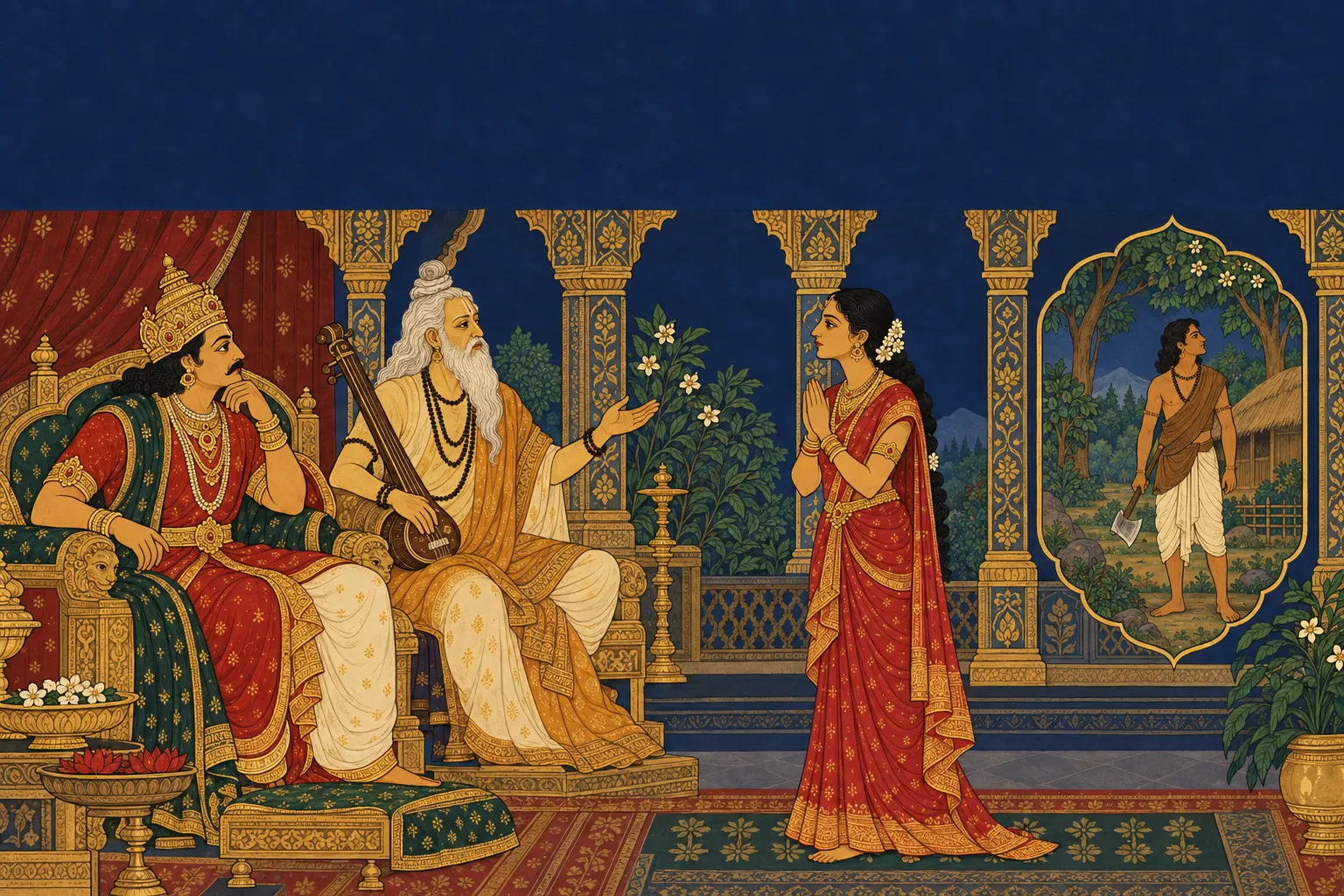
Some time later, when Ashvapati was seated with Narada in his court, Savitri returned. She bowed to both her father and Narada, touching their feet. Narada asked — "Where has your daughter been, and where has she returned from? And why have you not married her, now that she has come of age?" Ashvapati said — "It was for this very purpose that she went, and she has just returned. Hear from her own lips whom she has chosen."

At her father's command, Savitri said — "Among the Shalvas there was a virtuous kshatriya king named Dyumatsena. In time he became blind. That blind and wise king had an only son. An old enemy nearby, taking advantage of the king's misfortune, seized his kingdom. The king then went into the forest with his wife and infant child. That very son, born in the city, grew up in that hermitage — it is that youth I have chosen in my heart as my lord."

Narada's prophecy

Hearing this, Narada said — "Alas, my king, Savitri has unknowingly made a grave error, for she has chosen for her lord this Satyavan of excellent qualities, not knowing everything about him! His father speaks the truth, and his mother too is truthful — it is for this that the Brahmins named the son Satyavan. In his childhood he loved horses greatly — he used to make clay horses and draw pictures of horses. For this he is sometimes also called Chitrashva."

Ashvapati asked — "Is prince Satyavan, devoted to his father, endowed with energy, intelligence, and courage?" Narada replied — "In energy he is like the sun, in wisdom like Brihaspati, in courage like Indra, in forgiveness like the earth herself. In gift-giving he is like Rantideva, in truthfulness like Shivi, in magnanimity like Yayati, and in beauty like the moon." Ashvapati asked further — "Then does he have any fault?" Narada said — "He has just one fault, that outweighs all his virtues, and it cannot be overcome by any effort. Within one year from this day, Satyavan, short-lived, will cast off his body!" Hearing this, the king said — "Come, Savitri, go and choose another for your lord! This one great fault covers all his merits. The illustrious Narada himself, honoured by the gods, says Satyavan's days are numbered, that within a year he must cast off his body!" At these words Savitri said — "Death falls but once. A daughter is given away but once. And a person says 'I give' only once. These three things happen only once. Whether his life be short or long, whether he be full of virtues or without them, I have chosen my husband once, and I will not choose a second time." Narada said — "Best of men, your daughter Savitri's heart does not waver. It is not possible, by any means, to turn her from this path. No one else possesses the virtues that dwell in Satyavan. I give my approval to this marriage." The king said — "What you have said, illustrious one, must never be disobeyed, for your words are true. I shall act as you say, since you are my preceptor." Narada said — "May the giving of your daughter Savitri bring peace. I depart now. Blessings on you all."

Narada rose into the sky and returned to heaven, and the king began to make arrangements for his daughter's wedding.

Note: This episode is given at length in Ganguli's translation — Narada's comparison of Satyavan's virtues to the sun, Brihaspati, Indra, the earth, Rantideva, Shivi, Yayati, and the Ashvins is exactly as the original text gives it. Savitri's famous line — "Death falls but once, a daughter is given but once" — is also directly from the text. The English dialogue lines are flowing paraphrases of the Sanskrit verses, not word-for-word translations.

Source: Mahabharata, Vana Parva — Pativrata-mahatmya Parva, The One She Chose

Now — how much stayed with you?

What happened?

What did Ashvapati say to Savitri?

  • That she should take refuge in another kingdom
  • That she should not marry
  • That she should go and seek out a husband worthy of her herself
  • That she should marry a sage
Read the whole story — Sent to choose her own husband

Savitri had come of age, but no one came to seek her hand.

Ashvapati told her to go and find a husband worthy of her herself.

Savitri set out on a golden chariot to roam among sacred places and hermitages.

Who said it?

"Where has your daughter been, and where has she returned from? And why have you not married her?" — Who said this?

  • Narada, to Ashvapati
  • Ashvapati, to Savitri
  • Dyumatsena, to Ashvapati
  • Satyavan, to Savitri
Read the whole story — A question in court

Savitri returned while Ashvapati sat with Narada in his court.

Narada asked where she had been and why she was still unmarried.

Ashvapati asked Savitri herself to tell her own story.

What happened?

Whom did Savitri choose as her husband?

  • King Dyumatsena of Shalva
  • One of Narada's disciples
  • A Brahmin
  • Satyavan, son of the blind and deposed King Dyumatsena
Read the whole story — A youth raised in the forest

Savitri told how King Dyumatsena of Shalva had gone blind.

An old enemy seized his kingdom, and he went into the forest.

She had chosen his son Satyavan in her heart.

Who said it?

"In energy he is like the sun, in wisdom like Brihaspati, in courage like Indra, in forgiveness like the earth herself." — Who said this?

  • Ashvapati, to Savitri
  • Narada, to Ashvapati
  • Savitri, to Narada
  • Dyumatsena, to Narada
Read the whole story — Satyavan's virtues

Ashvapati asked Narada about Satyavan's virtues.

Narada compared him to the sun, Brihaspati, Indra, the earth, Rantideva, Shivi, Yayati, and the moon.

Then Ashvapati asked whether he had any fault at all.

Fact

What fault did Narada reveal about Satyavan?

  • Within one year from that day, he would die
  • He was quick to anger
  • He was fond of gambling
  • He would go blind
Read the whole story — A single fault

Ashvapati asked whether Satyavan had any fault at all.

Narada said there was one, outweighing all his virtues.

Within a year from that very day, Satyavan would cast off his body.

Who said it?

"Death falls but once. A daughter is given away but once. I have chosen my husband once, and I will not choose a second time." — Who said this?

  • Narada, to Ashvapati
  • Ashvapati, to Savitri
  • Dyumatsena, to Savitri
  • Savitri, to her father
Read the whole story — An unshakeable resolve

Ashvapati asked Savitri to choose someone else.

Savitri answered that death and the giving of a daughter both happen only once.

She said plainly that she would not choose a second time.

What happened?

How did Narada react to Savitri's resolve?

  • He scolded Savitri
  • He said her heart could not be turned from this path, and gave the marriage his approval
  • He told Ashvapati to stop the marriage
  • He gave no answer at all
Read the whole story — A seal of approval

Narada said Savitri's heart could not be moved by any means.

He said no one else possessed the virtues that dwelt in Satyavan.

Ashvapati, following Narada's word, began preparations for the wedding.

Why is that?

Why did Ashvapati give Savitri the freedom to choose her own husband?

  • Because he was in no hurry for the marriage
  • Because Savitri had refused marriage
  • Because her radiance left every prince too fearful to ask for her, and he also wished to avoid the disgrace the learned describe for a father who fails to marry his daughter
  • Because a sage had ordered it
Read the whole story — Avoiding disgrace

No prince dared ask for Savitri, overwhelmed by her radiance.

Ashvapati said a father who fails to marry his daughter earns disgrace.

For this reason he sent Savitri to choose her own husband.

Fact

What was Satyavan fond of as a child, and by what other name was he known?

  • Music; he was called a singer
  • Warfare; he was called Viraashva
  • Astrology; he was called Jnanashva
  • Horses
Read the whole story — A childhood fondness

Satyavan loved horses deeply as a child.

He made clay horses and drew pictures of them.

For this he was also known by the name Chitrashva.

Riddle

I am the sage who listed a prince's every virtue, then named a single fault — that his life had only a year left. Who am I?

  • Narada
  • Markandeya
  • Vasishtha
  • Agastya
Read the whole story — Virtues, and one fault

Narada gave a long list of Satyavan's virtues.

Then he said his life had only a year left.

After Savitri's unshakeable resolve, it was Narada himself who approved the marriage.