Chapter 15

Ardhanarishvara

The Shiva who had burned Kamadeva is half Parvati in one body — the ascetic on the right, the goddess on the left

Creation that would not go on

Brahma made many beings, but creation would not go on — the beings he created could not reproduce, and creation could not continue.

Brahma understood that he had made only one side. He realised that creation could not continue without the complementary principle.

He meditated on Shiva.

Half and half

Shiva appeared — but not alone.

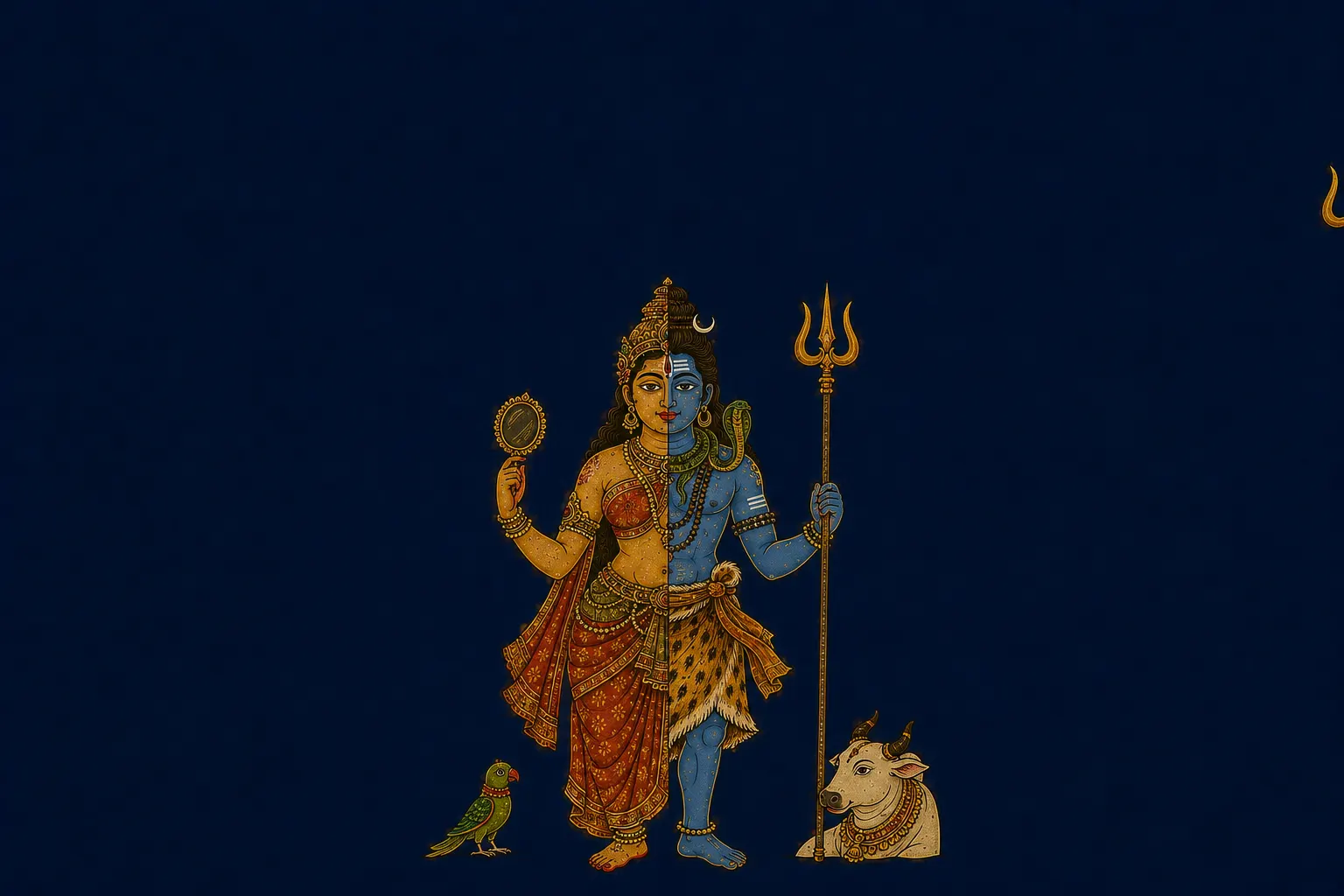
It was one body, divided down the middle. On the right, Shiva — matted hair, ash, trident, tiger-skin. On the left, Parvati — styled hair, silk, a mirror, an anklet. One brow, on which half a third eye and half a tilak. One body, two natures.

Brahma prayed to that left side — that she give the power by which creation could divide in two and grow.

The goddess separated from that body, and divided herself into many forms. From that point onward, creation could renew itself through paired forms.

Bhringi, who worshipped only Shiva

There was a sage — Bhringi. He was such a devotee of Shiva that he circumambulated only Shiva, not Parvati. He would not even bow to Parvati.

Parvati said, "I too am half of this body. How can there be a circuit that leaves me out?"

Bhringi did not agree. Then Parvati merged into Shiva's body — becoming half the body.

Now when Bhringi circled Shiva, Parvati came in between too. He took the form of a bee (bhringa) and began to bore through between the two — to make his circuit of the Shiva half alone.

A frame of bones

Now Parvati's anger came. "He spurns my part? Then whatever in him came from the mother — the flesh, the blood — all that is mine. I take it back."

The flesh and blood dried from Bhringi's body. Only the bones were left. He was too frail to balance on two legs.

Shiva gave him a third leg, so that he could stand like a tripod.

Then Bhringi understood. The body he was worshipping — he had spurned half of it, and without that half he could not even stand.

The chapter that closes the story

These stories began at Daksha's sacrifice — a wife who gave up her body in protest at an insult.

They come to a close at Ardhanarishvara — a wife who became his very body.

In every chapter in between there was this clash: the house within convention, and the ascetic beyond it. Ardhanarishvara says that the ascetic was never alone. The one who burned Kamadeva, who sits alone in the cremation ground, who listens to no one — he is half goddess, and incomplete without that half.

He gives freely, without weighing the one before him — and in the end he gave away half his own body.

Note: The story of Ardhanarishvara has several forms — Brahma's prayer to carry creation on, in the Shiva Purana, the Linga Purana, the Vayu Purana and the Skanda Purana; the story of the over-devotion of the sage Bhringi, in the Tamil sthala-puranas and the Skanda Purana; and in some traditions Parvati's wish never to be separate. In tradition Shiva is on the right, the goddess on the left. The most famous ancient images are at Elephanta (sixth century), Badami and Gangaikonda Cholapuram. This form is also linked to the Purusha-Prakriti of the Samkhya philosophy, and is different from Harihara (Shiva-Vishnu).

Source: from several texts, Ardhanarishvara

Now — how much stayed with you?

Why is that?

Why did Brahma meditate on the Ardhanarishvara form?

  • Because he wanted to arrange the marriage of Shiva and Parvati
  • Because he needed a weapon from Shiva
  • Because the creation he had made would not go on
  • Because the gods told him to do it
Read the whole story — One side not enough

In this story of the Shiva Purana and the Linga Purana, Brahma's first creation is stuck — there are beings, but no new beings come out of them.

The vision of Ardhanarishvara shows Brahma what was missing in his making: two sides to everything, and it is the meeting of the two that is going on.

This is why this form is not only an image — it is a principle: Shiva and Shakti can be worshipped separately, but they are two halves of one body.

Who am I?

I was such a devotee of Shiva that I circumambulated only him, not Parvati. The price I paid for this was that my flesh and blood dried up and I had to stand on a third leg. Who am I?

  • Markandeya
  • Bhringi
  • Apasmara
  • Nandi
Read the whole story — A devotee who spurned half

Bhringi's story is mainly in the Tamil sthala-puranas and the Skanda Purana — he is a cautionary form of over-devotion.

His mistake was not in worshipping Shiva — it was in not worshipping Parvati, holding the two to be separate.

The third leg became his identity: images of Bhringi are often of a lean, three-legged sage, hands folded.

What happened?

What did Parvati do at Bhringi's stubbornness?

  • She cursed him to stone
  • She had him put out of Kailasa
  • She had Shiva take away his devotion
  • First she merged half into Shiva's body so that Bhringi could not circle him leaving her out; then, when he became a bee and bored through, she took from his body the flesh and blood
Read the whole story — Two moves, one lesson

Parvati first tried the gentler approach — merging into the body to force Bhringi to circle both.

Bhringi defeated that too — he became a bee and got through the middle. Then Parvati did the thing that was the real lesson: every part given by the mother, back.

It's another form of Shakti's anger across these stories — the Bhadrakali of the Daksha-sacrifice, the Mahakali of the Ganesha story, and here Parvati taking her parts back from Bhringi.

Fact

What is on the right and the left in the Ardhanarishvara image?

  • On the right, Shiva
  • On the right, Parvati; on the left, Shiva
  • The same on both sides, only the colour different
  • Shiva above, Parvati below
Read the whole story — One body, two of everything

The whole skill of the Ardhanarishvara image is in this: one figure, but from the middle line everything on the two sides is different — the hair, the breast (on one side), the line of the waist, the ornaments, the garments, even the pose of the foot.

On the brow half a third eye and half a tilak — this is the finest part.

The most famous images are in the Elephanta caves, Gangaikonda Cholapuram and Badami — in each the balance is a little different.

Who said it?

"I too am half of this body. How can there be a circuit that leaves me out?" — Who said this, and to whom?

  • Shiva, to Bhringi
  • Brahma, to Ardhanarishvara
  • Parvati, to Bhringi
  • Nandi, to Bhringi
Read the whole story — The claim of the half

Parvati's words are a fact, not a threat: if Shiva is half Parvati, then a circuit of Shiva alone cannot be made at all.

Bhringi's stubbornness was to deny this very fact — and the story defeats him with that same fact.

This is the central idea of the chapter, in one sentence: Shiva and Shakti cannot be seen apart, however much a devotee wishes it.

Riddle

On my one brow is half a third eye and half a tilak. On my one side is ash, on the other silk. I am one body, but in me are two whole gods. Who am I?

  • Harihara
  • Ardhanarishvara
  • Dattatreya
  • Trimurti
Read the whole story — Two gods, one body

Ardhanarishvara is often confused with Harihara (Shiva-Vishnu) — but the two are different: Harihara is a joining of two gods, Ardhanarishvara of a god and a goddess.

The vision of this form says that the male and the power are two aspects of one reality — an idea also linked to the "Purusha" and "Prakriti" of the Samkhya philosophy.

It's the last word this whole cycle of stories has to offer: even the one who looks most alone is never really alone.

Put it in order

Which is the correct order of events in the Bhringi story?

  • Parvati taking Bhringi's parts back → Bhringi becoming a bee → Parvati merging into Shiva's body → Shiva giving the third leg
  • Bhringi getting a third leg → circumambulating only Shiva → Parvati merging into the body → becoming a bee
  • Shiva giving the third leg → Bhringi's understanding → Parvati's anger → becoming a bee
  • Bhringi circumambulating only Shiva → Parvati saying "I too am half" → Bhringi not agreeing → Parvati merging half into Shiva's body → Bhringi becoming a bee and getting through the middle → Parvati taking his flesh and blood back → Bhringi left a frame of bones → Shiva giving the third leg → Bhringi's understanding
Read the whole story — Stubbornness, stratagem, price, understanding

The conflict escalates step by step: each time Bhringi finds a way around Parvati's response, until she leaves him with no way around it.

The turning point is Bhringi becoming a bee — that is where Parvati's patience ends.

The last scene — Bhringi standing on a third leg, hands folded — echoes how many of these chapters end: the other side finally admits it had denied half the truth.

The texts disagree

What do the texts say about the "why" of Ardhanarishvara?

  • More than one reason is found
  • All the texts agree that this form was made because of Bhringi
  • This form is only in sculpture, in no story
  • This form is in the Vedas at length
Read the whole story — One form, several reasons

Ardhanarishvara is among the few forms of Shiva that have no single "original story" — different traditions give different reasons, and all three run together.

The creation reason is philosophical (Purusha-Prakriti), the Bhringi one moral (a warning about over-devotion), and the "never be separate" one emotional.

Shiv-Mahima records all three, because this form is itself made of several layers — and it feels fitting for the whole telling to end on that multiplicity.

Later tradition

Where are the most famous ancient images of Ardhanarishvara?

  • Only in the temples of North India
  • Nowhere; this form was made only in paintings
  • In the Elephanta caves (Maharashtra), Badami (Karnataka) and Gangaikonda Cholapuram (Tamil Nadu)
  • Only in the temples of Nepal
Read the whole story — Balance in stone

The Ardhanarishvara image at Elephanta (sixth century) is the most famous — a vast figure in which the difference of right and left shows even in the curve of the waist.

In the Chola bronzes this same form is finer still — two different body-structures in one casting.

That is, Ardhanarishvara is not only an idea — it has been among the hardest challenges for sculptors: to show two equally in one body.

Who said it?

This story begins at Daksha's sacrifice and ends at Ardhanarishvara. What does this pairing say?

  • That Shiva had in the end to live apart from Parvati
  • That the wife who in the first chapter gives up her body in protest at an insult is in the last chapter herself become his body
  • That Daksha's sacrifice and Ardhanarishvara are two names for one story
  • That Shiva had to marry Parvati twice
Read the whole story — One arc, two ends

The whole cycle begins with a breaking — Sati's body, at Daksha's sacrifice. It ends with a joining — Parvati, in Shiva's body.

In every chapter between, the same clash recurs: the house inside the order versus the ascetic outside it. Ardhanarishvara says that the ascetic was never wholly alone.

That is why this chapter closes the story: Shiva gives without judging the one who asks, and in the end he gave away half his own body — freely, without condition.