Chapter 10

Bhasmasura

Shiva granted the boon without thinking, and the very next moment that boon moved toward his own head

A penance, a god at hand

An asura did fierce penance for Shiva — years of it, without grain, without water.

Shiva is famously easy to please. They call him "Ashutosh" — the one quickly pleased — and "Bholenath" — the plain and simple one. The penance was not even complete when Shiva came and stood before him.

"Ask," he said. "Whatever you want."

A boon, without weighing

The asura said: "Let whoever's head I place my hand on burn to ash in that same instant."

He did not ask how the power would be used or what consequences it might have. He only said, "So be it."

It is the story's central truth in its barest form: Shiva grants without judging the petitioner. The same nature that makes him drink the poison no one else will touch puts into this asura's hand a power that could end the world.

A hand that moved toward Shiva

The moment he got the boon, the asura thought: "First let me test it on this very god. Then Parvati is mine."

He raised his hand and moved it toward Shiva.

Shiva turned and ran. Behind him the asura, hand outstretched. Mountains were crossed, rivers were passed, whole worlds went by — and the very god who had given the boon was now running for his life from it.

To Vishnu

Shiva, running, reached Vishnu.

"I gave a boon," he said, "and did not think."

Vishnu said nothing. He vanished — and in the asura's path there appeared a woman, so beautiful that the asura stopped where he was. This was Mohini — the same form of Vishnu that had come to hand out the nectar at the churning of the ocean.

A dance built on imitation

"Who are you?" the asura asked, forgetting all about his hand.

"I dance," said Mohini. "If you can dance with me — every pose exactly like mine — then I am yours."

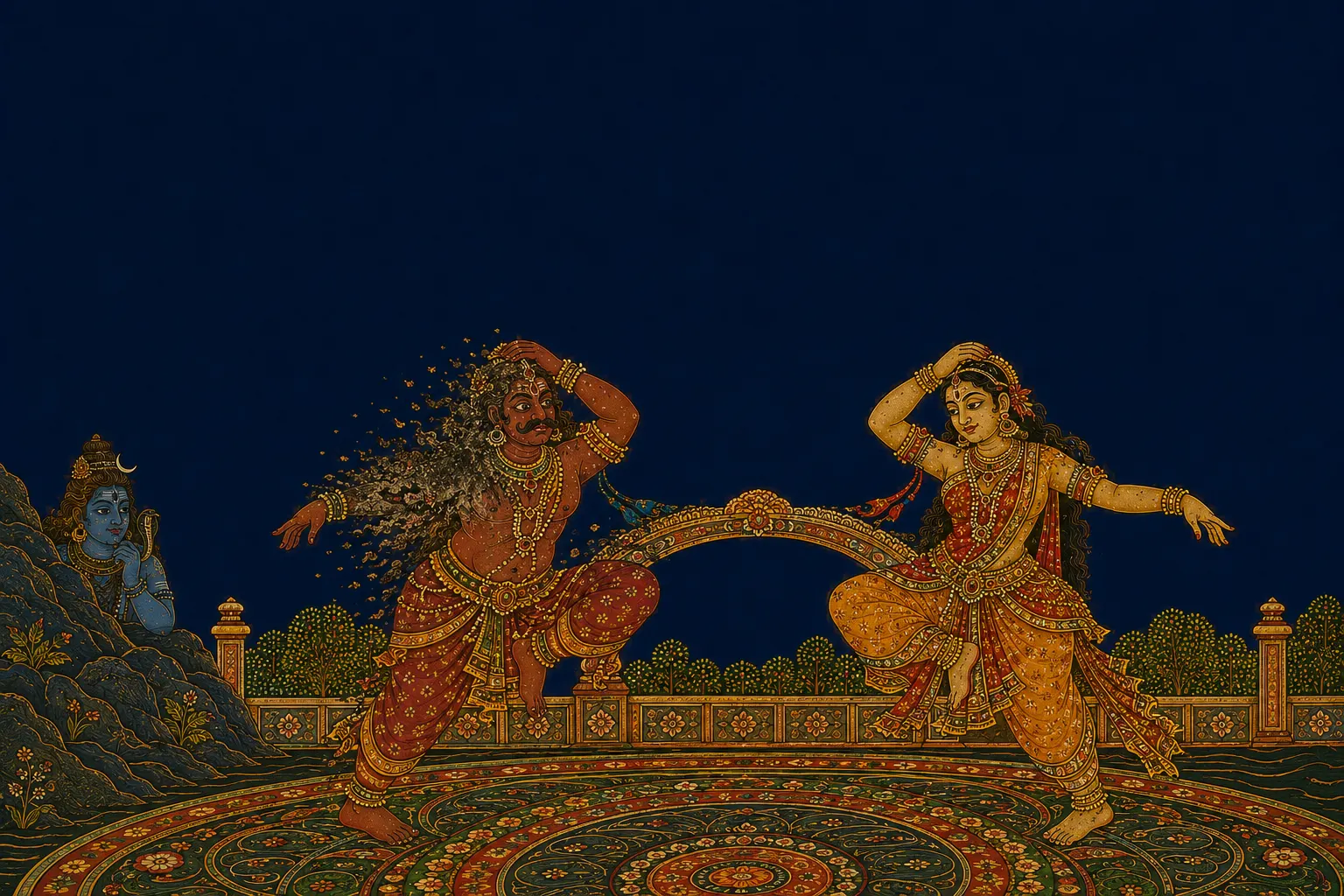
The asura agreed. Mohini began to dance, and the asura went on imitating her every pose — hand this way, hand that way, the waist, the neck.

Then Mohini, dancing on, placed her hand on her own head.

The asura too — without thinking, in imitation — placed his hand on his own head.

He turned to ash in that same instant. By the very boon that Shiva had given him.

What Shiva learned, and what he did not

Parvati must have asked, later, why he gave the boon without thinking.

But the story records no regret for it. Shiva goes on giving such boons — to Ravana, to Andhaka, to Banasura. Every time, someone else — often Vishnu — is left to contain the consequences.

Whether this is Shiva's weakness or simply his nature, the story never decides. It only says this much: the hand that opens for the poison stays open for the boon too — and both times, without weighing.

Note: The Bhasmasura story comes with Mohini and a dance in the Shiva Purana and folk tradition; in the Bhagavata Purana (tenth skandha, chapter 88) the asura's name is Vrikasura and Vishnu, as a brahmachari boy, tricks him. The Bhagavata form is in Krishna's telling and its emphasis is on the point that Shiva gives boons in haste while Vishnu's devotees stay protected — that is, it is a Vaishnava text's comment on a Shaiva god, exactly as Lingodbhava is a Shaiva claim. In Kerala this story is a favourite subject of Kathakali and Mohiniyattam.

Source: from several texts, Bhasmasura

Now — how much stayed with you?

Why is that?

Why did Shiva grant the asura's boon without asking whom it would fall on?

  • Because Shiva knew the asura's intent and wanted to trap him
  • Because this is Shiva's nature
  • Because Parvati had told Shiva to do it
  • Because giving boons was Brahma's work and Shiva was forced
Read the whole story — An open hand, without weighing

This chapter states the story's central truth in its most direct form: Shiva gives, without weighing who is asking or what the end of the ask will be.

The same nature shows itself two ways across these tales — on one side he drinks the poison no one else will touch (Neelkanth, in Vishnu-Puran), on the other he hands Bhasmasura, Ravana and Andhaka boons that are later turned back on the world.

It is never called a "mistake." It is Shiva's one same nature, running in both directions.

Fact

What exactly did the asura ask for as a boon?

  • That he become immortal
  • That no weapon could kill him
  • That he could change form whenever he wished
  • That whoever's head he placed his hand on would burn to ash in that same instant
Read the whole story — One ask, that could go any way

The very build of the boon is what makes it dangerous: it has no condition, no limit — "whoever's head."

The asura's first thought was to test it on the giver of the boon himself — because then both Parvati and Kailasa become his.

This is why this story differs from Tripura: there the boon had a crack in it (one line, one arrow); here the boon was flawless, and the only way to stop it was the asura's own foolishness.

Who said it?

"I gave a boon, and did not think." — Who said this, and to whom?

  • Shiva, to Vishnu
  • The asura, to Shiva
  • Vishnu, to Shiva
  • Parvati, to Shiva
Read the whole story — A confession, without regret

This line is composed in the spirit of the story, not quoted word for word from a text. But the sense is the same — "did not think" — and there is no apology or regret in it.

Vishnu's answer too is not in words — it is in the deed. He does not argue, he only finds the solution.

It is the clearest picture anywhere in these stories of the Shiva-Vishnu relation: Shiva the open hand, Vishnu the repair that follows behind. Lingodbhava, the Shakti Pithas, Tripura — the same pairing, every time.

Who am I?

I am a female form of Vishnu. I first came to hand out the nectar at the churning of the ocean. In this story I tangled an asura in a dance and made him place his own hand on his own head. Who am I?

  • Rati
  • Devasena
  • Mohini
  • Bhadrakali
Read the whole story — One form, two stories

Mohini is Vishnu's most famous female form — at the churning of the ocean she used this same form to keep the asuras away from the nectar.

In the Bhasmasura story that same form returns, but the weapon is different: there the trick was the sharing of the nectar, here a dance.

The lesson of both stories is the same — the asura's defeat comes not from his power but from his own greed or foolishness.

What happened?

How was Bhasmasura killed in Mohini's dance?

  • Mohini placed her hand on his head
  • Mohini, dancing, placed her hand on her own head, and the asura in imitation placed his hand on his own head
  • The asura grew tired and fell down and died
  • Vishnu cut off his head with the discus
Read the whole story — Imitation, which was a snare

Mohini's whole trick rested on one condition: the asura would imitate every pose exactly. The more the dance went on, the more the asura forgot to think.

The last pose — hand on one's own head — looked innocent, which is why the asura imitated it without stopping.

This is the finest turn of the story: no one killed the asura. His own boon, his own hand, his own imitation.

Riddle

A god gave me the power to turn anyone to ash by a touch. I made my first target the god himself. In the end I became that ash — by my own hand. Who am I?

  • Vritrasura
  • Hiranyakashipu
  • Ravana
  • Bhasmasura
Read the whole story — The end in the name itself

The name "Bhasmasura" carries the whole story within it — the one who could turn others to ash became ash himself.

It is the clearest irony of any boon in these stories: the asuras of Tripura lost by giving up their devotion, Bhasmasura by his own foolishness — but every time, the weapon that destroyed them was theirs alone.

In the Bhagavata this same asura's name is Vrikasura, and there the trick is done by a brahmachari boy, not by Mohini — but the end is the same.

Put it in order

Which is the correct order of events?

  • The asura's penance → Shiva appearing and giving the boon → the asura moving his hand toward Shiva → Shiva running to Vishnu → Vishnu's Mohini form → the asura placing his hand on his own head in the dance and turning to ash
  • Shiva running → the asura's penance → the boon → Mohini's dance
  • Vishnu's Mohini form → the asura's penance → Shiva's boon → the asura turning to ash
  • The asura's penance → the asura's hand toward Shiva → Shiva's boon → Mohini's dance
Read the whole story — From penance to ash

This chapter's shape is the most direct of all: an ask, an unweighed yes, and then that yes turning back on the giver.

The pivot is Shiva reaching Vishnu — that is where the story turns from danger to solution.

The last scene — the asura turning to ash by his own hand — ends the story on an irony: the boon was not taken back, only its direction was turned.

The texts disagree

Which texts is the Bhasmasura story in, and what do they say about who did the trick?

  • All the texts say the trick was done by Mohini
  • In the Shiva Purana and folk tradition, Vishnu as Mohini tricks him with a dance; in the Bhagavata (tenth skandha) the asura's name is Vrikasura and Vishnu, as a brahmachari boy, makes him place his hand on his own head
  • This story is only a folk tale of South India, in no Purana
  • In every text the asura's name is Bhasmasura
Read the whole story — One story, two tricks

The Bhagavata form (10.88) is the most "scriptural," and there Krishna tells this story to Arjuna — to prove one particular point: that Shiva gives boons in haste, while Vishnu's devotees stay protected. This is a Vaishnava text commenting on a Shaiva god.

In the Shiva Purana and folk tradition this same story comes with Mohini and a dance — in the Kathakali of Kerala and the dance traditions of the south this form is the most common.

Shiv-Mahima records both, and also that the Bhagavata form is told from one point of view — as Lingodbhava is from another.

Later tradition

What place does the Bhasmasura-Mohini story have in the dance tradition of Kerala?

  • It has no place; it is told only in North India
  • It is a favourite subject of both Kathakali and Mohiniyattam, and the name "Mohiniyattam" itself is held to be linked to this very dance-form of Mohini
  • It is only in Bharatanatyam, not in Kerala
  • It is in no dance tradition, only in temple images
Read the whole story — A dance that is both a story and a style

Bhasmasura-Mohini is a classic "story" of Kathakali — the difference between the asura's heavy, grounded step and Mohini's fluid, rounded poses is the very life of the whole play.

"Mohiniyattam" (the dance of Mohini) is a whole classical dance style of Kerala, and its name is linked to this very Mohini form of Vishnu.

That is, this story is not merely read — it has been danced for centuries in South India.

What happened?

After Bhasmasura, what does the story say about this nature of Shiva?

  • That Shiva learned a lesson and never again gave a boon without thinking
  • That Shiva stopped giving boons altogether
  • That Parvati took a promise from Shiva that he would not give any asura a boon
  • That this is Shiva's nature, not a weakness
Read the whole story — One nature, again and again

Bhasmasura is no single event — it is the clearest instance of a pattern. Shiva gives Ravana his own bow and invulnerability; he takes Andhaka as a son and lets him go; he stands guard over Banasura himself.

Every time the result is the same: the boon turns on the world or on Shiva, and Vishnu or some god finds the solution from behind.

That is why this chapter sits at the centre of the whole cycle — everything ahead (Ravana, Kirata) is a different outcome of this same nature.