
Chapter 2
Daksha's Sacrifice
A father would not give his daughter's husband a place at the sacrifice, and the daughter gave up her body in that same assembly by the power of yoga
The one who did not rise in the assembly
Prajapati Daksha had long harboured a grudge against his son-in-law.
At a great assembly, when Daksha entered, everyone rose to their feet — everyone except Shiva. Shiva stayed seated, eyes half closed, as though it made no difference to him whether the assembly existed at all.
Daksha took it as an insult. "I gave my daughter Sati to this one," he said, "this wanderer of cremation grounds, snakes coiled at his neck, ash smeared on his body. And he sits there in front of me, without so much as rising."
Shiva said nothing. Daksha did not forget the slight.
The invitation that did not come
Some time later Daksha arranged a great sacrifice. Every god, every sage, every prajapati was invited. Chariots converged on Kanakhal from every direction.
There was one conspicuous omission: Kailasa.
Sati watched the chariots streaming through the sky, heard the music drifting on the wind, and learned of her father's sacrifice that way. She said to Shiva, "I have to go. He is my father. Invited or not, a daughter needs no summons to visit her own home."
"You'll be insulted there," Shiva said. "And through you, so will I. Don't go."
Sati went anyway.
In the full assembly
Sati reached the sacrifice ground. The rest of the assembly held back, afraid of Daksha, but her mother and sisters ran to her, embraced her, and welcomed her warmly, tears in their eyes. Daksha alone paid his daughter no attention — he stood by the fire-pit as though she weren't there.
Sati asked, "You invited every god. Why not Shiva?"
Daksha answered in front of the whole assembly — about Shiva, about his appearance, about the company he kept, the kind of things no father-in-law should ever say of his daughter's husband. Sati stood and heard all of it.
The body that made her Daksha's daughter was no longer one she wanted to keep.
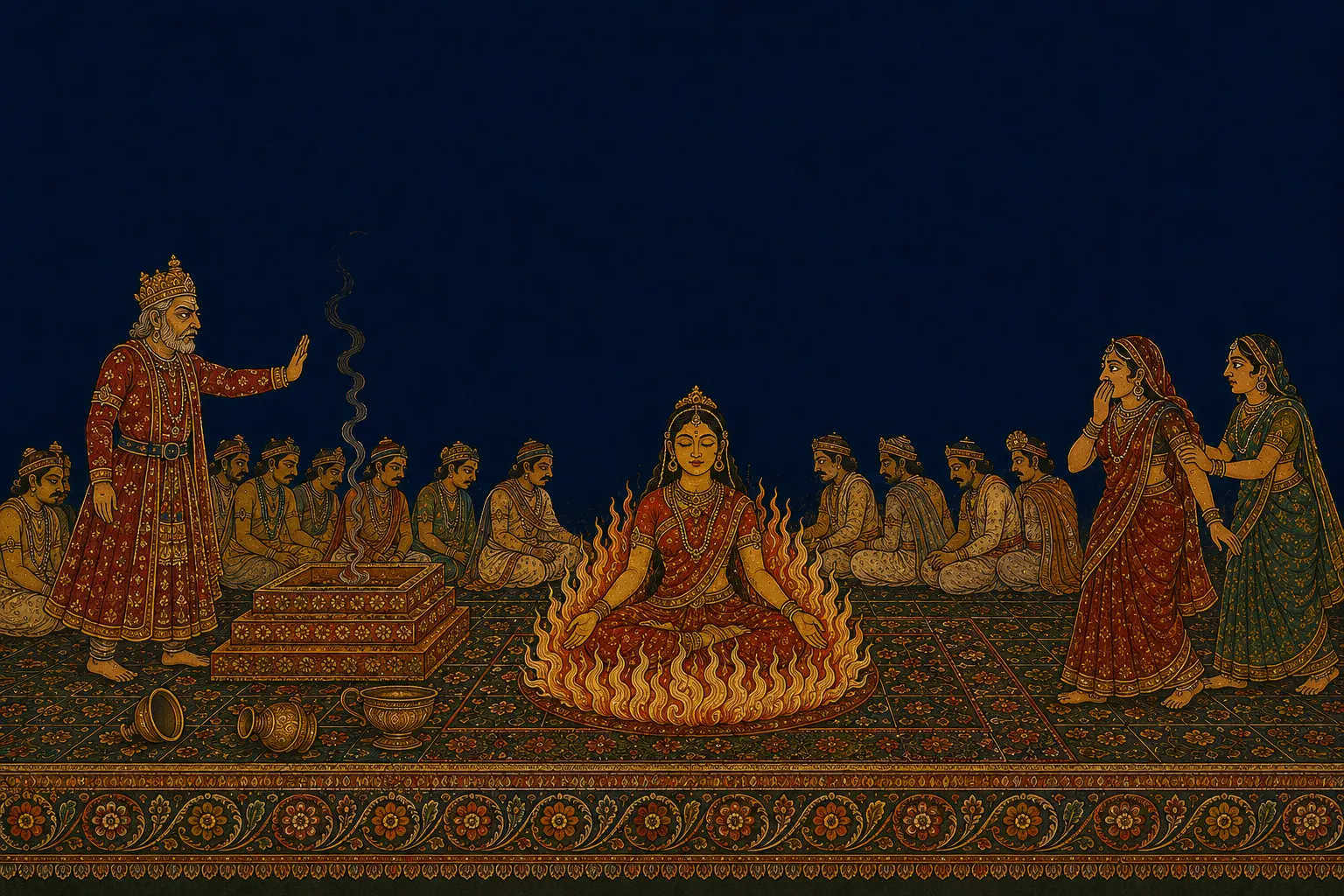
The fire of yoga
Sati sat down on the ground, closed her eyes, and turned her breath inward.
"I return this body," she said, "which came from you. In my next birth, may I be born into a house where Shiva is never insulted."
A fire rose within her, kindled by her own yoga, and consumed the body to ash. Silence fell over the sacrifice ground. The fire in the pit still burned, but the sacrifice itself had stopped.
News of what had happened began making its way toward Kailasa.
Word reaches Kailasa
Shiva heard the news and for a while did nothing at all — did not speak, did not move.
Then he tore a lock from his matted hair and struck it against the ground.
What happened next belongs to the next chapter — but what rose from that single lock tore Daksha's sacrifice out by its roots.
What the texts tell differently
This story is told at greatest length in the Shiva Purana (Rudra Samhita, Sati Khanda), though it also appears in the Bhagavata Purana, the Vayu Purana, the Matsya Purana and the Kurma Purana — and the details shift from one to the next.
In the Bhagavata, Sati does not leap into a fire; she gives up her body through the power of her own yoga. Some Puranas trace the quarrel back to that assembly insult; others have Daksha disliking Shiva from the start. The Mahabharata tells the story very briefly, with the emphasis falling on the ruin of the sacrifice rather than on Sati.
One thing holds true everywhere: a father, in the pride of his office, humiliated his daughter's husband, and his daughter paid for it with her body.
Note: The Daksha-sacrifice story is told at fullest length in the Shiva Purana (Rudra Samhita, Sati Khanda), and also in the Bhagavata Purana (fourth skandha), the Vayu Purana, the Matsya Purana and the Kurma Purana. In the Bhagavata, Sati gives up the body in yogic absorption, not by leaping into a fire. In the Mahabharata this episode is brief and the emphasis there is on the wrecking of the sacrifice. The goddess-form of Sati that this story tells has only a link of name with the later "sati custom" — in the story the giving up of the body is Sati's own choice and her own yoga.
Source: from several texts, Daksha's Sacrifice